|
Getting your Trinity Audio player ready… |
Table of Contents
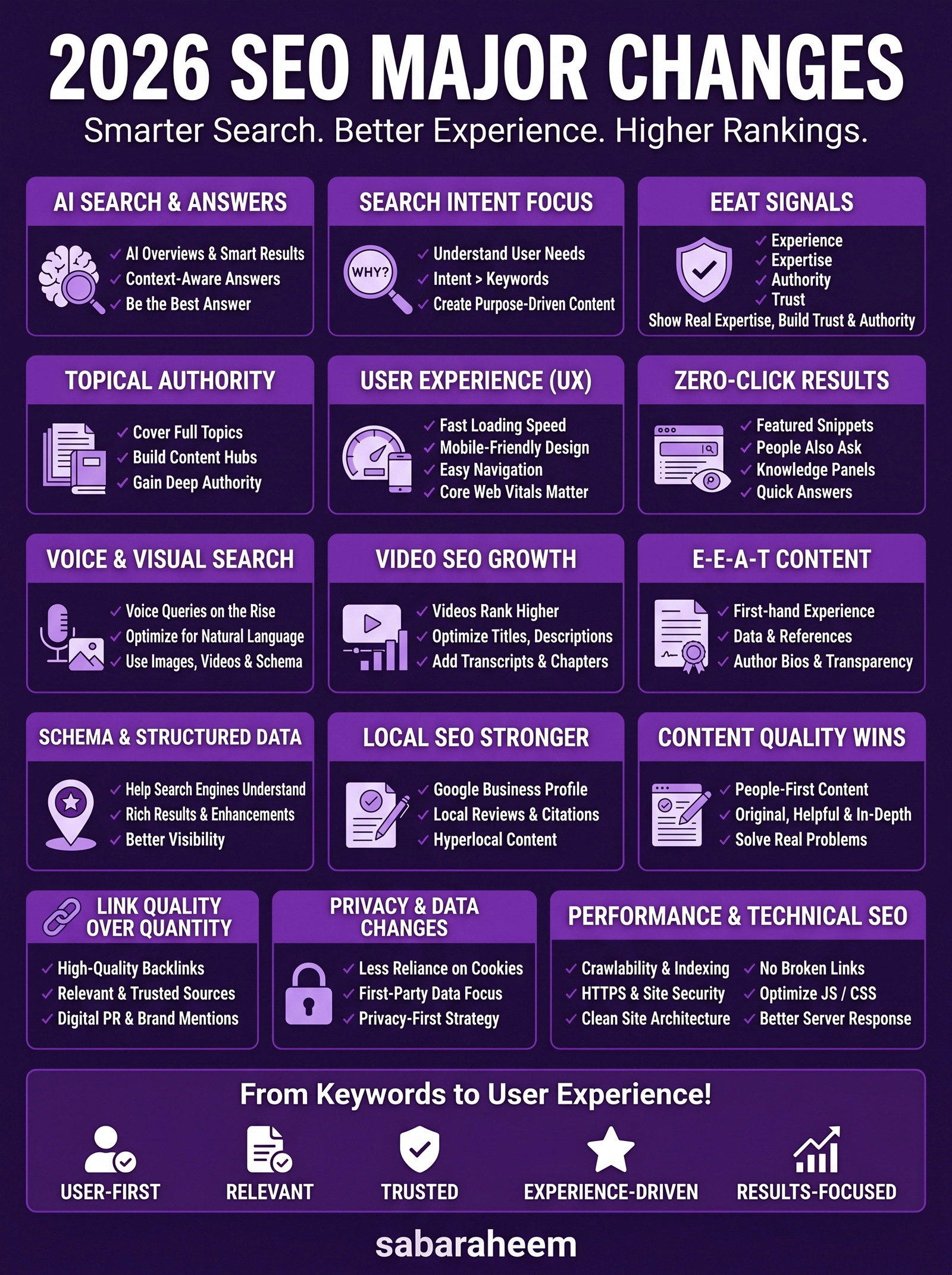
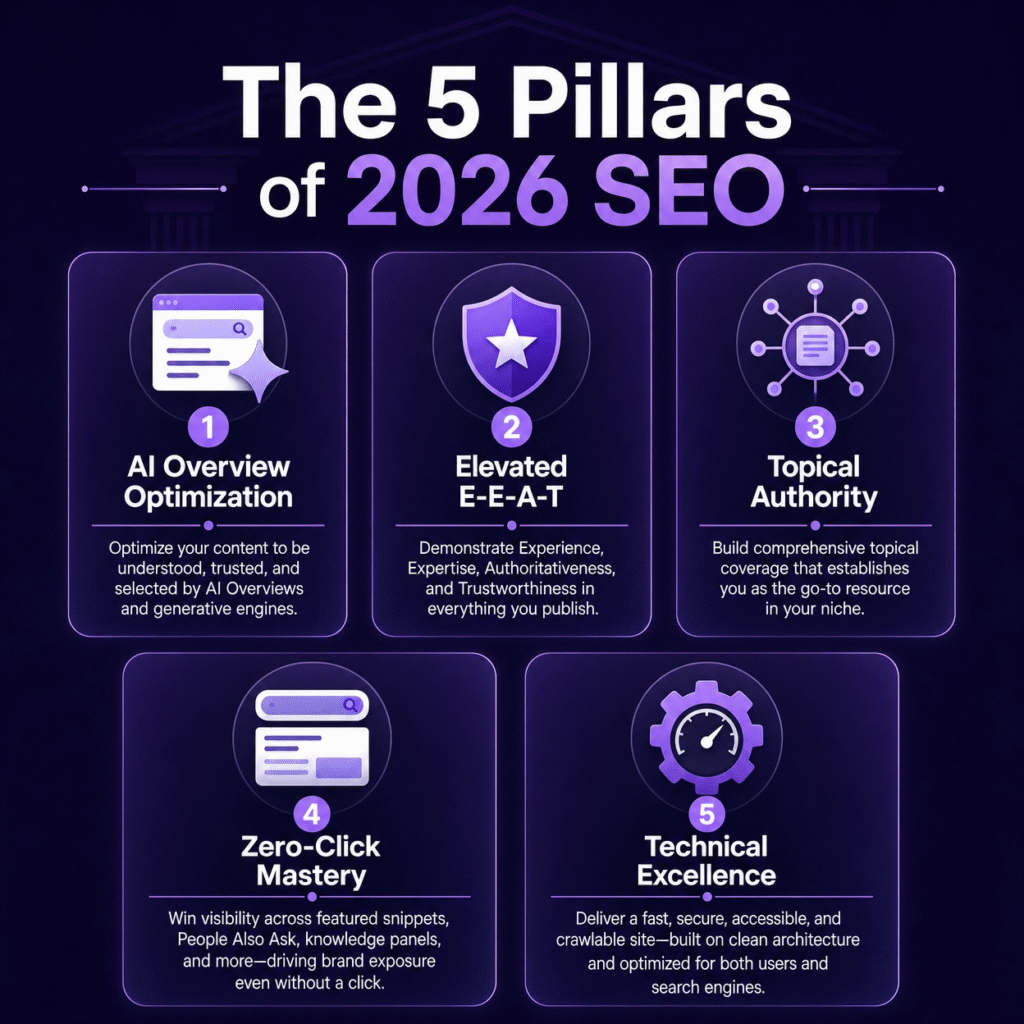
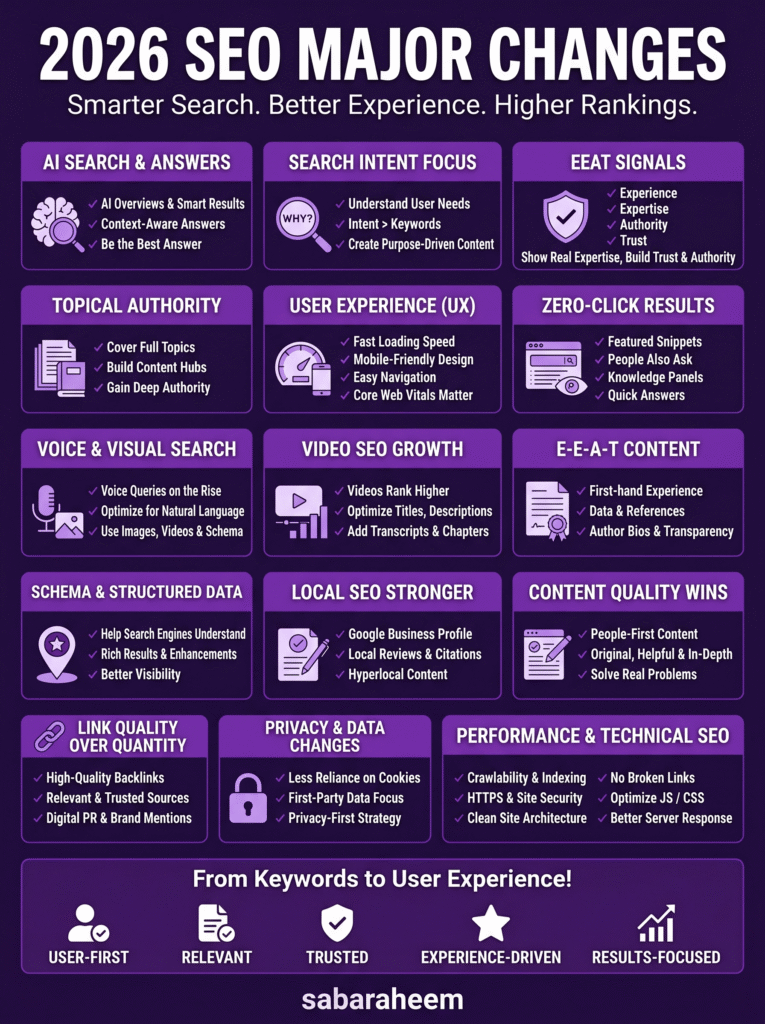
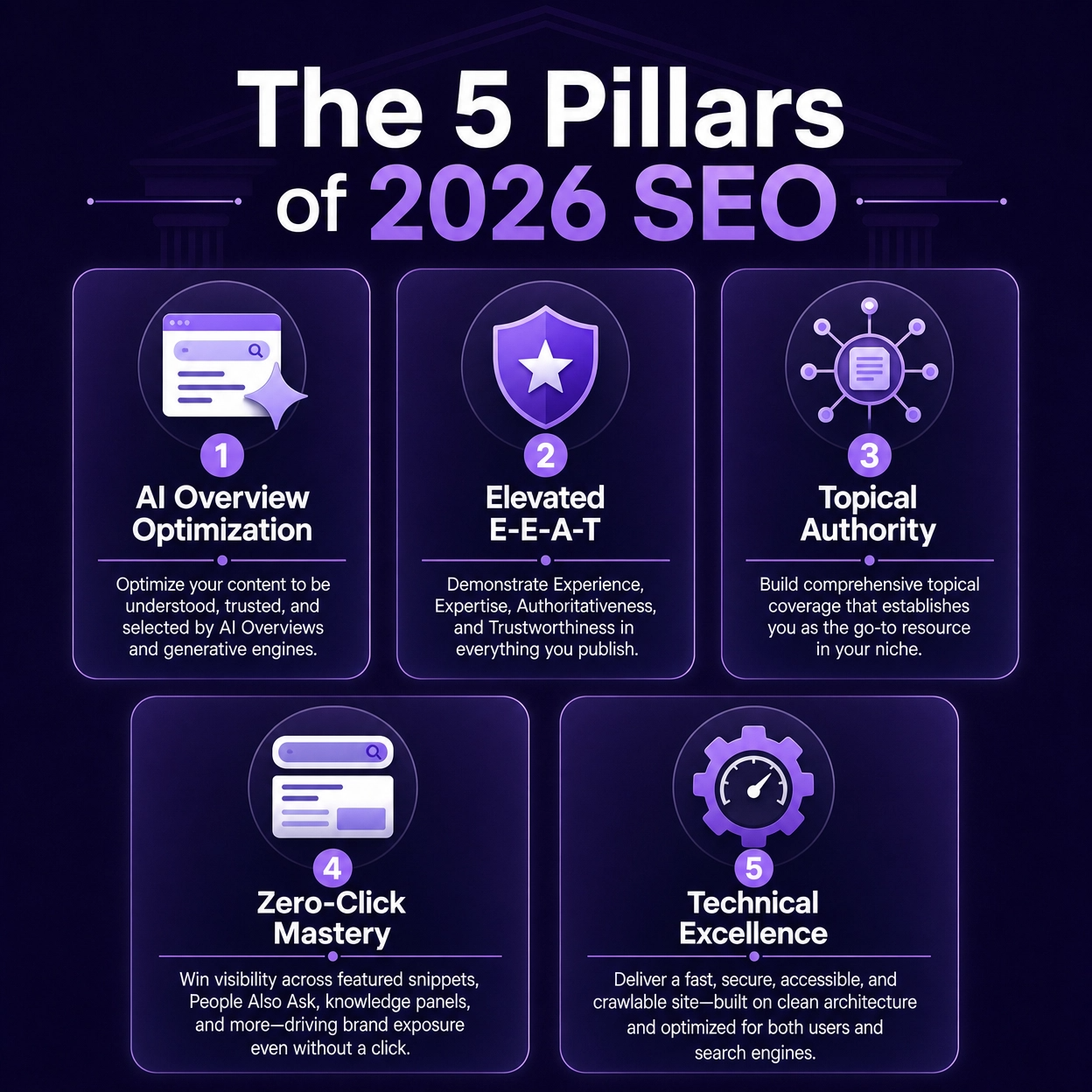
| Mastering 2026 SEO requires an AI-first approach built on five pillars: (1) optimising content for AI Overviews with direct 40-60 word answers and schema markup, (2) elevating E-E-A-T through verified author expertise and real-world experience signals, (3) building topical authority through interconnected content clusters, (4) optimising for zero-click SERP features including featured snippets and knowledge panels, and (5) ensuring technical excellence through Core Web Vitals and mobile-first indexing. Keyword volume alone no longer determines rankings — intent, context, and AI comprehension do. |
I. Introduction: The Dawn of a New SEO Era
Something fundamental broke in SEO between 2023 and 2026. Not gradually — abruptly. The professionals who saw it coming repositioned their strategies in time. Those who didn’t lost rankings, traffic, and in some cases, their businesses.
The breaking point wasn’t a single algorithm update. It was the convergence of several forces simultaneously: large language models reaching human-level comprehension of text, Google’s full deployment of AI Overviews reshaping what users see before any blue link, voice interfaces becoming primary for hundreds of millions of queries, and zero-click searches crossing the majority threshold for informational searches.
The result: the SEO playbook that worked in 2022 — keyword research, on-page optimisation, backlink building — still matters, but it’s no longer sufficient. In 2026, those are baseline requirements, not competitive advantages. The edge belongs to those who understand how AI systems evaluate, rank, and cite content.
This isn’t speculation. The shift is already visible in Google Search Console data, SERP analysis, and the citation patterns of AI tools like Perplexity, ChatGPT, and Gemini. As I documented in my own experience with optimising my personal brand like a client site, the brands winning in 2026 search are those that treat AI comprehension as the primary audience — with human readers as the important second.
This guide is your comprehensive roadmap. Not theory — actionable frameworks, specific tactics, and the exact strategic shifts that separate 2026 SEO winners from those still fighting the last war.

II. The AI-First Search Revolution: Understanding the Core Shift
| What Is AI-First SEO? Optimising for how AI systems understand, evaluate, and surface your content — not just how keyword algorithms rank it.AI-First SEO is the strategic shift from optimising purely for keyword matching to optimising for semantic comprehension and contextual relevance. Where traditional SEO asked ‘does this page contain the target keyword at the right density?’ — AI-First SEO asks ‘does this content comprehensively answer the user’s underlying need in a way that an AI system can extract and attribute?’The difference is enormous in practice. A page stuffed with the keyword ‘best project management software’ might have ranked in 2020. In 2026, Google’s AI evaluates whether the page actually helps someone choose project management software — covering use cases, comparisons, limitations, pricing context, and specific scenarios. The comprehensiveness and usefulness of the answer is the ranking signal, not the keyword density.Three dimensions of AI-First SEO that traditional SEO neglects:Intent mapping: Understanding not just what someone searched, but why — and what decision they’re trying to makeContextual depth: Covering a topic with enough breadth and specificity that an AI system recognises your content as authoritativeEntity clarity: Establishing that you (as a person or brand) are a recognised, trustworthy entity in your topic domainThe comprehensive framework for understanding this transition is covered in what is the new SEO for AI — strategies for success. And if you’re still asking whether traditional SEO is dead, the answer is nuanced — covered in full in is traditional SEO dead in the age of AI search. |
II.B The Impact of AI Overviews and SGE on the SERP
Google AI Overviews — the AI-generated summaries that now appear at the top of results for hundreds of millions of queries — have fundamentally changed the economics of organic search. They appear before any organic result. They synthesise multiple sources into a single answer. And critically, they either cite your content or they don’t.
| SERP Feature | Pre-AI Era (2022) | AI Overview Era (2026) | Impact on Traffic |
|---|---|---|---|
| Position #1 Organic | ~28% CTR | ~11% CTR (AI Overview above) | ↓ 61% CTR reduction |
| Featured Snippet | ~8% additional CTR | Now often absorbed into AI Overview | Merged with AI Overview |
| AI Overview Citation | Did not exist | Equivalent to old Position #1 | New primary visibility goal |
| Zero-Click Rate (info queries) | ~34% | ~65%+ | ↑ Majority of info searches |
| Branded Search Lift from AI Cite | N/A | +31% average | New brand building signal |
| Voice-driven queries | ~20% of searches | ~45% of searches | Growing priority channel |
Strategies for Visibility Inside AI-Driven Results
- Direct answer formatting: Every section that addresses a question must open with a 40-60 word direct answer. This is the format AI Overview extraction prioritises above all other signals.
- FAQ Schema deployment: Structured data explicitly marking question-answer pairs dramatically increases the probability of AI Overview citation and featured snippet capture.
- Topical cluster architecture: Single posts rarely earn consistent AI citations. Interconnected content clusters covering every angle of a topic establish the domain authority that makes AI systems confident in citing you.
- Source diversity: Being cited across multiple authoritative platforms (LinkedIn, Reddit, industry publications) tells AI systems you’re a trusted entity — not just a website with content.
The complete AI Overviews optimisation playbook is in how to win the zero-click search game in 2026.
II.C Adapting Content for AI Understanding: Structured Data and Semantic SEO
AI systems don’t read content the way humans do — they parse structure, identify entities, evaluate semantic relationships, and assess factual consistency against their training data. Optimising for AI understanding means making those parsing tasks as easy and reliable as possible.
| Optimisation Layer | What It Does | Implementation Priority |
|---|---|---|
| Schema Markup (FAQ, Article, Author) | Explicitly labels content type, questions, answers, and authorship for AI parsers | Critical — Week 1 |
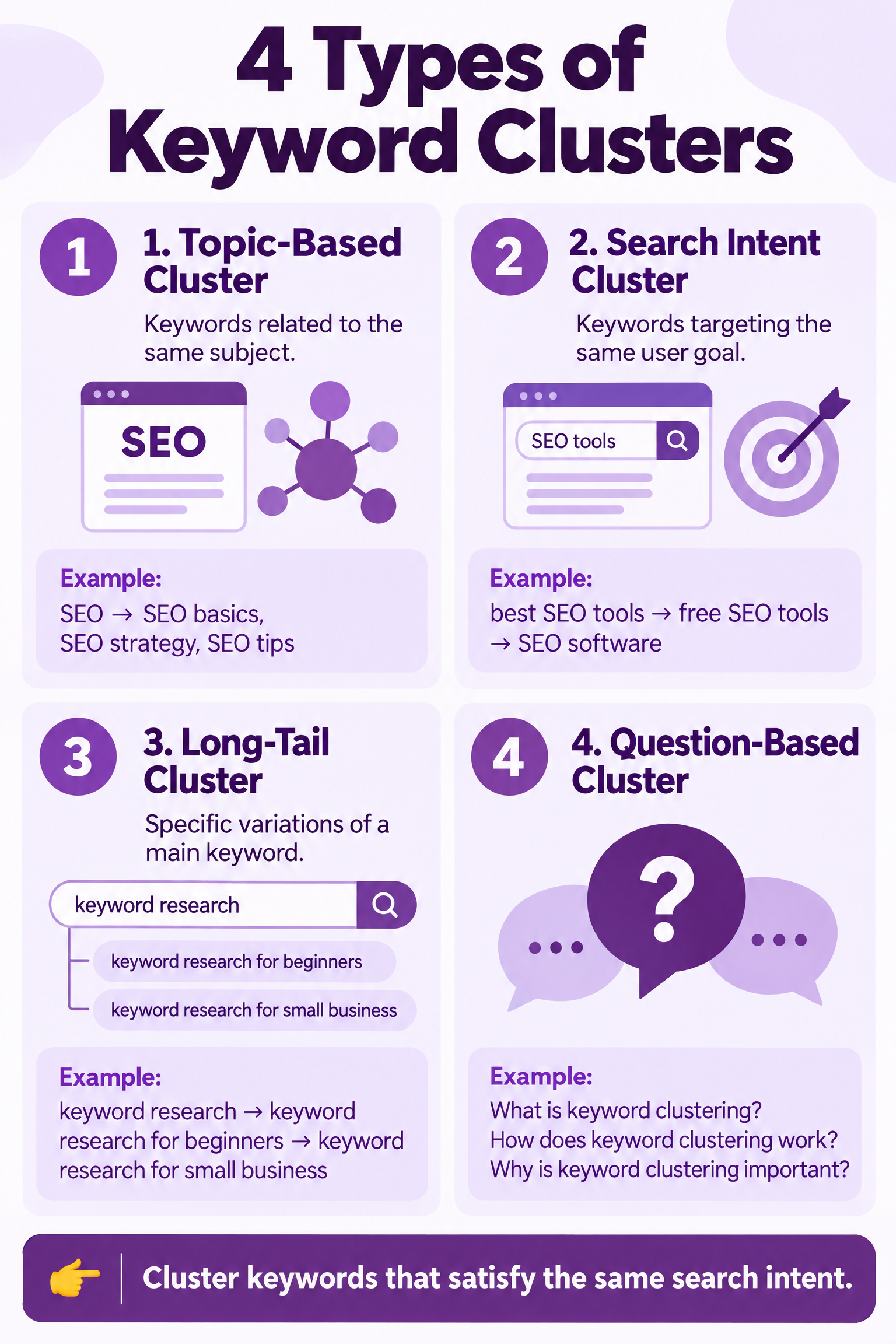
| Semantic keyword clusters | Groups conceptually related terms that AI uses to verify topical coverage | High — Ongoing |
| Entity establishment (sameAs) | Links your author entity across LinkedIn, About page, social profiles | High — Week 1 |
| Direct answer structure | 40-60 word opening answers under H2/H3 question headings | Critical — Immediate |
| Internal linking architecture | Signals topical relationships between pages to AI crawlers | Medium — Ongoing |
| Content freshness signals | Updated dates, new statistics, current examples | High — Quarterly |
AI content optimisation is not separate from traditional SEO — it’s an extension of it. For the beginner’s foundation of how these systems work together, the beginner’s guide to SEO: how it works and boosts your website traffic provides the core framework before you layer AI-era optimisation on top.
III. Beyond Traditional Metrics: E-E-A-T, User Experience, and Intent
| III.A Elevating E-E-A-T in 2026Experience, Expertise, Authoritativeness, Trustworthiness — Google’s framework for deciding which content deserves to rank and be cited.E-E-A-T (the first E — Experience — was added in 2022) now functions as a filter, not just a ranking signal. Content that fails E-E-A-T evaluation doesn’t just rank lower — it risks deindexation under Google’s helpful content framework. In 2026, E-E-A-T applies to your content, your author, and your domain simultaneously.The four E-E-A-T pillars and how to build them in 2026:Experience: First-hand, documented experience with your topic. Case studies, real data from your own work, before-and-after results. AI cannot fabricate this — and Google knows it.Expertise: Demonstrated knowledge depth — credentials, certifications, years of practice, professional recognition. All must be verifiable and consistently named across platforms.Authoritativeness: Third-party recognition — backlinks from authoritative sources, mentions in industry publications, speaking credits, awards, and endorsements that you did not create yourself.Trustworthiness: Accurate, verifiable information consistently delivered. Transparent authorship. Clear business information. No misleading claims. Regular content updates to maintain accuracy.Personal branding is the accelerator for E-E-A-T. The moment your name is associated with a specific expertise across multiple authoritative platforms — LinkedIn, guest publications, industry forums — your E-E-A-T signals compound. This is the core thesis of why your personal story is your best SEO strategy in 2026. |
| III.B Prioritising User Intent Over KeywordsThe fundamental question has shifted from ‘what did they search?’ to ‘what decision are they trying to make?’User intent classification has always existed in SEO theory — informational, navigational, transactional, commercial. In 2026, Google’s AI can identify intent at a much more granular level: not just ‘what type of search is this’ but ‘what stage of the decision is this person in, what do they already know, and what specific answer will satisfy them.’The five intent dimensions Google AI evaluates in 2026:Primary intent: What they explicitly want (the surface query)Secondary intent: What they also expect to find (implicit related needs)Decision stage: Awareness, consideration, or decision — shapes what depth and format the content needsKnowledge baseline: What level of existing knowledge the searcher has — determines whether to explain fundamentals or go straight to advanced tacticsFormat preference: Does this query expect a list, a how-to guide, a comparison, a definition, or a narrative?Keyword research in 2026 is intent research. Understanding which keywords represent which decision stages is central to the SaaS keyword research strategy beyond basic search volume — and the same framework applies to any industry. |
III.C Optimising for Superior User Experience: Core Web Vitals in 2026
Core Web Vitals — Google’s measurable user experience metrics — are no longer a ‘nice to have’ technical consideration. In 2026, they function as a ranking floor: pages that fail Core Web Vitals thresholds are disadvantaged regardless of content quality. And in mobile-first indexing, mobile performance is the primary evaluation.
| Core Web Vital | What It Measures | 2026 Target | Failure Consequence |
|---|---|---|---|
| LCP (Largest Contentful Paint) | How fast the main content loads | Under 2.5 seconds | Ranking suppression, higher bounce rate |
| INP (Interaction to Next Paint) | How responsive the page is to user input | Under 200ms | Reduced engagement signals, lower ranking |
| CLS (Cumulative Layout Shift) | Visual stability — does content jump? | Under 0.1 | User frustration, immediate bouncing |
| FCP (First Contentful Paint) | How fast something visible appears | Under 1.8 seconds | Users abandon before content loads |
| TTFB (Time to First Byte) | Server response speed | Under 800ms | Cascading delays across all other metrics |
The 3-second principle applies acutely here: users who don’t see meaningful content within 3 seconds leave — and Google’s algorithm knows it. The full breakdown of how page speed affects ranking and what to fix first is in the 3-second rule in web design and SEO performance.
IV. Strategic Shifts for 2026: Navigating the New Landscape
| IV.A Embracing Zero-Click ResultsVisibility without clicks is not a consolation prize — it’s the new first-page ranking.Zero-click results — where users find their answer directly on the SERP — now represent the majority of informational search sessions. This terrifies traditional SEO practitioners focused on click metrics. It shouldn’t. Brands consistently appearing in Featured Snippets, Knowledge Panels, and AI Overviews build awareness and authority that converts to branded searches, direct traffic, and assisted conversions that GA4 multi-touch attribution captures.The five SERP features worth targeting for zero-click visibility:AI Overviews: The new #1 position — captured through direct answer formatting, FAQ schema, and topical authorityFeatured Snippets: Paragraph, list, and table formats — captured through direct answer structure under question-format headingsPeople Also Ask boxes: Captured through comprehensive FAQ sections that address the full question cluster around your topicKnowledge Panels: Captured through entity establishment — consistent brand information across Google Business Profile, Wikipedia mentions, and authoritative third-party citationsLocal Pack (for local businesses): Captured through Google Business Profile optimisation, review volume, and citation consistencyThe complete zero-click strategy with new KPIs (Answer Inclusion Rate, Branded Search Volume, SERP Real Estate Score) is covered in AI Overviews vs. your website: how to win the zero-click search game. |
| IV.B The Rise of Topical AuthorityIn 2026, domain authority matters less than topical authority — and topical authority is earned through content clusters, not isolated posts.Topical authority is Google’s assessment of how comprehensively and reliably your domain covers a specific subject area. It’s the reason a brand-new website with excellent cluster content can outrank a decade-old domain with a single post on the same topic. AI systems — which now power Google’s quality evaluation — are remarkably good at identifying which domains genuinely own a topic versus which are dabbling.The content hub architecture that builds topical authority:Pillar page: A comprehensive 3,000-5,000 word authoritative guide on the core topic — this is your ‘home base’ for that subjectCluster posts: 8-15 supporting posts covering specific subtopics, questions, and use cases — each linking back to the pillarSpoke pages: Tactical, specific posts addressing long-tail queries within the cluster — highly targeted, highly citableInternal linking logic: Every cluster post links to the pillar; the pillar links to all cluster posts; related spokes link to each other contextuallyGoogle Trends is the free tool that makes topical cluster planning data-driven rather than intuitive — identifying which subtopics are growing in search interest before competitors publish them. The full methodology is in Google Trends for SEO: 11 expert hacks to dominate search in 2026. |
| IV.C Voice & Visual Search Optimisation45% of searches in 2026 are voice or image-initiated — and most SEO strategies still don’t account for either.Voice search fundamentally changes the query format. Typed queries are often fragmented (‘SEO tips 2026’). Voice queries are complete sentences (‘What are the most important SEO changes I need to know about for 2026?’). This conversational phrasing requires content structured around natural language questions — not keyword variations.Voice search optimisation requirements:Question-format H2/H3 headings that mirror how people actually speak their queriesDirect, conversational answers in 40-60 words — the length voice assistants prefer to read aloudLocal optimisation for ‘near me’ voice queries — GBP accuracy and local schemaSpeakable Schema markup — explicitly flags content suitable for voice assistant readingVisual search optimisation requirements:Descriptive, keyword-rich alt text on every image — AI image search reads alt text firstImageObject Schema — marks up images with subject, creator, license, and contextual informationProduct Schema for e-commerce — enables Google Lens and visual shopping resultsThe complete voice search optimisation playbook — including real-world case study data — is in how to do voice search SEO in 2026. |
V. Actionable Steps: Mastering Your 2026 SEO Strategy
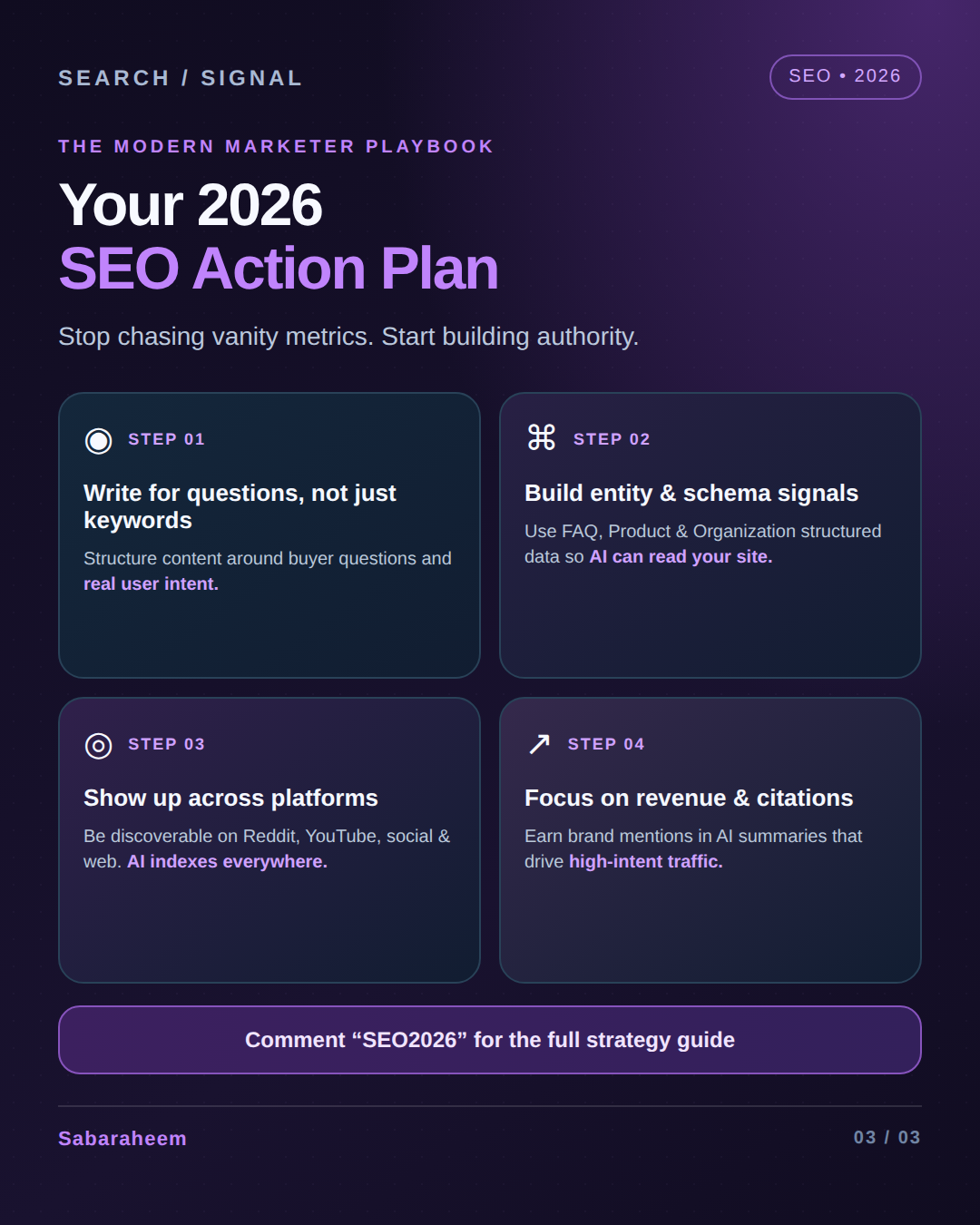
Frameworks without execution are theory. Here are the four action priorities for implementing 2026 AI-first SEO — organised by impact and sequenced by implementation order.
| Action A:Re-evaluating Your Keyword Strategy: Intent Over VolumeThe keyword research that matters in 2026 is intent research. Search volume tells you how many people search a term. Intent analysis tells you what decision they’re trying to make — and whether your content can actually help them make it. These are very different questions.The 2026 keyword qualification checklist:Does this keyword represent a real decision or question — not just a topic?Can I address the full intent (including secondary intent) with my existing expertise?Is this keyword part of a cluster I’m building — or an isolated target with no supporting structure?What SERP features currently appear for this query — and which can I realistically capture?Is the trend direction up, flat, or declining? (Check Google Trends 5-year view before committing)For the full intent-first keyword research methodology applied to competitive niches, see SaaS keyword research strategies beyond basic search volume — the framework scales to any industry. |
| Action B:Content Creation for the AI Era: Quality, Depth, and Problem-SolvingThe content that wins in 2026 has one non-negotiable characteristic: it solves the problem the searcher actually has. Not a simpler version of the problem. Not an adjacent problem. The real, specific problem — completely.The AI-era content quality framework:Direct answer first: Every H2 section opens with a 40-60 word answer to its implied question — extractable by AI, valuable for impatient humansOriginal data or experience: First-hand case studies, proprietary research, or personal experience that AI cannot replicate from training dataComprehensive coverage: Address the topic from every relevant angle — not just the primary query but all related questions a thorough reader would haveNamed sources and data: Cite specific studies, reports, and authorities — not vague ‘research shows’ claims. Named sources build factual credibility with AI systems‘Un-summarisable’ depth: The basic answer lives in the AI Overview. The complete value — frameworks, templates, case studies, interactive tools — lives behind the clickThe devastating cost of the opposite approach — AI-generated thin content at volume — is documented in AI didn’t kill SEO — it killed the illusion that ‘more content’ is a strategy. Read that before publishing anything. |
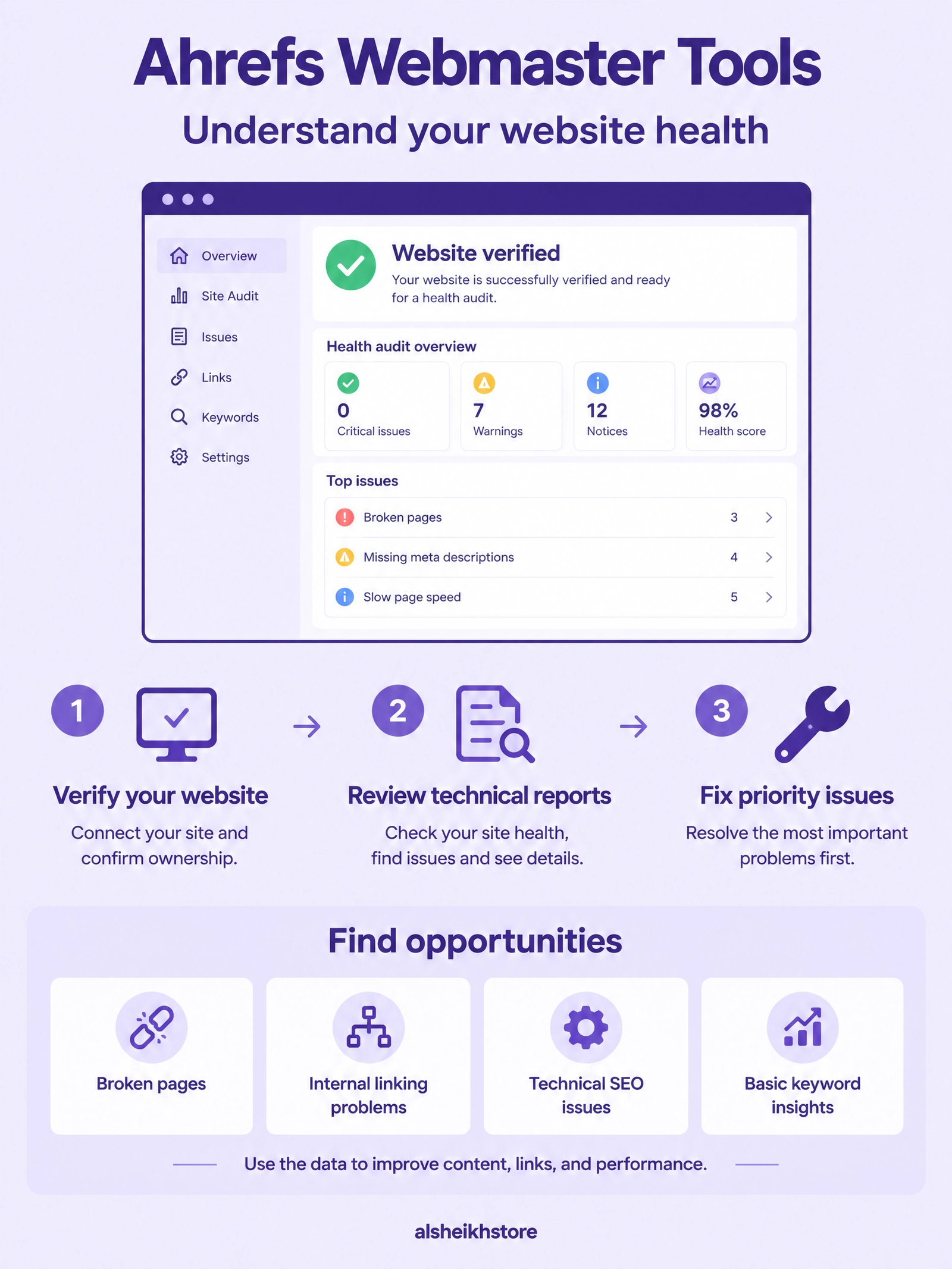
| Action C:Technical SEO Fundamentals: Crawlability, Security, and Site HealthTechnical SEO in 2026 is simultaneously more important and more overlooked than ever. AI systems need to crawl, parse, and understand your content before they can rank or cite it. Technical barriers — even minor ones — create compounding disadvantages in an AI-first search environment.2026 technical SEO priority checklist:Schema markup: FAQ, Article, Author, and LocalBusiness Schema deployed correctly across all relevant pagesAI crawler access: Verify GPTBot, PerplexityBot, GoogleOther, and CCBot are NOT blocked in robots.txtCore Web Vitals: LCP under 2.5s, INP under 200ms, CLS under 0.1 — measured on mobile, not desktopHTTPS and security: SSL certificate current, no mixed content warnings, clean security headersXML sitemap: Submitted to both Google Search Console AND Bing Webmaster Tools (for ChatGPT search mode)Mobile-first indexing: Every page must function perfectly on mobile — Google evaluates the mobile version firstInternal linking: Every page reachable within 3 clicks from the homepage; no orphaned pagesA comprehensive technical audit catches all of these issues and prioritises them by impact. The structured audit methodology — covering schema, crawlability, Core Web Vitals, and content gaps simultaneously — is in the SEO audit formula: strategy session, not a to-do list. |
| Action D:Continuous Monitoring and Adaptation: Staying Agile in 2026The 2026 search landscape changes faster than any previous era of SEO. Google deploys AI model updates, not just algorithm updates — which means search behaviour can shift meaningfully within weeks rather than months. The professionals who maintain their rankings are those who monitor continuously and adapt quickly, not those who optimise once and walk away.The 2026 monitoring stack:AI visibility tracking (weekly): Query ChatGPT, Perplexity, and Google AI Overviews for your 10 priority keywords — are you being cited?Branded search volume (monthly): Google Search Console — is brand search growing as a result of AI citation visibility?Core Web Vitals (weekly): Google Search Console Core Web Vitals report — any new failing URLs?Content freshness audit (quarterly): Which high-performing posts need updated statistics, new sections, or revised examples?Competitor AI citation monitoring (monthly): Are competitors being cited in AI answers where you aren’t? What content do they have that you don’t?For the complete AI brand visibility tracking framework including tools, query templates, and what to do with the data, see how are you tracking AI brand visibility in search engines. |
VI. Conclusion: Future-Proofing Your Digital Presence
| The 5 Key Takeaways for 2026 SEO Success:AI-first optimisation is now the baseline: Direct answer formatting, schema markup, and entity establishment are non-negotiable for any content strategyE-E-A-T is your competitive moat: Real experience, demonstrable expertise, and verifiable authority cannot be faked — and AI systems are increasingly good at detecting when they’re being fakedTopical authority beats domain authority: A focused content cluster in your niche outperforms scattered posts on a high-DA domainZero-click visibility is the new Page 1: Featured snippets, AI Overview citations, and People Also Ask domination build brand awareness that converts to direct traffic and branded searchesTechnical excellence is the foundation: No amount of content quality compensates for a site that AI crawlers can’t access, parse, or trust |
The search landscape of 2026 rewards one quality above all others: genuine usefulness. Not keyword density. Not backlink count. Not publishing volume. The brands, businesses, and individuals who provide the most genuinely useful, comprehensively structured, and reliably accurate information on their topic will be the ones that AI systems consistently surface — in organic results, in featured positions, and in the AI-generated answers that now appear before everything else.
The shift to AI-first search is not finished. The models will improve. The citation patterns will evolve. The SERP will change again. The only sustainable response is to build a content and technical foundation so solid that each new development improves your visibility rather than threatening it. That’s what mastering modern search with SEO, AEO, and GEO strategies looks like in practice.
Start with one audit. Fix the technical foundation. Build one content cluster. Track your AI citation rate. Iterate from data. The professionals succeeding in 2026 search are not doing 20 things at once — they’re doing 5 things comprehensively and consistently. If you want help building that strategy, let’s work together.
| Ready to Master AI-First SEO in 2026?Start with a free SEO audit — get a personalised roadmap for your AI-era ranking strategy.>>> Download Your Free 2026 SEO Audit <<<Or book a strategy session to implement these changes with expert guidance |
People Also Ask
What is AI-first SEO and how is it different from traditional SEO?
AI-first SEO optimises content for how AI systems understand, evaluate, and surface information — focusing on semantic comprehension, intent matching, and direct-answer formatting rather than keyword density and backlink volume alone. Traditional SEO targets keyword-algorithm ranking signals. AI-first SEO targets both traditional signals and the additional layer of AI comprehension signals: direct answers, schema markup, entity establishment, and topical authority. In 2026, traditional SEO signals are the floor; AI-first optimisation is the ceiling.
How do I rank in Google AI Overviews in 2026?
To appear in Google AI Overviews: (1) structure every content section with a 40-60 word direct answer under a question-format H2, (2) implement FAQ Schema on all relevant pages, (3) build topical authority through a content cluster rather than isolated posts, (4) establish your author entity with verifiable credentials and sameAs links across platforms, and (5) ensure your site is technically crawlable with no robots.txt restrictions on AI crawlers. Full strategy in how to win the zero-click search game.
Is keyword research still important in 2026?
Yes — but the methodology has fundamentally changed. Keyword research in 2026 is intent research: understanding what decision or question a search represents, what stage of the journey the searcher is in, and what format of answer will satisfy them. Raw search volume is a starting point, not a decision. A low-volume keyword representing a high-intent decision stage is more valuable than a high-volume informational keyword with no purchase intent.
What is topical authority and how do I build it?
Topical authority is Google’s assessment of how comprehensively your domain covers a specific subject area. It’s built through content clusters: a pillar page covering the core topic comprehensively, supported by 8-15 cluster posts covering specific subtopics, all internally linked in a logical architecture. AI systems use topical authority signals to decide which sources to trust for AI Overview citations — making it one of the highest-leverage investments in 2026 SEO.
How do Core Web Vitals affect SEO rankings in 2026?
Core Web Vitals function as a ranking floor in 2026 — pages that fail LCP (over 2.5s), INP (over 200ms), or CLS (over 0.1) thresholds are disadvantaged against equivalently qualified pages that pass. Google evaluates Core Web Vitals on the mobile version of your site (mobile-first indexing), making mobile performance the primary technical priority. Beyond rankings, Core Web Vitals failures directly increase bounce rates, reducing the engagement signals that further reinforce ranking.
Frequently Asked Questions
How long does it take to see results from AI-first SEO changes?
Technical fixes (schema, crawlability, Core Web Vitals) typically produce measurable changes within 2-6 weeks as Google re-crawls and reassesses affected pages. Content restructuring for direct answer formatting can produce AI Overview citation improvements within 4-8 weeks. Topical authority cluster building shows compound ranking improvements over 3-6 months of consistent publishing. The fastest results come from fixing technical barriers first, then optimising existing high-traffic content for AI comprehension. Real timeline data from a case study is in how long do SEO results take.
Do backlinks still matter for SEO in 2026?
Yes — backlinks remain a significant authority signal, but their role has shifted. In 2026, quality and relevance vastly outweigh volume. A single backlink from a highly relevant, high-authority domain in your specific niche carries more weight than 50 generic directory links. Additionally, backlinks from platforms cited by AI systems (industry publications, research sites, authoritative blogs) carry an implicit AI citation benefit. The modern link building approach that accounts for AI-era signals is in link building strategies that actually work in 2026.
What schemas are most important to implement in 2026?
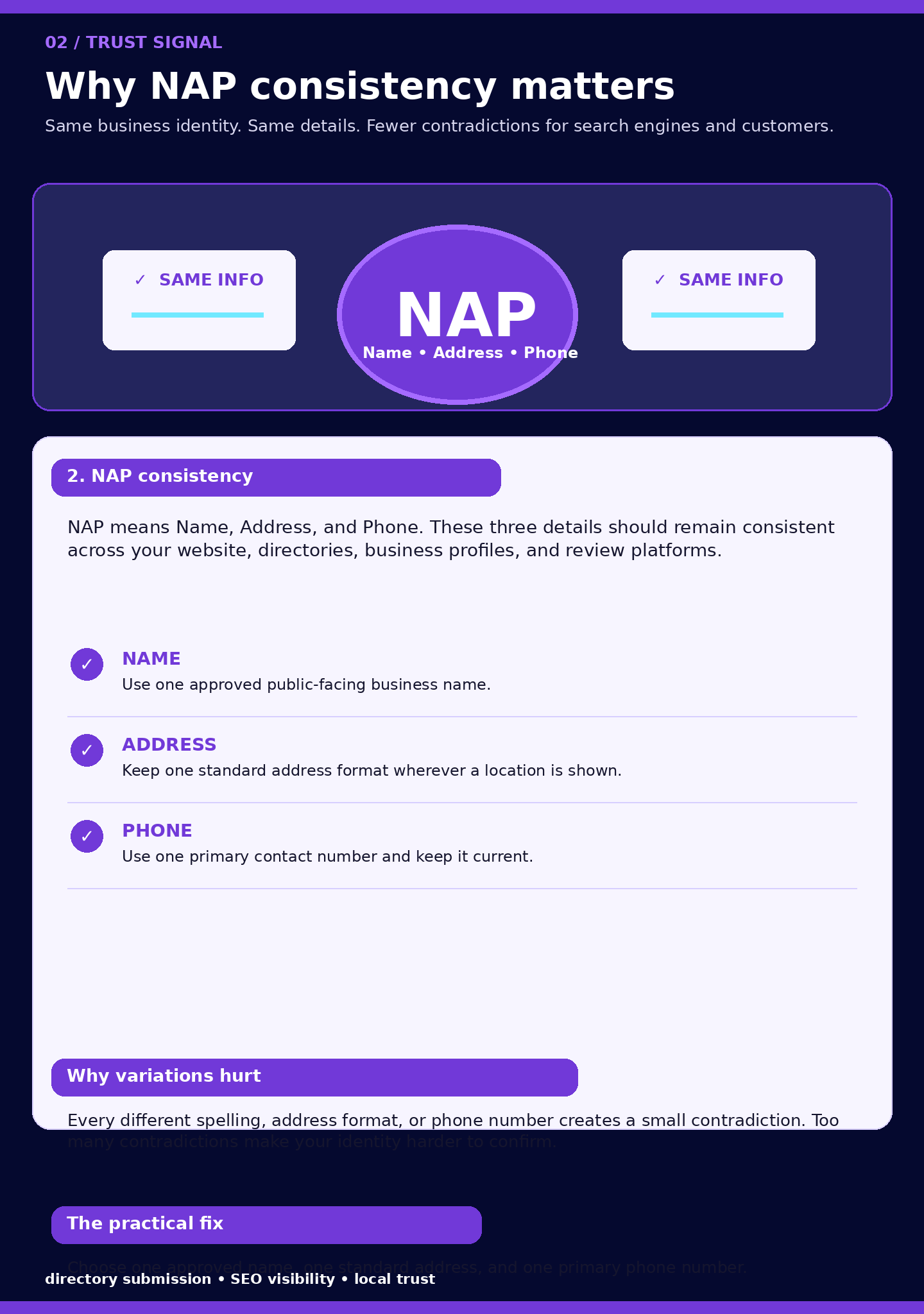
In priority order: (1) FAQ Schema — directly marks question-answer pairs for AI extraction and featured snippet capture, (2) Article/BlogPosting Schema — establishes content type, author, and publication date for AI trust evaluation, (3) Author Schema with sameAs links — builds your personal entity recognition across AI systems, (4) Organization Schema — establishes your brand entity with consistent NAP and contact information, (5) LocalBusiness Schema — critical for any business with a physical location or local service area. Implement all five for maximum AI comprehension coverage.
How does voice search affect my content strategy?
Voice search queries are conversational, complete sentences rather than fragmented keyword strings. This requires content structured around natural language questions (matching how people speak, not type), with direct 40-60 word answers that voice assistants can read aloud cleanly. Pages that rank for voice search typically appear in Featured Snippets or AI Overviews — which means voice search optimisation and AI Overview optimisation use the same content techniques. The full strategy with implementation examples is in how to do voice search SEO.
Should I focus on SEO or GEO (Generative Engine Optimization) in 2026?
Both — and they’re more complementary than competitive. SEO optimises for traditional search ranking signals (keywords, backlinks, technical health). GEO optimises for AI system citation signals (direct answers, entity recognition, schema, external citation footprint). The content that ranks well in traditional search increasingly uses the same structural signals that earn AI citations. Treating them as a unified strategy rather than competing priorities is the 2026 professional standard — covered fully in mastering modern search with SEO, AEO, and GEO strategies.

Sharing my journey and learnings in Tech and AI. As a Digital Marketing Expert, I help brands boost their visibility and sales with smart personal branding and the latest AI tricks.
Leave a Reply