|
Getting your Trinity Audio player ready… |
Table of Contents
| Direct Answer (AI Overview Optimized):To get cited in ChatGPT, Perplexity, and Google AI Overviews, you need to: (1) structure content with direct 40-60 word answers under clear headings, (2) implement FAQ and Article schema markup, (3) build topical authority through interconnected content clusters, (4) earn citations on authoritative third-party sites, and (5) write in a clear, declarative tone that AI systems can extract and attribute. Each platform has different citation signals — this guide breaks all three down. |
Introduction: The New Citation Economy
There’s a new kind of SEO win in 2026, and most people aren’t even tracking it.
It’s not a #1 ranking. It’s not a featured snippet. It’s the moment when a user asks ChatGPT a question about your topic — and your website is the source ChatGPT cites.
This is the citation economy — and it’s reshaping how content authority is built online. Google AI Overviews, ChatGPT Search, and Perplexity AI together now handle hundreds of millions of queries per day. They don’t just retrieve links. They synthesize content into answers and attribute sources. The question is: will your brand be one of those sources?
This isn’t just a traffic play. Being cited in AI answers is a brand authority signal that compounds over time — the same way backlinks did in 2010. As I explored in my deep dive on ranking on Google vs. getting cited in AI answers, the brands winning the citation game right now are those who started treating AI optimization as a first-class SEO priority.
This guide gives you the exact playbook — broken down by platform, by content type, and by action steps you can start this week.
1. Understanding How Each AI Platform Decides What to Cite
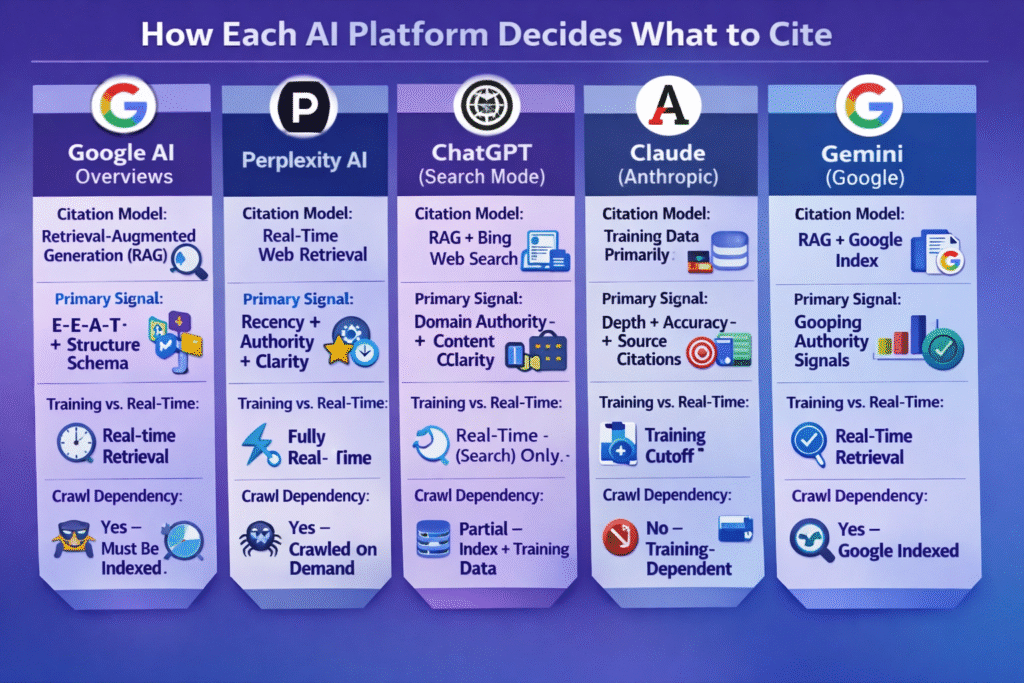
Before optimizing, you need to understand that ChatGPT, Perplexity, and Google AI Overviews each have different citation logic. One strategy does not fit all three.
| Platform | Citation Model | Primary Signal | Training vs. Real-Time | Crawl Dependency |
|---|---|---|---|---|
| Google AI Overviews | Retrieval-Augmented Generation (RAG) | E-E-A-T + structure + schema | Real-time retrieval | Yes — must be indexed |
| Perplexity AI | Real-time web retrieval | Recency + authority + clarity | Fully real-time | Yes — crawled on demand |
| ChatGPT (Search mode) | RAG + web search via Bing | Domain authority + content clarity | Real-time (search) or training (no search) | Partial — index + training data |
| Claude (Anthropic) | Training data primarily | Depth + accuracy + citations in source | Training cutoff | No — training-dependent |
| Gemini (Google) | RAG + Google index | Google authority signals | Real-time retrieval | Yes — Google indexed |
Key insight: Perplexity and ChatGPT in search mode reward recency and web accessibility heavily. Google AI Overviews reward established topical authority and schema markup. Optimize for all three by combining both signals.
2. The 7 Universal Citation Signals All AI Platforms Share
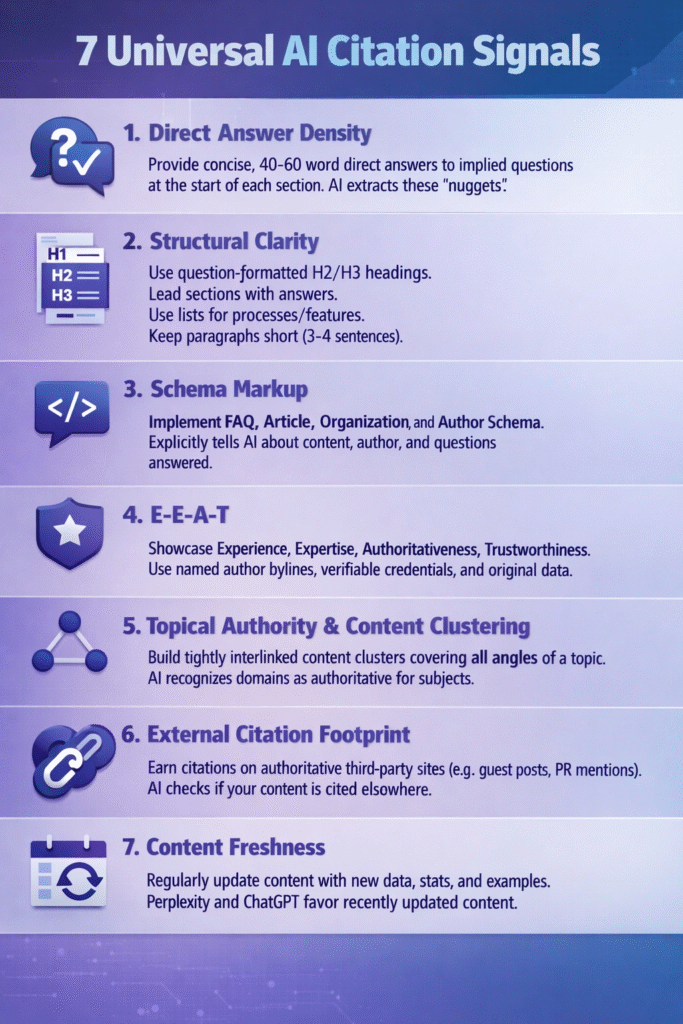
Despite platform differences, seven content signals reliably increase citation probability across all AI systems:
Signal 1: Direct Answer Density
Every section of your content should open with a 40-60 word direct answer to the implied question. AI systems scan for extractable ‘nuggets’ — self-contained units of information that answer a specific question without requiring surrounding context.
| Content Formula That Gets Cited:H2: [Question phrasing] → Direct answer (40-60 words) → Supporting explanation → Data point or example → Internal link to deeper resource |
Signal 2: Structural Clarity
AI systems parse HTML structure. Use H2 and H3 headings that mirror how users phrase questions — not clever marketing headlines. ‘What Is Topical Authority?’ beats ‘The Power of Owning Your Niche’ every time for AI extraction.
- Use question-format H2s for informational sections
- Lead each section with the answer — not a rhetorical windup
- Use numbered lists for processes, bullet lists for features
- Keep paragraphs to 3-4 sentences maximum
Signal 3: Schema Markup
Schema is the single most under-used citation signal. It tells AI systems explicitly what your content is about, who wrote it, when it was published, and what questions it answers. Without it, AI systems have to infer — and they sometimes infer wrong.
- FAQ Schema — marks question-answer pairs directly in your HTML
- Article/BlogPosting Schema — establishes author, date, and content type
- Organization Schema — builds brand entity recognition across platforms
- Author Schema with sameAs — links your author entity to LinkedIn, Twitter, Google Scholar
If you’re not sure whether your schema is set up correctly, my SEO audit formula includes a full schema checklist as part of the technical audit process.
Signal 4: E-E-A-T (Experience, Expertise, Authoritativeness, Trustworthiness)
Google AI Overviews heavily weight E-E-A-T. ChatGPT and Perplexity have similar trust hierarchies — they prefer established domains, named authors with credentials, and content that cites external sources.
- Named author bylines with credentials on every post
- About page with verifiable expertise claims
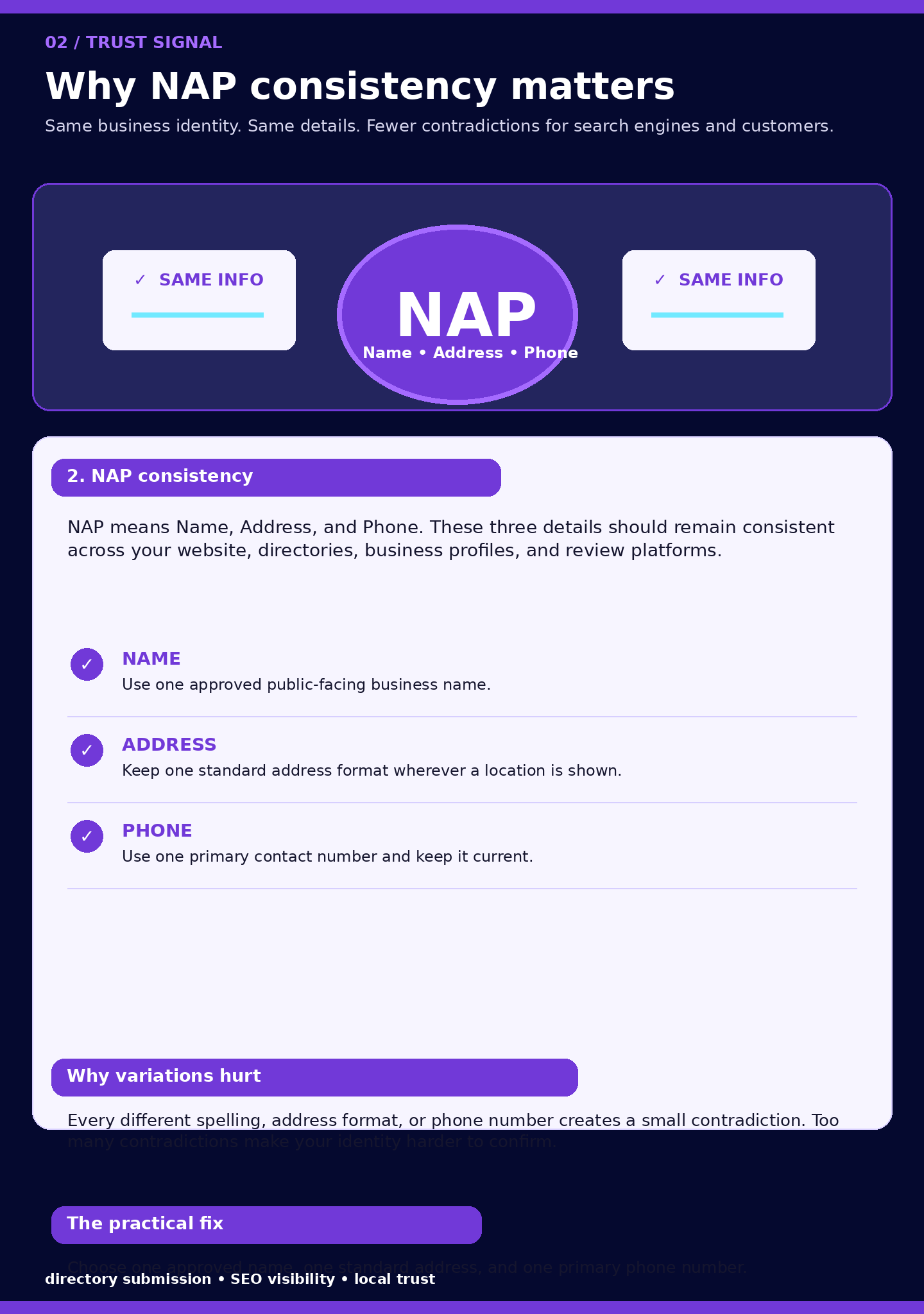
- Accurate, consistent NAP (Name, Address, Phone) data
- Active citations from external authoritative sources
- Original data, case studies, or first-hand experience — things AI cannot fabricate. This is why your personal story is your best SEO strategy in the AI era.
Signal 5: Topical Authority and Content Clustering
A single blog post rarely gets cited consistently. A tightly interlinked content cluster covering every angle of a topic gets cited repeatedly, because AI systems recognize the domain as authoritative for that subject.
Think of it this way: if you have 12 interconnected posts about SaaS marketing, AI systems learn your domain ‘owns’ that topic. If you have one post, you’re just a visitor. I break down the cluster-building methodology in detail in my SaaS keyword research strategy guide — the same principles apply to any industry.
Signal 6: External Citation Footprint
AI systems check if your content is cited elsewhere. A brand mentioned in Forbes, Search Engine Journal, or a high-authority industry blog has a stronger citation signal than an identical article on an uncited site. This is the modern relevance of link building for authority and AI citations.
- Guest posts on DA 60+ industry publications
- PR mentions in news outlets
- Academic or research citations if applicable
- Being referenced in roundup posts or expert quotes
Signal 7: Content Freshness
Perplexity AI and ChatGPT in search mode heavily favor recently updated content. Google AI Overviews also factor freshness for time-sensitive topics. Update your highest-performing posts quarterly with new data, stats, and examples — even small updates reset the freshness signal.
3. How to Get Cited in Google AI Overviews: Platform-Specific Strategy
Google AI Overviews use Retrieval-Augmented Generation (RAG) — meaning they pull from Google’s live index at query time. This makes traditional SEO signals directly relevant.
Step 1: Get Indexed and Stay Indexed
- Submit your XML sitemap in Google Search Console
- Ensure all target pages pass Core Web Vitals
- Fix crawl errors immediately — uncrawled pages cannot be cited
- Run a monthly SEO technical audit to catch indexation issues early
Step 2: Optimize for AI Overview Inclusion
According to my analysis in the zero-click search strategy guide, Google AI Overviews favor content that:
- Opens sections with a direct 40-60 word answer
- Uses H2/H3 headings phrased as questions
- Includes FAQ Schema with the exact questions your target audience asks
- Has strong E-E-A-T signals (author bio, credentials, update date visible)
- Is part of a content cluster — not an isolated post
Step 3: Target ‘AI Overview Trigger’ Query Types
Not all queries trigger AI Overviews. Focus your content on query types that do:
| Query Type | Example | AI Overview Likelihood |
|---|---|---|
| Definitional / What Is | What is topical authority? | Very High |
| How-To / Process | How to build a content cluster | Very High |
| Comparison | ChatGPT vs Perplexity for research | High |
| Best practices | Best schema markup for SEO 2026 | High |
| Cause / Why | Why does zero-click hurt traffic? | Medium-High |
| Transactional | Buy SEO services | Low |
4. How to Get Cited in Perplexity AI: Platform-Specific Strategy
Perplexity is a real-time research engine. It crawls the web fresh for every query. This makes it different from Google — and in some ways, easier to win.
What Perplexity Looks For
Perplexity’s citation algorithm strongly favors:
- Recency — freshly published or updated content gets prioritized over older posts with similar authority
- Source credibility — domains with established authority and named authors
- Answer density — content that answers the query in the first 100-150 words
- Factual specificity — posts with specific numbers, dates, named sources, and citations
- Crawlability — no JavaScript-blocking, fast load speed, no robots.txt restrictions
Perplexity Optimization Tactics
- Publish with today’s date and update posts monthly — Perplexity’s crawler rewards freshness signals
- Add a ‘Last Updated’ date visible in your HTML and schema
- Include specific statistics with named sources (e.g., ‘According to Semrush’s 2026 State of SEO report…’)
- Use descriptive meta descriptions — Perplexity often pulls from meta description for its source preview
- Make your robots.txt Perplexity-permissive — verify that PerplexityBot is not blocked. Run a technical SEO audit to check
- Submit to Perplexity’s publisher program if eligible — cited publishers get priority placement
5. How to Get Cited in ChatGPT: Platform-Specific Strategy
ChatGPT is the most complex platform to optimize for, because it operates in two modes: training data mode (no internet access) and search mode (live web retrieval via Bing).
ChatGPT Training Data Citations
In non-search mode, ChatGPT cites information from its training dataset (cutoff: early 2025 for GPT-4o). To appear in training data citations:
- Your content must have been crawled and indexed by Common Crawl or Bing before the training cutoff
- Content needs significant external citation and link authority to be weighted in training
- Building high-authority backlinks increases the probability your content was included in training data
- Consistent publishing history signals a reliable information source
ChatGPT Search Mode (Real-Time Bing Retrieval)
When ChatGPT uses web search (the default in many queries), it retrieves from Bing’s index. This means:
- Bing SEO matters — submit your sitemap to Bing Webmaster Tools if you haven’t already
- Bing weights domain age and authority heavily — established domains with clean backlink profiles perform well
- Direct answer formatting wins — ChatGPT’s web retrieval extracts the same 40-60 word answer nuggets as Google
- Structured data helps — FAQ and Article schema are processed by Bing’s crawler
| Pro Tip: The Bing Submit HackGo to Bing Webmaster Tools → URL Inspection → Submit URL. You can force-crawl your most important pages. Do this every time you publish a new post to maximize ChatGPT search mode citation speed. |
6. The GEO Content Framework: Writing for AI Citation
GEO (Generative Engine Optimization) is the emerging discipline of optimizing content for AI citation. It builds directly on SEO foundations but adds new layers. Here’s how I apply it across the content marketing strategy I use for clients:
The CITE Writing Framework
| Letter | Principle | What to Do | What to Avoid |
|---|---|---|---|
| C | Clarity | Open every section with a direct, declarative answer | Hedging language (‘it depends’, ‘many factors’) |
| I | Integrity | Cite named sources, include original data, named author | Anonymous content, unsourced statistics |
| T | Topicality | Stay tightly focused on one subject per post | Covering 5 unrelated subtopics in one article |
| E | Entity Signals | Schema markup, brand consistency, external mentions | Inconsistent brand name, missing schema, no About page |
Content Templates That Get Cited
Based on analysis of what actually gets cited in AI answers vs. Google rankings, these content formats consistently earn citations:
- The Definition + How-To Hybrid: Define a concept in 50 words, then explain how to apply it in a numbered list. AI loves this format.
- The Comparison Table: Side-by-side comparisons are highly extractable by AI systems. Include at least one data table per 1,000 words.
- The Original Research Post: Surveys, experiments, or data analysis you conducted. AI systems cite original data sources heavily.
- The Process Walkthrough: Step-by-step guides with numbered sections. Process clarity is a top AI citation trigger.
- The FAQ Cluster: A post structured entirely as questions and answers. Pair with FAQ Schema for maximum extraction.
7. Building Your Entity Presence for AI Recognition
AI systems think in entities, not just keywords. Your brand, your name, your domain — these are entities that AI systems either recognize or don’t. If they don’t recognize you, citing you is a risk they won’t take.
How to Build Entity Recognition
- Create a comprehensive About page with your full name, credentials, and what you do
- Use the same brand name consistently across your website, social profiles, and third-party citations
- Build your personal brand as a recognized entity in your field — authored posts, podcast appearances, speaking engagements
- Implement Organization Schema with your official brand name, logo, and sameAs links to all social profiles
- Get cited in Wikipedia-adjacent sources — industry wikis, authoritative glossaries, reference pages
- Create a Google Knowledge Panel by ensuring consistent NAP data across 20+ directories
The ‘Parasite SEO’ Play for AI Citations
Want a shortcut to AI citations? Parasite SEO — publishing content on high-authority third-party platforms — gives your content instant entity credibility. A guest post on Forbes or Search Engine Journal is far more likely to be cited by AI systems than an identical post on a new domain.
The strategy: publish your core insights on your own domain first (for ownership), then republish or summarize on high-authority platforms (for AI citation velocity).
8. Tracking Your AI Citation Performance
You cannot improve what you don’t measure. Here’s how to build a citation tracking system. I cover this in depth in my post on tracking AI brand visibility, but here’s the core framework:
| Tracking Method | Platform | Frequency | What to Record |
|---|---|---|---|
| Manual SERP sampling | Google AI Overviews | Daily (top 10 queries) | Citation Y/N, anchor text, position |
| Perplexity query testing | Perplexity AI | Weekly (top 20 queries) | Citation Y/N, source position |
| ChatGPT query testing | ChatGPT + Search | Weekly (top 20 queries) | Citation Y/N, verbatim vs paraphrase |
| Branded search volume | Google Search Console | Monthly | Volume trend, query variants |
| Referral traffic from AI | GA4 | Weekly | Sessions from Perplexity, ChatGPT referrer |
Tools worth using in 2026: Semrush AI Toolkit, Ahrefs AI Visibility tracker, BrandMentions, and manual query sampling in incognito mode. No single tool covers all three platforms yet — manual testing remains essential.
9. Common GEO Mistakes That Prevent AI Citations
- Blocking AI crawlers in robots.txt: Some sites accidentally block GPTBot (OpenAI), PerplexityBot, or GoogleOther. Check your robots.txt right now.
- No schema markup: The single highest-impact technical fix for AI citation. Implement FAQ Schema on every post this week.
- Vague, hedging content: ‘It depends on various factors’ is uncitable. Replace with: ‘For [specific scenario], the answer is [specific answer] because [specific reason].’
- No topical cluster: A single well-written post won’t establish authority. Build at least 5 interconnected posts before expecting consistent AI citations.
- Ignoring Bing: ChatGPT search uses Bing. If you’ve never submitted to Bing Webmaster Tools, you’re invisible to a major AI citation source.
- Thin author profiles: Content without a credible named author gets deprioritized by trust-based AI systems.
- Overlooking voice search integration: Voice queries feed directly into AI systems. If you haven’t optimized for conversational queries yet, read my guide on how to do voice search SEO.
10. Your 30-Day AI Citation Sprint Plan
Stop planning. Start executing. Here’s your 30-day action plan:
Week 1: Technical Foundation
- Check robots.txt — ensure GPTBot, PerplexityBot, and GoogleOther are not blocked
- Submit sitemap to Google Search Console AND Bing Webmaster Tools
- Implement FAQ Schema on your top 10 pages
- Add Article Schema with author sameAs links to all blog posts
Week 2: Content Restructuring
- Rewrite the first paragraph of your top 10 posts to lead with a 40-60 word direct answer
- Convert all H2 headings to question format on your 5 most-visited posts
- Add a comparison table to any post that compares two or more things
- Build or strengthen your content cluster with 2-3 new interlinked posts
Week 3: Authority Building
- Pitch 2 guest posts to DA 60+ publications in your industry
- Update your About page with full credentials, linked social profiles, and Organization Schema
- Add a visible ‘Last Updated’ date to your top 10 posts and update with fresh data
- Consider branding strategy to consolidate your entity presence across the web
Week 4: Measurement and Iteration
- Set up your AI citation tracking spreadsheet — 10 queries per platform, tracked weekly
- Baseline your branded search volume in Google Search Console
- Identify your top 3 cited pages — double down on that content format across the site
- Book a content marketing strategy session to scale what’s working
People Also Ask
How long does it take to get cited in ChatGPT or Perplexity?
For Perplexity (real-time crawl), you can appear within 24-48 hours of publishing a well-optimized post on an indexed domain. For ChatGPT in search mode (Bing retrieval), expect 1-2 weeks for new pages to be indexed and cited. For ChatGPT’s training data, citations only happen in future model updates — focus on search mode instead.
Do backlinks help with AI citation?
Yes — significantly. Backlinks are a proxy for external authority, which AI systems use to decide whether to trust a source. High-authority backlinks from domain-relevant sites increase citation probability in all three platforms. See my full breakdown in link building for SaaS and authority sites.
What is the difference between GEO and SEO?
SEO (Search Engine Optimization) optimizes content to rank in traditional search results pages. GEO (Generative Engine Optimization) optimizes content to be cited by AI-powered answer engines like ChatGPT, Perplexity, and Google AI Overviews. The foundations overlap (quality, structure, authority), but GEO additionally requires direct-answer formatting, entity recognition, and schema markup for AI extraction.
Does Google AI Overviews cite the same pages as organic results?
Not always. Google AI Overviews are generated from a separate retrieval pool that prioritizes content with strong direct-answer formatting, FAQ schema, and E-E-A-T signals. A page ranking #4 organically might be cited in the AI Overview over the #1 result if it has clearer answer structure. This creates a GEO opportunity for pages stuck below position 1.
Can I be cited in AI answers without ranking on Google?
For Perplexity, yes — it has its own crawler independent of Google rankings. For ChatGPT search mode, partial yes — it uses Bing which has different ranking signals. For Google AI Overviews, it’s harder — Google’s index is the primary source pool. But being cited in AI Overviews without ranking #1 organically is very common for well-structured, schema-rich content.
Frequently Asked Questions
What is Generative Engine Optimization (GEO)?
GEO is the practice of optimizing web content to be cited by AI-powered search systems — including ChatGPT, Perplexity AI, Google AI Overviews, and other large language model-based answer engines. It extends traditional SEO with additional signals: direct-answer formatting, entity schema markup, named authorship, and external citation footprint.
Which schema markup is most important for AI citation?
FAQ Schema is the single most impactful schema type for AI citation because it explicitly marks question-answer pairs in machine-readable format. Article/BlogPosting Schema is second — it establishes content type, authorship, and publication date. Organization Schema builds brand entity recognition. Implement all three for maximum coverage.
Does word count matter for AI citations?
Not directly. AI systems cite the most clearly structured and authoritative answer — which might be 60 words or 600 words. However, longer content with multiple well-structured sections naturally creates more citation opportunities across more queries. Aim for comprehensive coverage of your topic (1,500-3,000 words) with each section independently optimized for direct-answer extraction.
How do I check if my site is blocking AI crawlers?
Open your robots.txt file (yourdomain.com/robots.txt) and search for ‘GPTBot’, ‘PerplexityBot’, ‘GoogleOther’, and ‘CCBot’. If any of these are listed under a ‘Disallow: /’ rule, you are blocking them. Remove these restrictions to allow AI crawlers access. If you’re unsure, a technical SEO audit will catch crawler restrictions.
What content format gets cited most by Perplexity?
Perplexity consistently cites content that: (1) was published or updated recently, (2) answers the exact query in the first 100-150 words, (3) includes specific named data points and sources, and (4) comes from a domain with clear topical authority. FAQ-format posts and original research posts perform especially well on Perplexity.

Sharing my journey and learnings in Tech and AI. As a Digital Marketing Expert, I help brands boost their visibility and sales with smart personal branding and the latest AI tricks.

Leave a Reply