|
Getting your Trinity Audio player ready… |
Table of Contents
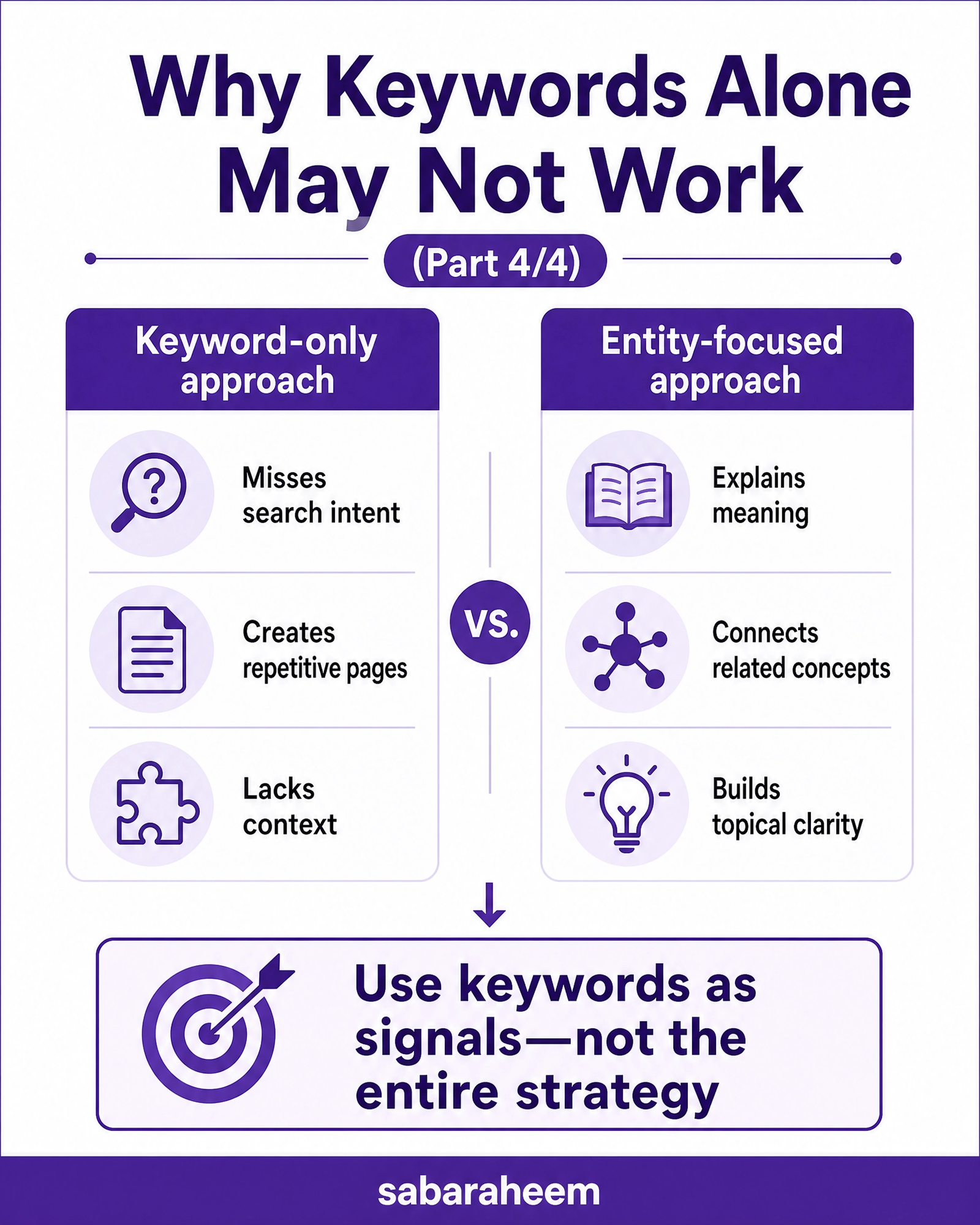
If your website is not showing up in Google even though you are using the right keywords, the problem is almost certainly not the keywords themselves. It is that Google stopped thinking the way you are optimising. Keywords were the language of search circa 2010. Topics became the language around 2015 when Google introduced RankBrain. Entities are the language of search in 2026 — and most websites are still speaking the first language. This guide explains exactly what changed, what entities are, how to find them, and what to do about it.
| Quick Answer: Google’s Knowledge Graph now contains over 800 billion facts about 8 billion entities. Google does not rank pages by counting keywords anymore — it ranks entities by evaluating their relationships, authority, and clarity. If your website is not a recognised entity in Google’s knowledge system, keyword optimisation alone will not fix your visibility. |
| 800BFacts in Google’s Knowledge Graph | 8BEntities Google recognises globally | 1400%Better visibility: entity content vs keyword content | 2026Entity SEO is now the foundation — not an advanced tactic |
Why Your Keywords Are Working — But Your Rankings Are Not

This is the most frustrating experience in modern SEO: you research the keyword, you write the article, you optimise the title and meta description, you build some links — and Google barely notices. Meanwhile, a competitor with a thinner article and fewer backlinks ranks above you consistently.
The explanation is not that SEO is broken. It is that the version of SEO you are doing is optimised for a version of Google that no longer exists. Here is what actually changed.
In 2012, Google launched the Knowledge Graph. In 2015, it introduced RankBrain — its first AI-based ranking signal, which understood user intent rather than just keyword matching. In 2019, BERT allowed Google to process natural language at a sentence level. In 2023 and 2024, the Helpful Content system and AI Overviews arrived. By 2026, Google’s primary question about your content is not ‘does this page contain the keyword?’ It is ‘is this a credible entity that I trust to be an authority on this subject?’
| In 2026, Google processes over 8.5 billion searches per day using semantic understanding. Websites that optimise for entities and meaning consistently outrank those that optimise for keyword density — even when the keyword-optimised pages have more backlinks. (SEOScore.tools, May 2026) |
The Three Stages of How Google Ranks Content
Stage 1 — Keyword Era (1998 to 2012): Strings of Text
In the beginning, Google matched the words on your page to the words in a search query. If someone searched for ‘best coffee NYC’ and your page contained those words, you had a ranking advantage. The game was simple: put the keyword in the title, in the headings, in the body, and get links pointing to the page. Keyword density was a real optimisation metric.
This era created an incentive to stuff pages with keywords, build thousands of low-quality links, and game the system at scale. Google responded with Panda (2011) and Penguin (2012) — updates that penalised keyword stuffing and link manipulation. But the fundamental model was still string-matching.
Stage 2 — Topic Era (2013 to 2021): Intent and Depth
Hummingbird (2013) was the first major shift. Google began understanding the intent behind a query rather than just the literal words. A search for ‘how do I get rid of fruit flies’ was understood as a question about pest control — not a request for pages containing all five of those words. RankBrain (2015) and BERT (2019) extended this further.
This stage rewarded topical depth. A site that covered a subject comprehensively — with multiple interlinked pages exploring different aspects of the same topic — began to outperform a site with a single well-optimised page. Topic clusters emerged as the primary content strategy.
Stage 3 — Entity Era (2022 to Present): Things, Not Strings
Google’s famous internal phrase — ‘things, not strings’ — describes what happened next. The Knowledge Graph moved from being a supplementary feature to being a core part of how Google evaluates websites. Instead of asking ‘what does this page say?’, Google began asking ‘what entity is this page about, and is that entity credible?’
An entity is not a keyword. ‘SEO services’ is a keyword. seoportfolio.in is an entity — a specific, identifiable thing with attributes (who runs it, where it operates, what it does, who has mentioned it) that Google can verify against its knowledge graph. Pages that are clearly about an entity, written by a credible entity, and linked to from recognised entities rank more stably and more broadly than keyword-optimised pages.
What Is an Entity in SEO? (The Clear Answer)
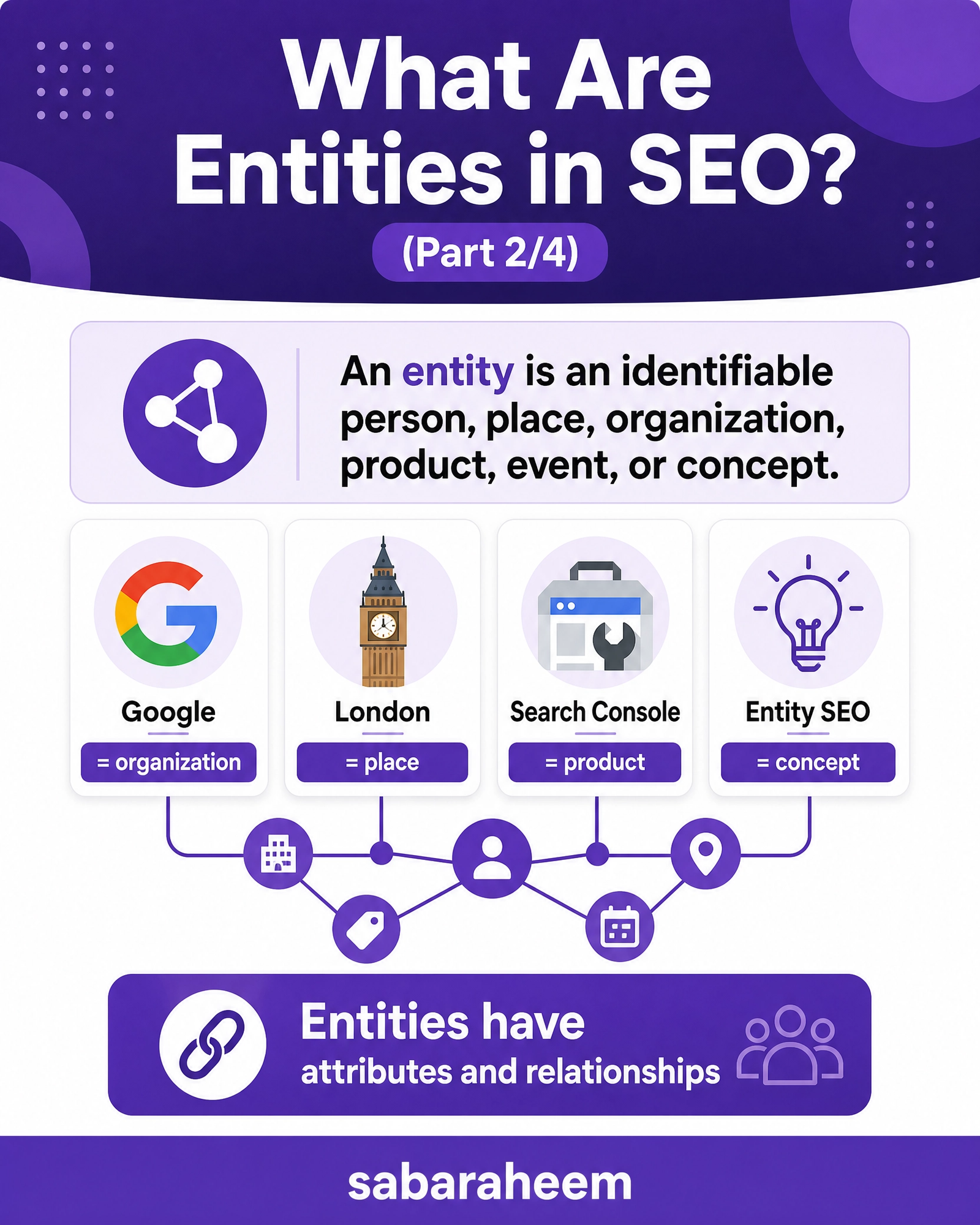
Google defines an entity as ‘a single, well-defined thing or concept.’ An entity is identifiable, unique, and has attributes — characteristics that describe it — and relationships — connections to other entities. The entity’s name is less important than its clarity and consistency.
Your brand is an entity. Your name as an author is an entity. The concepts you write about — entity SEO, generative engine optimisation, keyword research — are entities. The city you operate in is an entity. When Google can identify all of these clearly and connect them to each other, it trusts your content more.
The Six Types of Entities Google Recognises
| Entity Type | Examples | How Google Recognises It | SEO Implication |
| Person | Elon Musk, your author, your CEO | Wikipedia, LinkedIn, news mentions, Knowledge Panel | Author E-E-A-T — named experts increase content trust signals |
| Organisation | Google, seoportfolio.in, a local plumbing business | Google Business Profile, schema, Wikidata, mentions on authority sites | Brand entity recognition — critical for AI citation |
| Place | Sydney, a specific restaurant, a hospital | Google Maps, local schema, address consistency, reviews | Local SEO — NAP consistency builds place entity clarity |
| Product | iPhone 17, Olay Regenerist, a specific course | Product schema, reviews, merchant listings, price data | Product entity optimisation drives Google Shopping + AI results |
| Concept | Entity SEO, GEO, photosynthesis, inflation | Content depth, topical authority, cross-site references | Conceptual entity ownership — being the authority site on a concept |
| Event | Google I/O, World Cup, a product launch | Event schema, news mentions, calendar references | Event coverage at the right time builds topical relevance signals |
What Is Entity Salience?
Salience is how prominent an entity is within a piece of content. Google’s Natural Language Processing API assigns a salience score from 0 to 1 to every entity it extracts from a page. A score of 0.8 means that entity is highly central to the content. A score of 0.1 means it is mentioned in passing.
High salience for your primary entity — your brand, your main concept, your key service — tells Google clearly what this page is about. Low or absent salience for your brand entity is a signal that your content is not clearly identified with the entity you want to be known for.
You can test your own page’s entity salience for free using Google’s Natural Language API demo at cloud.google.com/natural-language. Paste your page content and see which entities Google extracts and at what salience score. This is also covered in our guide: What Is Entity SEO and Why It Matters More Than Keywords in 2026.

Keywords vs Topics vs Entities — Full Comparison
Here is exactly how these three approaches differ in practice:
| Factor | Keyword SEO | Topic SEO | Entity SEO |
| Google Sees | A string of text to match | A subject area to evaluate depth | A real-world concept with attributes and relationships |
| Optimization Focus | Repeat the keyword in the right places | Cover the topic comprehensively | Establish who and what you are — clearly and consistently |
| Content Strategy | One page per keyword | Topic clusters — pillar + support pages | Entity graph — interconnected authority signals |
| Trust Signal | Backlinks and domain authority | Topical authority — breadth and depth | Knowledge Graph recognition + E-E-A-T + external mentions |
| Ranking Question Google Asks | Does this page contain the keyword? | Does this site cover this topic well? | Is this a recognised authority on this concept? |
| AI Search Visibility | Low — AI looks beyond keyword presence | Medium — topic coverage helps but entity clarity needed | High — entity recognition drives AI Overview citations |
| Longevity | Short — algorithm updates erode rankings | Medium — strong but not self-reinforcing | Long — entity authority compounds over time |
| When It Works | Low competition, simple informational queries | Competitive niches with clear subject areas | Any niche — especially in AI-driven search |
What Is the Difference Between Ranking for Keywords and Ranking for Topics?
Ranking for a keyword means your page appears when someone types or speaks that specific phrase. Ranking for a topic means your site appears across a broad cluster of related queries — even ones that do not contain your target keyword — because Google recognises you as an authority on that subject area.
The difference matters because user queries are infinitely varied. People asking about the same thing use wildly different wording. If you only rank for the exact keyword, you miss 90 percent of the queries that express the same intent. Topic authority captures all of them.
Entity authority goes further. When your brand is a recognised entity in Google’s Knowledge Graph, Google attributes trust to everything you publish — not just the pages you have optimised. A new article from an entity-recognised site starts with an authority advantage that a keyword-optimised page from an unrecognised site simply does not have.
| The Practical Difference: Keyword SEO answers the question ‘what should I write about this month?’ Topic SEO answers ‘what cluster of content do I need to own this subject area?’ Entity SEO answers ‘who am I in Google’s understanding of the web — and is that clear enough for Google to trust and cite me?’ |
How to Find Entities for SEO Optimisation
Finding the right entities to optimise for involves two steps: identifying the entities you should already be associated with, and identifying the gaps — entities that your competitors rank for that you do not yet clearly signal.
| Method | Tool | What to Look For | How to Use It |
| Google Knowledge Panel | Google Search — search your brand name | Does a Knowledge Panel appear? What entities does it show? | If no panel, your brand entity is not recognised — this is your first problem to fix |
| Google NLP API | cloud.google.com/natural-language (free demo) | Which entities Google extracts from your page content | Paste your page text — check if your key entities appear and with what salience score |
| InLinks / Entity SEO Tools | InLinks, MarketMuse, Surfer SEO | Related entities, co-occurrence patterns, topic gaps | Identify which entities your competitors rank for that you do not cover |
| Wikipedia and Wikidata | wikipedia.org, wikidata.org | Whether your brand or key concepts are defined here | Wikidata is a primary source for Google’s Knowledge Graph — presence here accelerates recognition |
| Schema Markup Validator | schema.org/validator — Google Rich Results Test | Whether your structured data correctly signals your entities | Validate Organization, Person, and Product schema on your key pages |
| Competitor Knowledge Panels | Google Search — search your top competitors | What attributes Google shows for them — locations, services, related entities | Map the entity attributes your competitors have that you lack — these are your gaps |
| Google Search Console | Google Search Console — Search Results | Queries that include your brand name — branded vs non-branded ratio | Growing branded search volume is a signal that Google is recognising your entity and sending users to verify it |
How to Find Related Entities for SEO
Related entities are the concepts, people, places, and things that consistently appear alongside your primary entity in Google’s understanding of your niche. If your primary entity is ‘SEO services’, related entities might include: Google Search Console, Semrush, content marketing, technical SEO, backlinks, and specific named practitioners.
To find related entities for your niche:
- Search your primary topic in Google and examine the ‘Related searches’ and ‘People also ask’ sections — these reveal entities Google associates with your topic
- Examine the Knowledge Panel for your top competitor — the ‘People also search for’ section shows related entity associations
- Use Google’s Natural Language API on your top-ranking competitor’s page — see which entities they signal that you do not
- Use InLinks or a similar entity SEO tool to map the entity graph in your niche — which concepts cluster together and how
- Read your topic on Wikipedia — the linked concepts in a Wikipedia article on your subject are often the most important related entities in Google’s knowledge model

Why Isn’t My Website Showing Up in Google Even Though I’m Using the Right Keywords?
This is the most common question from businesses who have done keyword research correctly but still see poor results. The answer almost always comes down to one or more of these entity-related gaps:
Gap 1 — Google Does Not Know Who You Are
If your website has no named author, no clearly defined business entity, no Google Business Profile, no schema markup defining your organisation, and no external mentions of your brand by name — Google has no entity to attach your content to. Your page might match the keyword, but it floats unattached in Google’s knowledge model. Pages attached to verified entities rank more consistently.
The fix: create a clear About page with named individuals and credentials, implement Organisation schema with your name, url, and sameAs links to LinkedIn and other profiles, and claim your Google Business Profile if you have a local business.
Gap 2 — Your Content Covers Keywords Without Covering Entities
A page that contains the keyword ‘entity SEO’ 15 times but never mentions Google’s Knowledge Graph, never references related concepts like schema markup or topical authority, and never links to related content on your own site — has low entity salience and poor entity context. Google’s NLP system reads your page and sees keyword repetition, not conceptual depth.
The fix: write content that covers the topic ecosystem — the related entities, the connected concepts, the associated people and tools — not just the target keyword. Use Google’s NLP API to verify that your primary entity appears with high salience before publishing.
Gap 3 — You Have No External Entity Signals
Backlinks from random low-quality sites do not build entity recognition. What builds entity recognition is being mentioned by name — as a brand or as an individual — on authoritative third-party sources. A named mention of seoportfolio.in in a Search Engine Journal article is a far stronger entity signal than 50 directory links.
The fix: guest post on relevant industry publications with bylines. Get your brand mentioned in tool roundups, resource lists, and comparison articles. Build citations in industry databases. Each named mention is an entity signal that tells Google your brand is a real, recognisable thing.
Gap 4 — Your Strategy Is Outdated
If you are still building your SEO strategy around keyword density, exact-match anchor text, and volume-based link building — and you have not thought about your Knowledge Panel, your schema markup, or your entity attributes — then your strategy is built for 2015 Google, not 2026 Google.
For a full audit of whether your current SEO approach is up to date, read: Is SEO Dead? What You Need to Know About Search in 2026.
How Do I Know If My SEO Strategy Is Outdated? — Audit Checklist
Check your current website against these signals. Red column = your strategy needs updating. Green column = you are on the right track.
| Signal | Outdated SEO — You Have This | Modern Entity SEO — You Need This |
| Your brand search | No Knowledge Panel appears when you search your brand | Knowledge Panel with your name, logo, and description |
| Your content | Each blog post is written around a keyword with no connection to others | Topic clusters where each article links to a pillar and to related subtopics |
| Your schema markup | No schema, or only basic SEO plugin defaults | Organization, Person, FAQ, Article schema on key pages |
| Your About page | Generic ‘we are a team of experts’ with no named individuals | Named authors with credentials, photo, links to external profiles |
| AI Overview appearances | Never cited in Google AI Overviews or ChatGPT for your target queries | Cited in at least some AI Overviews for queries you rank top-10 for |
| Google NLP entity extraction | Google’s NLP API shows few or generic entities from your pages | Your brand, your key concepts, and your service areas appear as high-salience entities |
| Keyword rankings stability | Rankings drop significantly after every major algorithm update | Core rankings remain stable across updates because they are based on entity authority |
| External mentions | Links come from directories and PBNs — no named brand mentions | Named brand mentions on industry publications, news, and social platforms |
Entity SEO vs Keyword SEO — What the Same Strategy Looks Like
Here is a side-by-side example of how keyword SEO and entity SEO approach the same website differently. The site is seoportfolio.in — an SEO portfolio and services site:
| Page Element | Keyword SEO Approach (Old) | Entity SEO Approach (2026) |
| Title | Best SEO Services in 2026 | Affordable SEO Company | seoportfolio.in — SEO Specialist for Small Business and AI Search Visibility |
| Opening Paragraph | We provide the best SEO services. Our SEO experts offer affordable SEO. Contact our SEO agency today for SEO results. | seoportfolio.in is run by Faizan Ul Haq, an SEO specialist with 5+ years of experience helping small businesses and service providers improve search visibility in traditional Google results and AI Overviews. |
| About Page | No About page, or generic ‘About Us’ with mission statements only | Named individual, credentials, location, services, clients, external publications — all entity signals |
| Schema Markup | None, or generic webpage schema only | Organization schema with name, url, logo, sameAs (LinkedIn, Twitter, Crunchbase), Person schema for author |
| Content Strategy | 30 posts targeting 30 different keywords with no connection between them | Topic clusters: 5 pillar pages + 8 supporting articles each, all interlinked and referencing the same entities |
| External Mentions | Backlinks from random directories and low-quality sites | Named mentions on SEJ, Moz, industry publications, LinkedIn — entity salience across the web |
| AI Visibility Result | Never cited in AI Overviews — Google cannot identify who this is | Cited in AI Overviews for entity-related queries — Google trusts and recognises the source |

How to Implement Entity SEO — 6 Practical Steps
Step 1 — Define Your Primary Entity
Before you can optimise for entities, you need to be clear about what entity you want to be. For seoportfolio.in: the entity is a freelance SEO specialist operating globally, with expertise in LLM SEO, GEO, and entity-based search. State this clearly on your homepage and About page — not in keyword-dense promotional language, but in factual, specific, entity-clear language.
Step 2 — Implement Organisation and Person Schema
Add structured data that formally declares your entity to search engines. Organization schema should include: name, url, logo, description, sameAs links (LinkedIn, Twitter, Crunchbase, Wikipedia if applicable), and foundingDate. Person schema for your author should include: name, jobTitle, url, sameAs, and knowsAbout. This is the most direct way to communicate entity information to Google.
Step 3 — Build Entity-Rich Content Clusters
Rather than writing individual keyword-targeting articles, build topic clusters where each article covers a specific subtopic and links back to a comprehensive pillar page. Every article in the cluster should reference your primary entity, your brand, and the key related entities in your niche — creating a coherent entity ecosystem that Google can map.
Step 4 — Get Named External Mentions
Guest post, get interviewed, contribute to industry roundups, and participate in expert surveys — always with a named attribution to your brand or your personal name. Every named mention on an authoritative external site is an entity signal. Prioritise mentions over links when you have limited outreach capacity.
Step 5 — Use Google’s NLP API to Test Every Major Page
Before publishing any important piece of content, run it through Google’s Natural Language API. Check: does your brand appear as an entity? Is your primary concept a high-salience entity? Are the related entities in your field present? If your content does not surface these entities clearly, revise it before publishing.
Step 6 — Track Entity Recognition, Not Just Rankings
Traditional SEO is measured by keyword rankings. Entity SEO is measured by: Knowledge Panel existence and completeness, branded search volume growth, AI Overview appearances, and named brand mentions across the web. These are the metrics that tell you whether your entity is being recognised and trusted.
For tracking your AI visibility specifically, read: How Are You Tracking AI Brand Visibility?
What People Search About Entity SEO (Real Keywords — August 2026)
These are real search queries driving traffic to this topic — included because they reflect exactly the questions businesses are asking:
- What are entities in SEO — 320 searches per month
- How to find entities for SEO optimisation — 210 searches per month
- How to find related entities SEO — 210 searches per month
- How to find SEO entities — 210 searches per month
- What are Google entities — 210 searches per month
- What is entity SEO — 140 searches per month
- What is an entity in SEO — 90 searches per month
- What is entity based SEO — 90 searches per month
- Why isn’t my website showing up in Google even though I’m using the right keywords
- What’s the difference between ranking for keywords and ranking for topics
- How do I know if my SEO strategy is actually outdated
Frequently Asked Questions
What are entities in SEO?
In SEO, an entity is a uniquely identifiable real-world thing or concept that Google can recognise independently of how it is worded in a search query. Entities include people (named individuals), organisations (businesses, brands), places (cities, addresses), products, events, and abstract concepts (entity SEO, inflation, machine learning). Google’s Knowledge Graph contains over 800 billion facts about 8 billion entities. When Google can identify your brand and content as entities, it ranks them based on trust and relationship signals — not just keyword presence.
What is entity SEO and how is it different from keyword SEO?
Entity SEO is the practice of optimising your website, brand, and content to be recognised as a credible entity in Google’s Knowledge Graph — rather than just optimising individual pages for keyword rankings. Keyword SEO asks ‘which words should I put on this page?’ Entity SEO asks ‘what entity am I, what entities am I associated with, and how clearly do I signal this to search engines?’ Entity-based content consistently outperforms keyword-optimised content for long-term, stable rankings and AI citation visibility.
How do I find entities for SEO optimisation?
Start with Google’s Natural Language API — paste your page content into the free demo at cloud.google.com/natural-language and see which entities Google extracts and at what salience score. Then search your brand name in Google to check for a Knowledge Panel. Use Google’s ‘People also ask’ and ‘Related searches’ for your target topic to identify associated entities. Check competitor Knowledge Panels for entity attributes you lack. Tools like InLinks and MarketMuse also map entity relationships in specific niches.
Why isn’t my website showing up in Google even though I’m using the right keywords?
The most common cause is that Google does not recognise your website as a credible entity. Your content may contain the right keywords but lack the entity signals Google needs — a defined brand entity with schema markup, named author credentials, external mentions, and a Knowledge Panel. Google in 2026 evaluates entity authority, not just keyword presence. Fix: implement Organisation and Person schema, build a clear About page with named individuals, and earn named brand mentions on authoritative external sites.
What is the difference between ranking for keywords and ranking for topics?
Ranking for a keyword means your page appears for that specific phrase. Ranking for a topic means your site appears across a broad cluster of related queries because Google recognises you as an authority on that subject. Topic authority is built through interconnected content clusters — pillar pages supported by multiple related articles, all internally linked. Entity authority goes further: Google trusts everything you publish because your brand itself is a recognised, credible entity in its knowledge system.
How do I know if my SEO strategy is outdated?
Key signals of an outdated strategy: no Knowledge Panel appears when you search your brand name, your content is written around individual keywords with no topic cluster structure, you have no schema markup beyond basic SEO plugin defaults, your About page has no named individuals, you have never appeared in a Google AI Overview, and your rankings drop significantly after every algorithm update. If three or more of these describe your site, your strategy needs updating from keyword-based to entity-based optimisation.
Is Your Website Optimised for Entity SEO — or Just Keywords?
Get a free entity and SEO readiness audit at seoportfolio.in/seo-audit-formula — find out whether Google can identify and trust your brand as an entity, and what to fix first.
Sources and References
Google Knowledge Graph official documentation · SEOScore.tools Semantic SEO 2026 Guide (May 2026) · Stackmatix Entity-Based SEO Topical Authority (March 2026) · Xcceler.com Entity-Based SEO New Ranking Framework (March 2026) · Niumatrix Semantic SEO Guide (February 2026) · WireInnovation Mastering SEO Entities (January 2026) · Google Natural Language API documentation · Google Search Central E-E-A-T Guidelines

Sharing my journey and learnings in Tech and AI. As a Digital Marketing Expert, I help brands boost their visibility and sales with smart personal branding and the latest AI tricks.
Leave a Reply