|
Getting your Trinity Audio player ready… |
Table of Contents
The single biggest mistake SaaS companies make with keyword research in 2026 is optimizing for search volume instead of buyer intent. A keyword with 50,000 monthly searches means nothing if none of those searchers ever buy software — and in SaaS, the difference between a keyword that drives signups and one that just drives pageviews can cost you months of runway. This guide gives you the advanced SaaS keyword research strategy to fix that: from funnel mapping to long-tail discovery, competitor gap exploitation, and AI-era search optimization.
1. Why Traditional Keyword Research Falls Short for SaaS
Here is the uncomfortable truth: generic keyword research tools were not built with SaaS buying behaviour in mind. They show you volume. They show you difficulty. They do not show you intent depth, funnel stage, or the semantic context that separates a researcher from a buyer.
A SaaS buyer rarely converts on first contact. They search, they read, they compare, they ask colleagues, they come back three weeks later. That entire journey is a keyword map — and if you are only targeting the first search, you are missing 80% of the conversion opportunity.
Traditional keyword research also fails because it treats every keyword in isolation. ‘CRM software’ is not the same market as ‘CRM for small business sales team of 5.’ The first is a crowded, billion-dollar ad auction. The second is a specific buyer with a specific problem, ready to evaluate solutions. SaaS SEO lives and dies in that specificity.
In 2026, with Google’s AI Overviews reshaping how results appear for informational queries and ChatGPT becoming a product discovery tool, the stakes are even higher. Your keyword strategy must now serve both traditional search ranking and AI engine citation. That means context, entity relationships, and topical depth — not just keyword density.

2. Understanding SaaS Buyer Intent: Mapping Keywords to the Funnel
Every keyword tells you where a buyer is in their decision process. Your job is to decode that signal and match it to the right content, the right CTA, and the right page — so you capture them at every stage, not just the beginning.
The SaaS funnel has three clear intent tiers, and each one requires a different keyword strategy.
Top of Funnel — Awareness Keywords
These are educational, broad searches. The person knows they have a problem but has not yet decided what kind of solution they need. Examples: ‘what is CRM software,’ ‘how to manage a sales pipeline,’ ‘what does SaaS mean.’ Monthly volumes here are high — 5,000 to 15,000+ searches — but conversion intent is low.
Content play: long-form educational blog posts, explainer guides, glossary pages. Goal is email capture and brand awareness, not direct conversion. Do not put a ‘Buy Now’ CTA on an awareness page. It kills trust immediately.
Middle of Funnel — Consideration Keywords
This is where SaaS SEO gets valuable. The buyer knows the category exists and is actively evaluating options. Queries shift from ‘what is’ to ‘best’ and ‘how to choose.’ Examples: ‘best CRM software 2026,’ ‘CRM features list,’ ‘CRM for small business,’ ‘project management software comparison.’
According to Gartner’s B2B purchasing research, buyers spend approximately 27% of their total purchase journey doing independent online research — and most of that happens at this funnel stage. This is where your comparison pages, feature breakdowns, and competitor alternative pages do the work. A well-optimized consideration page targeting ‘best CRM for small business’ at 2,000–4,000 monthly searches converts at 3–8% for demo requests — far better than awareness traffic.
Bottom of Funnel — Decision Keywords
Low volume, high conversion. These searches are from people ready to act. ‘HubSpot free trial,’ ‘Salesforce pricing 2026,’ ‘CRM for real estate agents under 50 dollars per month,’ ‘HubSpot vs Salesforce for startups.’ A keyword getting 300 searches per month that converts at 12% is worth more than a 20,000-search keyword that bounces.
BOFU content: pricing pages, free trial landing pages, competitor comparison pages, niche-specific use case pages. Every BOFU page needs one clear CTA — not five.
SaaS Keyword Funnel Map — 2026 Intent & Volume Benchmarks
Here is how keyword types map to funnel stages, with estimated volumes and recommended content formats:
| Funnel Stage | Example Keyword | Monthly Vol. (Est.) | Content Type & Intent |
| Awareness (TOFU) | what is CRM software | 8,000–15,000 | Blog / Informational — educate |
| Awareness (TOFU) | what is SaaS product | 5,000–10,000 | Blog / Informational — educate |
| Consideration (MOFU) | best CRM software 2026 | 3,000–6,000 | Comparison Page / Commercial |
| Consideration (MOFU) | CRM features list | 1,000–2,500 | Feature Guide / Informational |
| Consideration (MOFU) | CRM for small business | 2,000–4,000 | Landing Page / Commercial |
| Decision (BOFU) | CRM for small business sales team | 300–800 | Service Page / Transactional |
| Decision (BOFU) | HubSpot vs Salesforce pricing | 1,500–3,000 | Comparison / Transactional |
| Decision (BOFU) | HubSpot free trial | 4,000–8,000 | CTA Page / Transactional |
| Long-tail BOFU | CRM for real estate agents under $50 | 100–300 | Niche Landing / High Conversion |
| Competitor Gap | Salesforce alternative 2026 | 1,200–2,800 | Competitor Page / Transactional |
Source: Keyword volume estimates based on Ahrefs/Semrush data ranges for SaaS category averages, 2025–2026. Conversion rates vary by niche, product price point, and page quality.
3. Long-Tail & Niche Keywords: Where SaaS Conversions Actually Come From
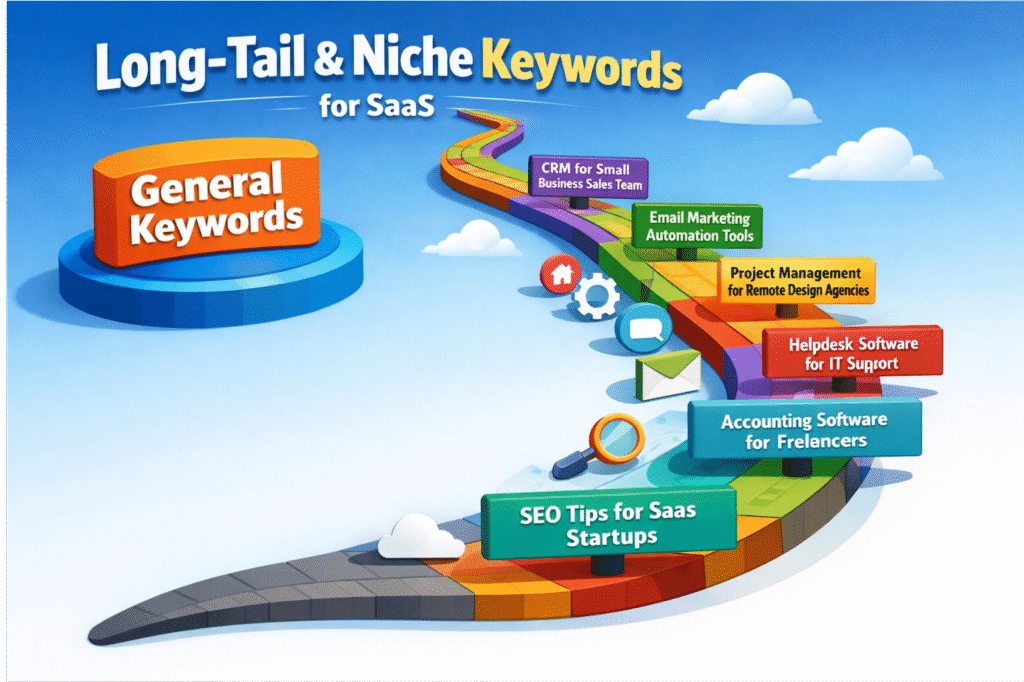
Long-tail keywords are the most underrated asset in SaaS SEO. They are specific, they signal strong intent, and they face dramatically lower competition than head terms. The math works in your favour at every level.
Instead of targeting ‘CRM software’ — a head term dominated by Salesforce, HubSpot, and Zoho with eight-figure SEO budgets — you target ‘CRM for small business sales team,’ ‘CRM with email automation under 30 dollars per month,’ or ‘CRM that integrates with Slack and Gmail.’ These queries are so specific that anyone searching them is already partially sold on the category. They are comparing solutions, not still deciding whether they need one.
How to Find Long-Tail SaaS Keywords
The most reliable source of long-tail SaaS keywords is not a keyword tool — it is your customers. Go where they talk honestly about their problems.
Reddit is the best free research tool available. Search r/saas, r/smallbusiness, r/sales, r/entrepreneur for your product category. Read the threads where people describe switching tools, evaluating options, or complaining about their current software. The exact phrases they use are long-tail keyword gold. People type on forums the same way they type in Google.
Quora works similarly. Search your product category and filter by recent. The questions people ask reveal solution-oriented queries you can build content around — and then answer in a way that positions your SaaS as the solution.
AnswerThePublic and AlsoAsked pull directly from Google’s autocomplete and ‘People Also Ask’ data. Run your seed keyword through both and export the question-based clusters. These are your long-tail targets and your FAQ schema content simultaneously.
Pain-point-based long-tail keywords often follow this pattern: ‘[product category] for [specific role],’ ‘[product category] without [specific limitation],’ ‘[product category] that [specific feature].’ Map your customer pain points to this formula and you will generate 20–30 high-intent long-tail keywords per product feature.
4. Competitor Keyword Analysis: Find the Gaps, Win the Traffic
Your SaaS competitors have already spent money testing what content ranks and converts. Competitor keyword analysis lets you use their investment as your research budget.
Step 1 — Pull Competitor Organic Keywords
In Ahrefs or Semrush, enter your top 3 competitors’ domains into the Site Explorer or Organic Research tool. Export their top 500 organic keywords. Filter for keywords ranking in positions 4 to 20 — this is your opportunity zone. They are getting traffic but have not fully optimized these pages. With better content, you can outrank them within 3 to 5 months.
Step 2 — Run a Content Gap Report
Ahrefs’ Content Gap tool (and Semrush’s Keyword Gap) lets you input your domain against 2 to 3 competitors and see every keyword they rank for that you do not. This list is your prioritized content calendar. Sort by traffic potential. Start with the highest-opportunity gaps that align with your product’s use cases and buyer stages.
Step 3 — Identify Thin Content Opportunities
Look at competitor pages ranking for keywords you want. If their page is under 800 words, lacks FAQ schema, has no data tables, and answers the query superficially — you can outrank it by publishing a more thorough, more current, and more structured version. Google rewards depth when it signals genuine expertise. A 2,000-word page with real data, entity-rich content, and proper schema consistently outranks a 600-word competitor page for the same keyword.
The content gap for seoportfolio.in right now is significant. Competitors have not covered AI search optimization for Perplexity and Gemini, have not published ROI-focused case studies for semantic SEO, and are using generic audit frameworks instead of niche-specific approaches for SaaS and startups. These are immediate traffic wins available without competing for head terms.
5. Tools & Techniques for Advanced SaaS Keyword Research
Ahrefs
Best for: keyword difficulty scoring, competitor organic keyword exports, content gap analysis, backlink profile evaluation. Use the Keywords Explorer to discover long-tail variations by filtering for questions and phrases. Set difficulty under 30 and minimum volume at 100 for SaaS niche targets. The Traffic Potential metric (not just search volume) shows you what a top-ranking page for that keyword actually earns — a more honest number than raw search volume.
Semrush
Best for: keyword position tracking, competitor ad keyword data (which shows commercial intent keywords worth targeting organically), and the Keyword Magic Tool for cluster discovery. Semrush’s intent filter — Informational, Navigational, Commercial, Transactional — saves hours of manual intent classification. Always run this filter before building your content plan.
Google Keyword Planner
Still useful for CPC data. In SaaS, a keyword with high CPC means advertisers are paying for clicks because those clicks convert. If a keyword has a CPC of 15 to 25 dollars, it is worth pursuing organically — you get the same buyer intent for free. Sort your keyword list by CPC descending to find your highest commercial-value targets.
AnswerThePublic & AlsoAsked
Visualize the full question landscape around any seed keyword. Run ‘CRM software,’ ‘project management tool,’ or your specific SaaS category. Export the question clusters and use them as H3 headings in your content — these are the exact queries Google pulls for ‘People Also Ask’ boxes and AI Overview answers. Answering them directly in your content is how you earn featured snippet positions and AI citations.
Reddit & Quora
Manual but irreplaceable. Set a 30-minute monthly research block. Search Reddit for your product category and sort by ‘Top’ of the past year. Read 10 to 15 threads. Copy exact user phrasing into a Google Doc. These phrases are your long-tail keywords in natural language — they are also the context signals Google’s NLP models recognize as genuine user language, which improves your content’s semantic alignment with real search queries.
Google Search Console
The most underused free tool available. Your GSC Queries report shows every keyword your site already appears for — including impressions with zero clicks. These are existing ranking seeds that need a stronger title tag, better meta description, or improved content to start converting. For seoportfolio.in, queries like ‘personal branding SEO,’ ‘SEO portfolio,’ and ‘latest SEO update 2026’ are already showing impressions — they need click-through rate optimization, not entirely new content.
Current Search Console Data — seoportfolio.in (Dec 2025)
Real GSC query data showing click-through opportunities and recommended actions:
| Top Search Query | Clicks | Impressions | Recommended Action |
| seo portfolio | 3 | 20 | Strengthen meta + title tag for CTR |
| “black box” “google analytics” | 0 | 11 | Create supporting blog targeting this query |
| latest seo update 2026 | 0 | 2 | Publish timely update article with schema |
| personal branding seo | 0 | 2 | Add internal link from portfolio hub |
| personal seo branding | 0 | 2 | Consolidate with ‘personal branding seo’ page |
| seo certification reddit | 0 | 2 | Create Reddit-optimized FAQ or community post |
| seo core update 2026 | 0 | 1 | Publish core update analysis blog post |
| seo for personal branding | 0 | 1 | Improve on-page semantic depth of portfolio page |
Intent Distribution (AI Chatbot Queries): Awareness 33% | Interest 27% | Consideration 20% | Purchase 20%. Strategy implication: publish more MOFU and BOFU content to convert existing awareness traffic.
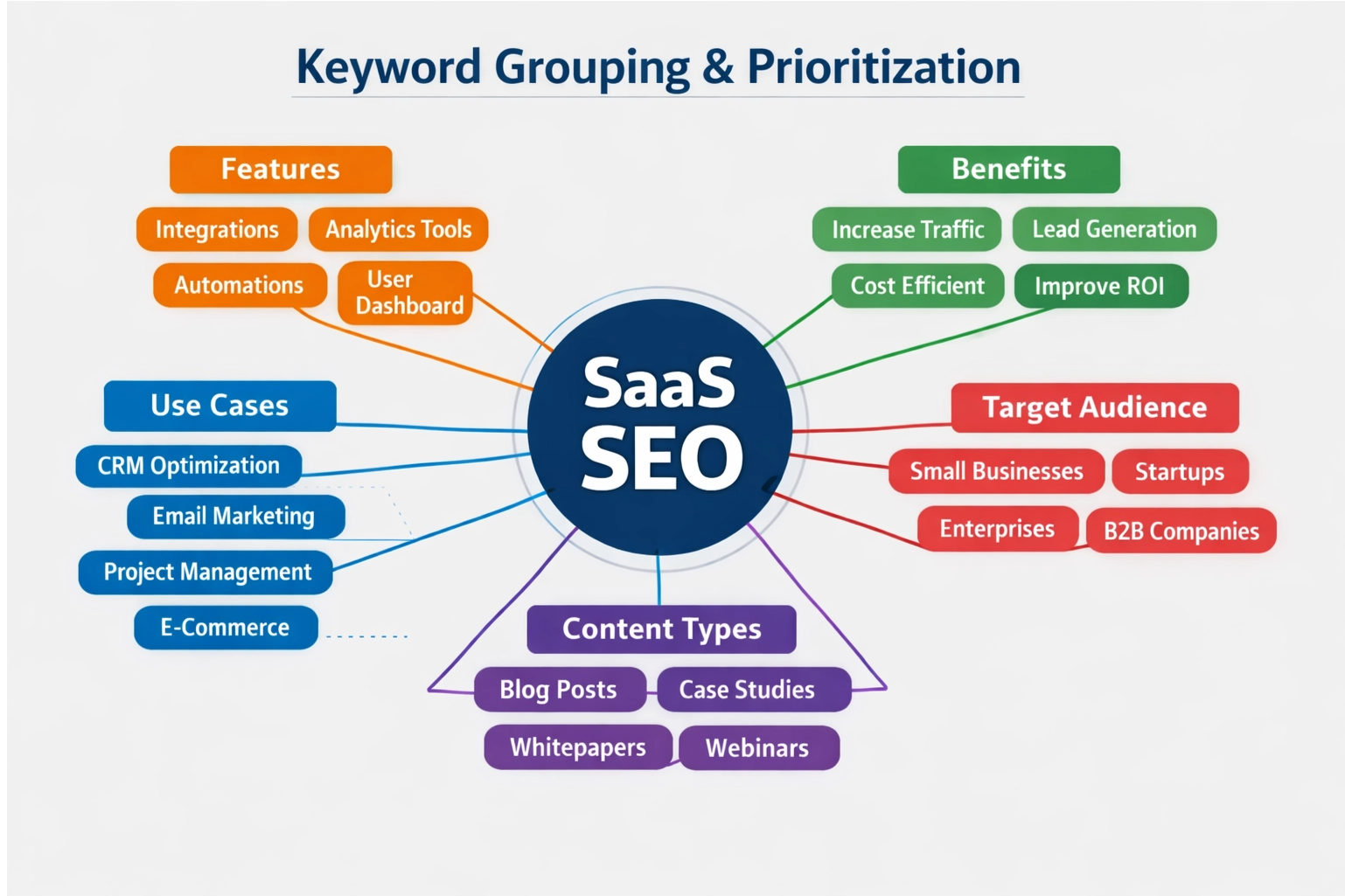
6. Keyword Grouping & Prioritization: From Raw List to Content Strategy
You have pulled hundreds of keywords. The worst thing you can do now is publish one page per keyword. That creates cannibalization, thin content, and a fragmented topical authority signal — the opposite of what Google rewards in 2026.
How to Group Keywords into Semantic Clusters
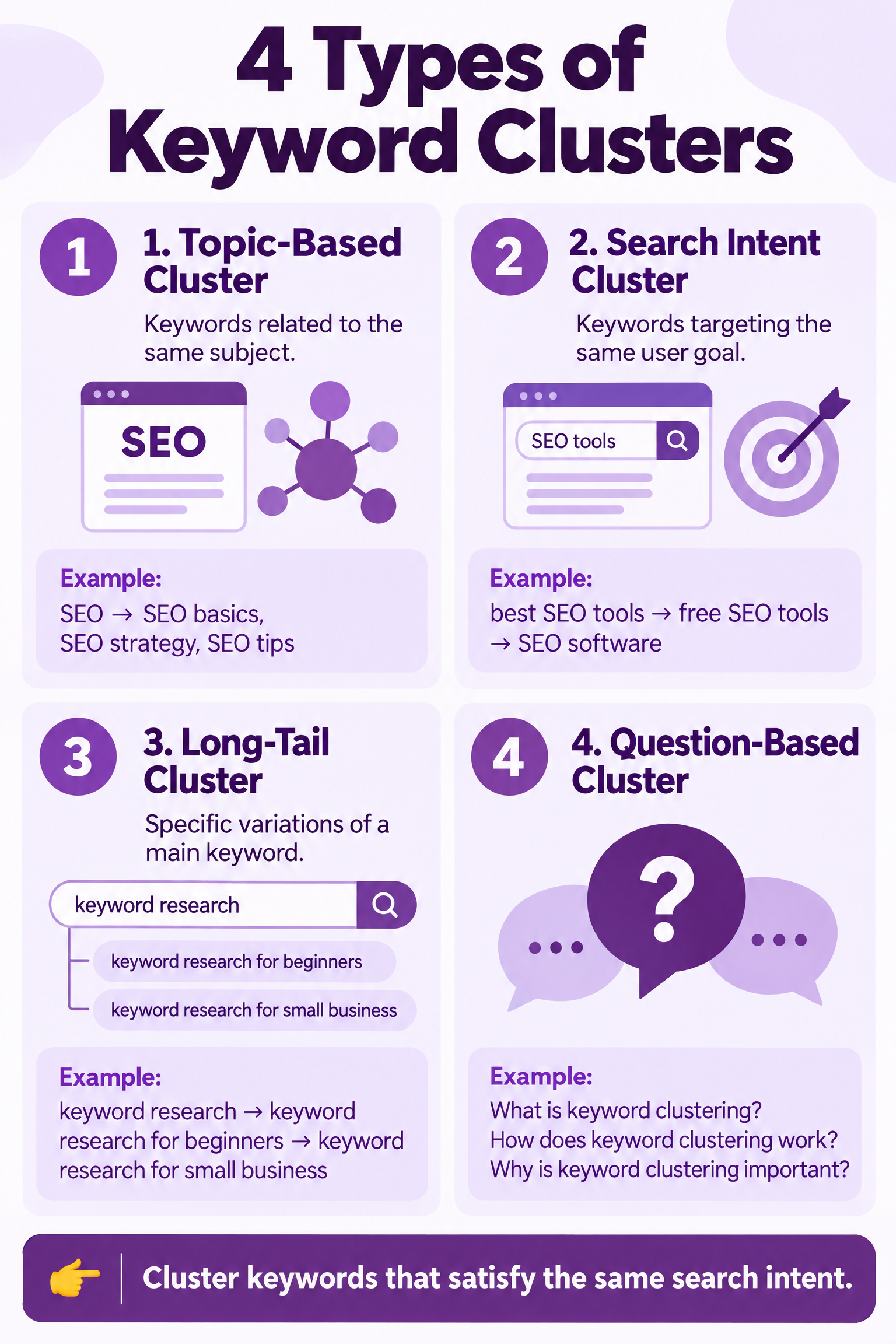
Group keywords by search intent and semantic similarity, not just by topic surface. ‘CRM for small business,’ ‘CRM software for startups,’ and ‘best CRM for small teams’ all target the same buyer with the same intent. They belong on one well-structured landing page — not three separate thin pages.
A practical grouping method: paste your keyword list into a spreadsheet. Add columns for Intent (Informational, Commercial, Transactional), Funnel Stage (TOFU, MOFU, BOFU), and Estimated Volume. Then manually group rows where the searcher intent is identical. Each group becomes one page.
How to Prioritize by Impact
Score each keyword group using three factors: Intent Score (Transactional = 3, Commercial = 2, Informational = 1), Traffic Potential (scaled 1 to 3 based on volume tier), and Competition Inverse (low difficulty = 3, high difficulty = 1). Add the scores. Highest total = first to publish.
This framework consistently surfaces the same result: low-competition, high-intent long-tail keywords outperform high-volume head terms for SaaS companies — especially in the first 12 months of an SEO campaign when domain authority is still building.
A realistic keyword clustering timeline for a new SaaS SEO campaign: Month 1 to 2, publish the pillar page targeting your core category keyword. Month 3 to 4, publish MOFU cluster pages — comparison, feature guides, use case pages. Month 5 to 6, publish BOFU niche pages — competitor alternatives, pricing comparison, specific role-based landing pages. By Month 6, topical authority across the full cluster compounds and all pages begin lifting each other’s rankings.

| Want a custom SaaS keyword research strategy built for your product? → seoportfolio.in/free-seo-audit/ |
FAQ — What SaaS Teams Search About Keyword Research
Why does traditional keyword research fail for SaaS companies?
Traditional keyword research focuses on search volume without accounting for buyer intent, funnel stage, or SaaS-specific purchasing behaviour. SaaS buyers move through a multi-stage research journey — from awareness to evaluation to decision — and each stage requires different keywords, different content, and different CTAs. Volume-first keyword research misses this entirely and drives traffic that never converts.
What is SaaS buyer intent in keyword research?
SaaS buyer intent refers to the stage of the purchasing journey reflected in a search query. Awareness queries (what is CRM software) need educational content. Consideration queries (best CRM for small business) need comparison and feature content. Decision queries (HubSpot free trial, Salesforce pricing) need transactional landing pages with clear CTAs. Mapping keywords to these intent tiers is the foundation of a SaaS keyword strategy that converts.
How do I find long-tail keywords for my SaaS product?
Use Reddit, Quora, AnswerThePublic, Google’s ‘People Also Ask,’ and your own customer support tickets. These sources surface real user language that captures specific pain points and use cases — the foundation of high-converting long-tail keywords. Then validate with Ahrefs or Semrush for volume and difficulty data before building content around them.
How often should I update my SaaS keyword research?
Run a full keyword research refresh every 6 months, and a lighter monthly review using Google Search Console. SaaS categories evolve fast — new competitors enter, new features become search trends, and Google algorithm updates shift what content ranks. A quarterly content gap analysis against your top 3 competitors keeps your strategy current.
What is keyword clustering and why does it matter for SaaS SEO?
Keyword clustering groups semantically related terms into single content topics rather than creating individual pages for each keyword. For SaaS, this means one comprehensive landing page covers ‘CRM for small business,’ ‘CRM for startups,’ and ‘affordable CRM software’ — all targeting the same buyer with related intent. This builds topical authority faster, prevents keyword cannibalization, and is how modern SEO aligns with Google’s entity-based ranking model.
Which keyword tool is best for SaaS keyword research in 2026?
Ahrefs for competitor analysis and content gap discovery. Semrush for intent filtering and position tracking. Google Search Console for existing opportunity identification. AnswerThePublic for question-based long-tail clusters. Reddit and Quora for authentic user language. No single tool is sufficient — a combined workflow across 3 to 4 sources produces the most complete keyword map.
Conclusion
Your SaaS company deserves a keyword strategy that actually maps to how buyers think — not just what a keyword tool spits out. At seoportfolio.in, the SaaS keyword research process covers full funnel mapping, long-tail discovery, competitor gap analysis, and semantic cluster building — all tied to measurable traffic and lead generation outcomes.
| → Get your custom SaaS keyword research strategy: seoportfolio.in/free-seo-audit/Focus Keyword: SaaS Keyword Research Strategy 2026 | Cluster: Keyword Research for SaaS |
Published: February 2026 | seoportfolio.in | Cluster 1 — SaaS SEO Content Hub | Updated post Google Core Update 2026

Sharing my journey and learnings in Tech and AI. As a Digital Marketing Expert, I help brands boost their visibility and sales with smart personal branding and the latest AI tricks.

Leave a Reply