|
Getting your Trinity Audio player ready… |
Table of Contents
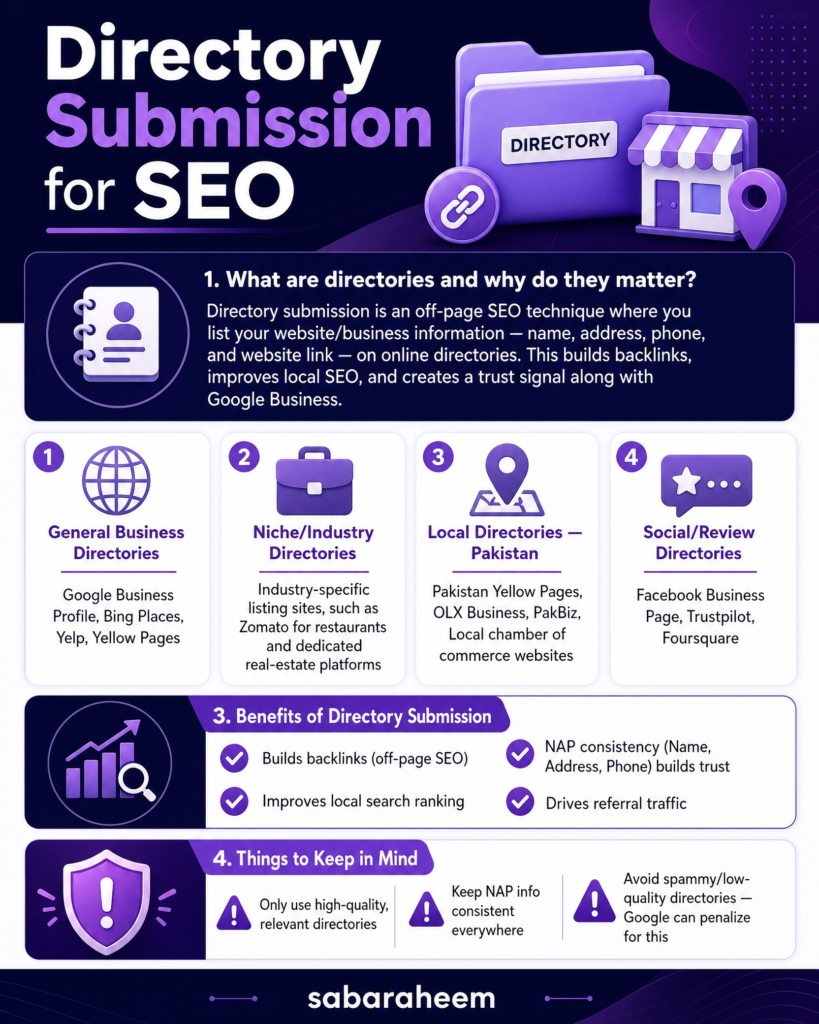
What Directory Submission Actually Is
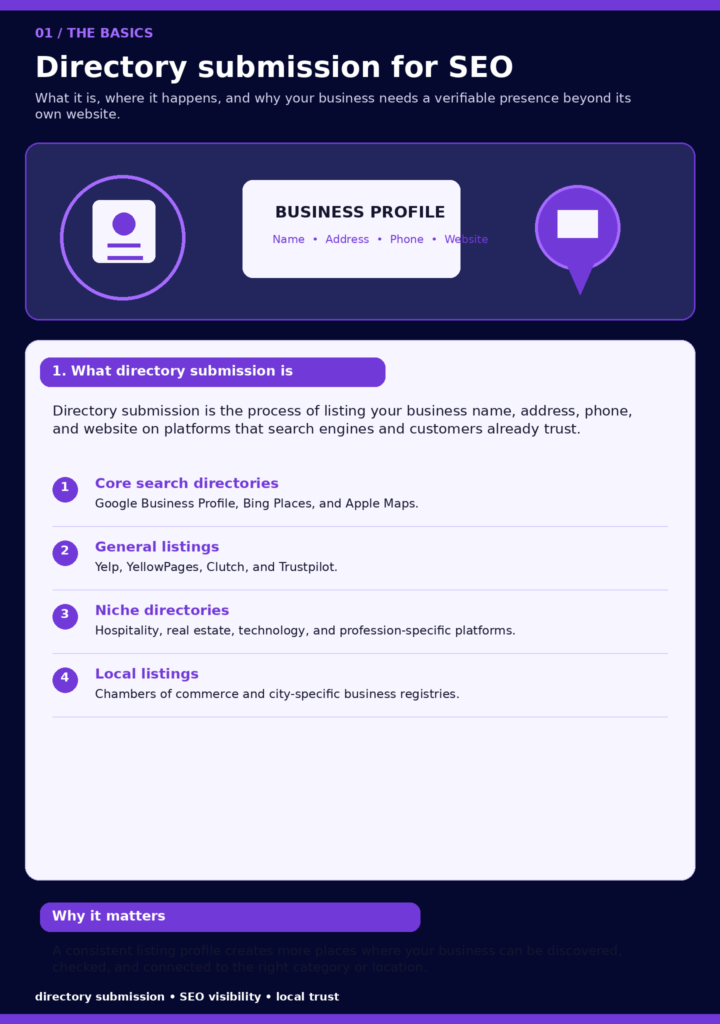
Stripped of the jargon: you list your business name, address, phone, and website on platforms search engines already trust. Google Business Profile. Yelp. Bing Places. Industry-specific directories. Local listings. Review platforms.
That’s it. That’s the whole mechanic.
But here’s why it matters more than it sounds.
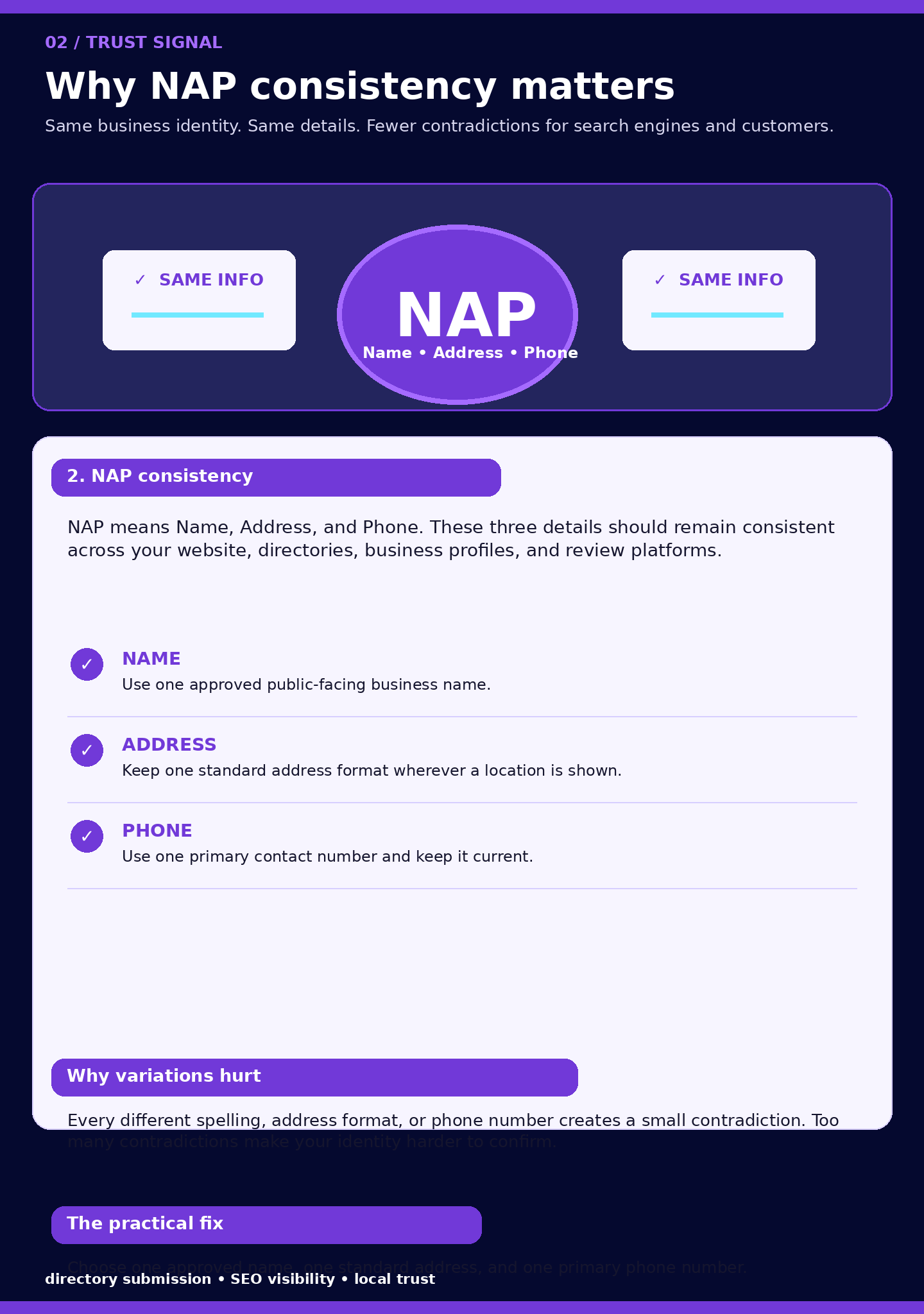
Google doesn’t just read your website. It cross-references your identity across the web. When your business information appears consistently — same name, same number, same address, everywhere — that consistency becomes a trust signal. A verification. Evidence that you exist in the real world, not just on a domain you registered last Tuesday.
NAP consistency. Name, Address, Phone. Three things. Identical everywhere.
Every variation is a small contradiction. Enough contradictions, and the algorithm simply can’t confirm who you are. Rankings suffer quietly. Local visibility disappears without explanation.
I see this constantly when auditing founder sites. Solid content. Decent backlinks. But the business barely exists outside its own pages. No citations. No directory presence. No structured signal telling search engines this brand is real, located somewhere, and trusted by other platforms.
The content is doing the work. The infrastructure isn’t backing it up. If you’re not sure where your own site stands on this, this breakdown of how SEO actually works is a good place to start.
Three Rules Before You Start Submitting
1. Quality Over Volume
One listing on Google Business Profile is worth more than forty on directories nobody visits. Prioritise platforms with real authority and real traffic — not a long list you can brag about.
2. Choose Relevant Niche Directories
A restaurant listed on a food-discovery platform. A real estate firm on a dedicated property site. Relevance amplifies the trust signal — Google reads “this business belongs in this category” faster when the surrounding directory agrees.
3. Avoid Low-Quality, Spammy Platforms
Bad directories don’t just fail to help. They can actively work against you. Google notices the company you keep, and a listing surrounded by link farms sends the opposite signal to the one you’re going for.
| Directory Type | Effort | Typical Value |
|---|---|---|
| Google Business Profile | Low | High — direct trust + local pack visibility |
| Niche/industry directory | Medium | High — relevance-based signal |
| General high-authority directory (Yelp, Bing Places) | Low | Medium-High — broad NAP verification |
| Mass/low-quality directory blasts | Low | Low to negative — risk outweighs benefit |
The Real Cost of Skipping This
The founders building compounding authority right now aren’t just publishing great content. They’re making sure the web can verify them. Directories are part of that verification layer — unglamorous, underused, and genuinely effective.
Your expertise deserves to be found. Make sure the infrastructure agrees. Want the fuller picture of how these pieces fit together? Visit SEO Portfolio for more.
FAQs
Does directory submission still help SEO in 2026? Yes, but selectively. It works as a trust and verification signal, not a volume game. A handful of relevant, high-authority listings outperform dozens of generic ones.
How many directories should I submit to? There’s no fixed number. Start with the platforms your customers actually use, plus core ones like Google Business Profile and Bing Places, then add niche directories relevant to your industry.
Can bad directory listings hurt my rankings? Yes. Low-quality or spammy directories can act as a negative association signal. It’s not usually a penalty — it’s more that they don’t build the trust you’re looking for, and in some cases undercut it.
What’s the difference between a citation and a backlink? A citation is a mention of your NAP data (name, address, phone) — it doesn’t always include a link. A backlink is a hyperlink to your site. Directories often provide both, which is part of why they’re valuable.
Why can’t customers find my business on Google? Usually it’s not a penalty — it’s absence. If your business isn’t listed consistently across Google Business Profile, directories, and other trusted platforms, Google has nothing to cross-verify you against, so it has no strong reason to surface you.
How do I get my business to show up in Google search results? Start with Google Business Profile and keep your NAP details identical everywhere. Then add a handful of relevant, high-authority directories and niche listings in your industry. Consistency across these builds the trust signal that pushes visibility.
My business has a website but doesn’t appear on Google — what’s wrong? A website alone isn’t proof of existence to Google. If there’s no directory presence, no citations, and no external platforms confirming who you are and where you’re located, the site can sit there indexed but still struggle to rank or show up locally.

Sharing my journey and learnings in Tech and AI. As a Digital Marketing Expert, I help brands boost their visibility and sales with smart personal branding and the latest AI tricks.

Leave a Reply