|
Getting your Trinity Audio player ready… |
Table of Contents
The SEO Mistake That’s Costing You 90% of Your Potential Traffic
You published a blog post for “best CRM software.” Then another one for “top CRM tools.” Then one for “CRM software for small business.” Then “affordable CRM platforms.” Then “CRM comparison 2026.”
Five separate pages. Five separate content investments. Five pages competing with each other in Google’s index — cannibalizing each other’s rankings, confusing Google about which one deserves to rank, and collectively performing worse than a single, well-structured cluster page would.
This is keyword fragmentation. And it’s the single most common SEO mistake that entrepreneurs, SaaS founders, and small business owners make when they finally start taking content seriously.
The solution — the strategy that the most visible websites in every niche are quietly using to rank for hundreds of keywords with a fraction of the content — is called keyword clustering.
And in 2026, with AI Overviews absorbing 84%+ of informational search traffic, keyword clustering isn’t just a smart tactic. It’s the only sustainable content strategy that survives the AI search era.
This guide will show you exactly what keyword clustering is, why it works at a technical and algorithmic level, and the complete step-by-step process to build clusters that rank for 100+ keywords — starting from scratch, using free and paid tools.
What Is Keyword Clustering? (The 60-Second Definition)
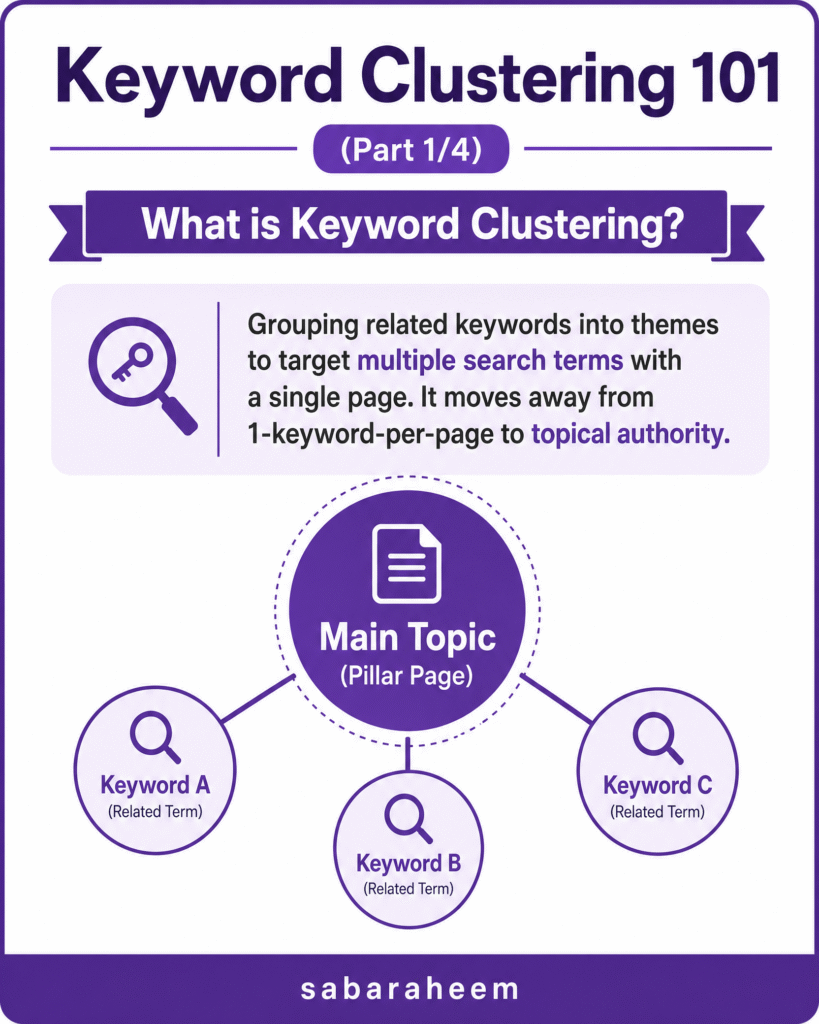
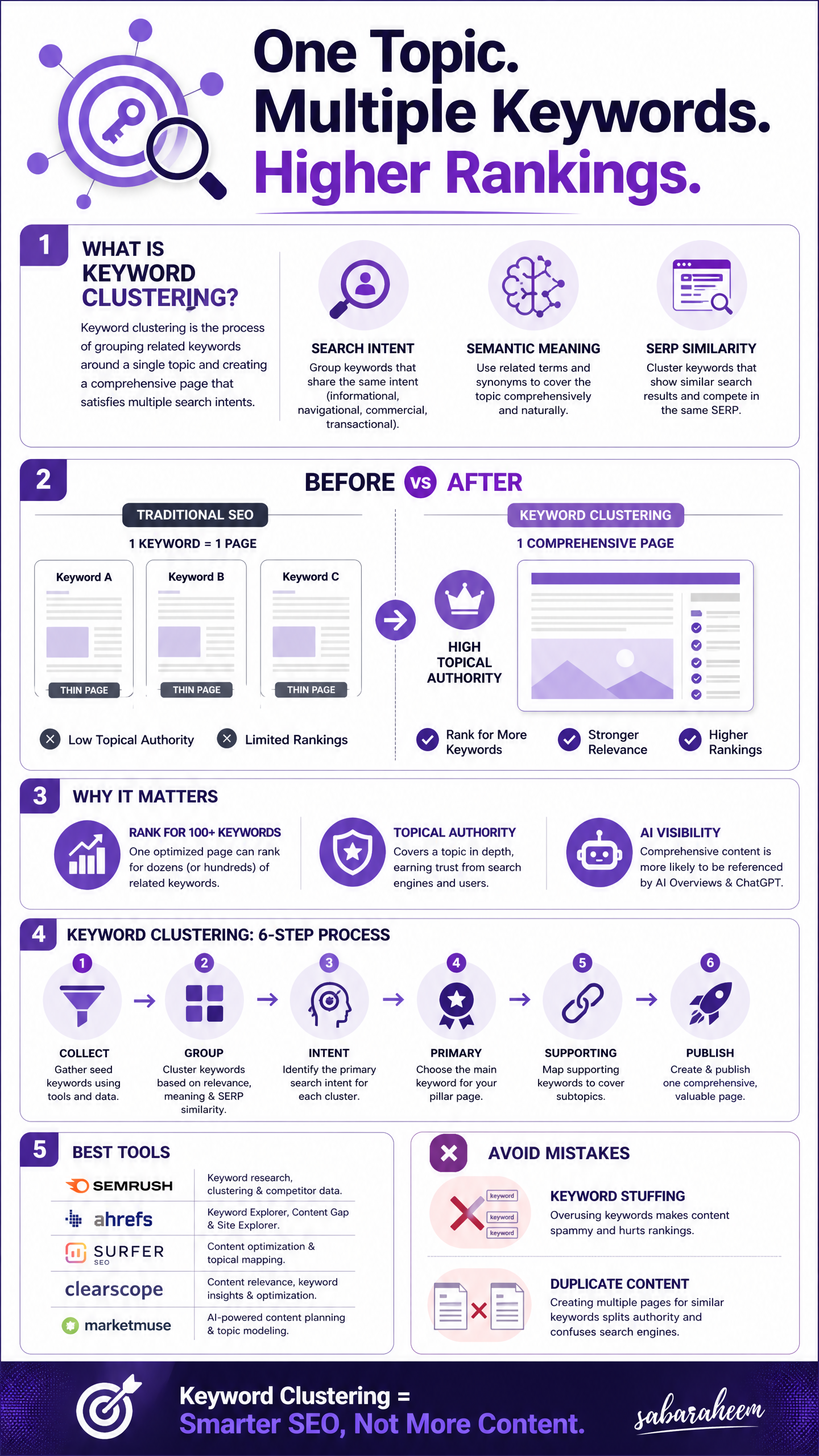
Keyword clustering is the process of grouping semantically related keywords together and mapping them to a single page — so that one piece of content can rank for dozens or hundreds of related search queries simultaneously.
Instead of: one keyword → one page → one ranking opportunity
Keyword clustering gives you: one page → one cluster of 50–200 keywords → 50–200 ranking opportunities
Google’s algorithm in 2026 evaluates pages for topical coverage, not just exact keyword match. A page that comprehensively covers a topic — answering every question, angle, and related search query a user might have — signals far stronger topical authority than a page optimized for a single keyword phrase.
This is why, as documented in the SaaS keyword research strategy for 2026, buyer intent mapping beats search volume targeting every time. Keyword clusters are the structural implementation of that principle.
Part I: Why Keyword Clustering Works — The Algorithm Science
Before the step-by-step process, you need to understand why clustering works. This isn’t just theory — it’s rooted in how Google’s natural language processing models actually evaluate content.
Google’s Semantic Understanding Has Changed Everything
Google no longer reads pages like a keyword scanner. It reads them like a subject matter expert. When Google crawls your page, it builds a semantic map of every concept, entity, question, and related term present in the content. It then evaluates whether your page demonstrates genuine expertise across the full topic — or just surface-level coverage of a single phrase.
A page that covers “CRM software,” “CRM tools comparison,” “CRM for small businesses,” “affordable CRM platforms,” and “CRM setup guide” in one comprehensive resource signals: this page understands the CRM topic deeply. Google rewards that signal with rankings across the entire topic cluster.
The Topical Authority Connection
Topical authority — the concept that a website should deeply cover one topic rather than superficially covering many — is the dominant ranking signal in 2026. As the topical authority strategy explained in the new SEO strategy guide makes clear: Google ranks websites, not just pages. A site that clusters its keyword coverage into comprehensive topic hubs earns domain-level authority that lifts every page — including new ones.
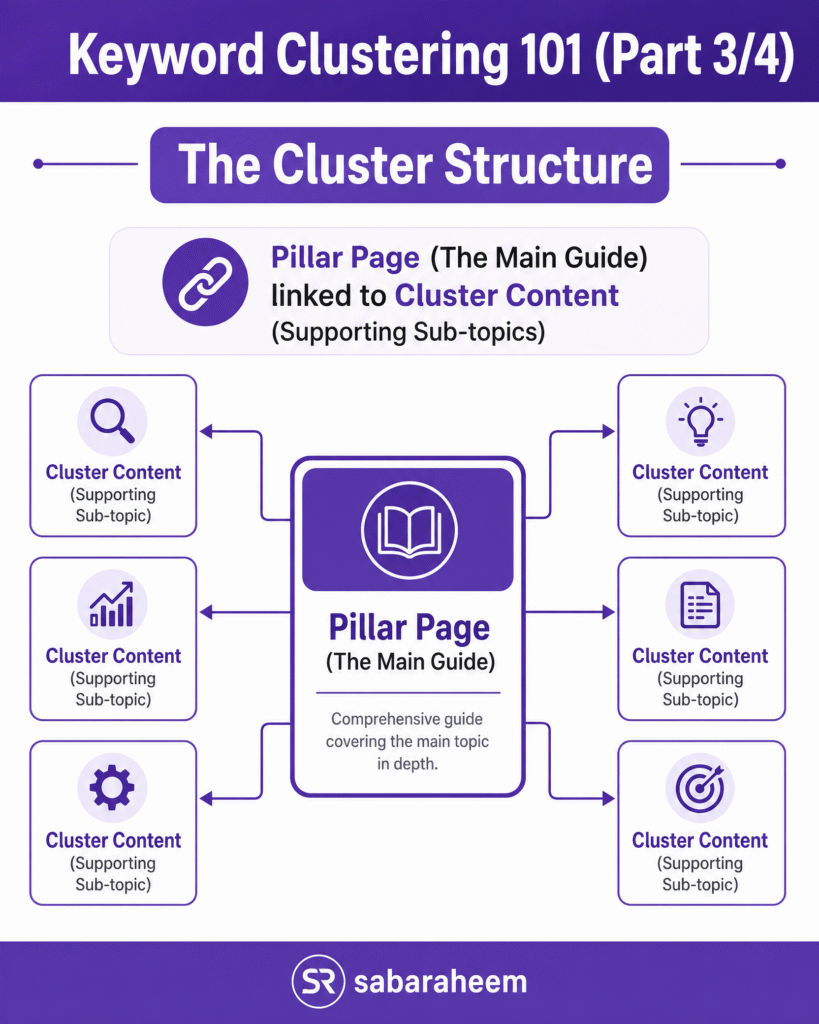
Keyword clusters are the building blocks of topical authority. Each cluster page becomes a “hub” in your content architecture, and Google rewards sites that build these hubs systematically.
Why This Matters for AI Overviews
AI Overviews pull from content that comprehensively answers the full spectrum of user intent around a query. A page that only answers one narrow question gets summarized once and dismissed. A page that answers the primary question and every related follow-up question gets cited repeatedly across multiple AI Overview responses.
This is the AI Overview multiplier effect of keyword clustering — and it’s why the analysis of Google AI Overviews and how they changed search citations consistently shows that comprehensive cluster pages outperform narrow keyword-targeted pages in AI visibility by a factor of 3–7x.
Part II: The 4 Types of Keyword Relationships You Need to Understand
Not all keywords belong together. Before building clusters, you need to understand the four types of keyword relationships — because grouping keywords incorrectly produces content that ranks for nothing.
Type 1: Exact Semantic Synonyms
These are different phrasings of the exact same search intent. They should always be in the same cluster and can often be addressed in the same paragraph.
Example: “keyword clustering,” “keyword grouping,” “keyword segmentation,” “semantic keyword grouping” — all mean the same thing to a user and to Google.
Type 2: Sub-Topic Keywords
These are related questions or angles that a user interested in your main topic would also want answered. They require dedicated sections within your cluster page.
Example: Main topic: “keyword clustering.” Sub-topics: “how to do keyword clustering,” “keyword clustering tools,” “keyword clustering for SaaS,” “keyword clustering vs topical authority.”
Type 3: Modifier Keywords
These are intent or qualifier variations — words like “best,” “free,” “2026,” “for beginners,” “for small business” — that modify the core keyword. They typically signal commercial or transactional intent and should be addressed in specific sections.
Example: “keyword clustering tool,” “best keyword clustering software,” “free keyword clustering method,” “keyword clustering for small business.”
Type 4: Adjacent Keywords (Separate Cluster)
These are related but distinct enough that they signal different user intent. They should be separate cluster pages, with internal links between them.
Example: “keyword clustering” and “keyword research” are adjacent — related, but a user searching “keyword research” has a different primary intent than one searching “keyword clustering.” These belong on separate pages, linked to each other.
Getting this distinction right is critical. The common SEO mistakes guide at seoportfolio.in documents keyword cannibalization — where pages compete against each other — as one of the most damaging and hardest-to-recover-from technical SEO errors. Keyword clustering prevents cannibalization by design.
Part III: The Step-by-Step Keyword Clustering Process
Here is the exact process. This is not a vague framework — it’s the operational workflow.
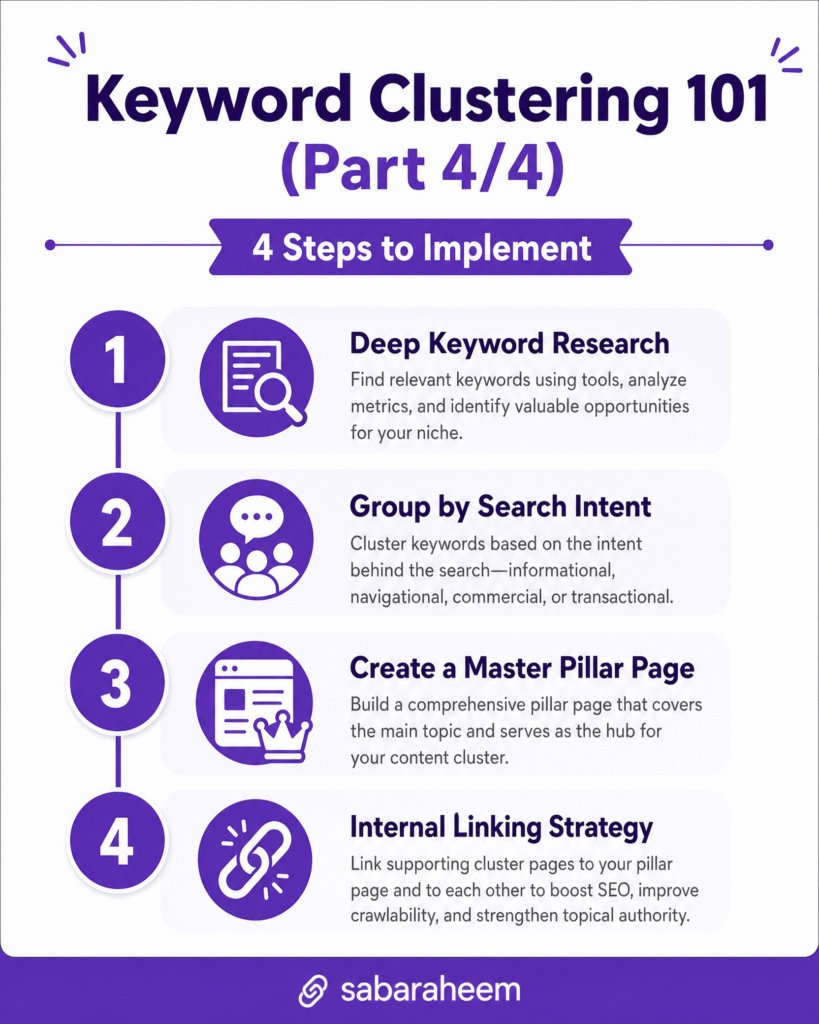
Step 1: Seed Keyword Extraction
Start with your topic. Not a specific keyword — a topic. “CRM software.” “Content marketing.” “Personal branding.” “Skincare for damaged skin.”
From that topic, extract 20–50 seed keywords using:
Free tools:
- Google Search autocomplete (type your topic and collect every suggestion)
- Google’s “People Also Ask” boxes (goldmine for sub-topic keywords)
- Google’s “Related Searches” at the bottom of results pages
- AnswerThePublic (free tier) — generates question-format keywords
Paid tools:
- Ahrefs: Keywords Explorer → “Having same terms” filter
- Semrush: Keyword Magic Tool → “Broad Match” with your seed term
- Google Search Console: existing queries your site already gets impressions for (often reveals cluster opportunities you didn’t know existed)
At this stage, quantity matters. Capture every keyword. You’ll filter and group later.
Step 2: SERP Similarity Analysis — The Clustering Test
This is the most important step and the one most keyword clustering guides skip entirely.
The fundamental rule of keyword clustering: two keywords belong in the same cluster if and only if they return substantially the same results in Google.
Why? Because if Google shows different pages for two keywords, it has determined they represent different user intents — and you need different pages to match those intents.
How to test SERP similarity:
Manual method (free, time-intensive): Search each keyword and note the top 3 results. If 2 of the top 3 URLs are identical between two keywords, they belong in the same cluster.
Automated method (paid): Tools like Ahrefs’ keyword clustering feature, Semrush’s Keyword Strategy Builder, or Keyword Insights automatically group keywords by SERP overlap at scale.
Practical example:
- “keyword clustering” → top 3: Ahrefs, Semrush, Backlinko
- “keyword grouping” → top 3: Ahrefs, Semrush, Search Engine Journal
- “keyword segmentation” → top 3: completely different analytics pages
Result: “keyword clustering” and “keyword grouping” belong together. “Keyword segmentation” is a separate cluster (it has different search intent — analytics users, not SEO users).
This is the same buyer intent mapping principle that separates keywords worth targeting from keywords that sound relevant but serve completely different audiences.
Step 3: Cluster Building — Assign Keywords to Groups
After SERP analysis, organize your keywords into clusters. Each cluster needs:
One primary keyword — the highest-volume, most directly relevant keyword that represents the cluster’s core topic. This becomes your page title and primary H1.
3–10 secondary keywords — related keywords with the same SERP overlap that will be addressed within dedicated H2 or H3 sections.
10–50 long-tail keywords — specific question-format and modifier keywords that will be naturally answered within the body content, FAQ section, and supporting paragraphs.
The 100-keyword cluster structure:
| Layer | Keyword Type | Count | Placement |
|---|---|---|---|
| Primary | Exact focus keyword | 1 | H1, meta title, first paragraph |
| Secondary | SERP-similar variations | 5–10 | H2 headings, section focuses |
| Sub-topic | Related questions | 10–20 | H3 subheadings, dedicated paragraphs |
| Long-tail | Modifier + question variants | 30–50 | Body text, FAQ, tables |
| Semantic | LSI / entity terms | 20–30 | Natural usage throughout |
| Total | 66–111 | One comprehensive page |
Step 4: Content Architecture — Building the Cluster Page
Now structure your content to systematically address every keyword layer.
The cluster page architecture:
Opening section (AI Overview optimized): Answer the primary keyword question directly in 40–60 words. This is the paragraph Google pulls for AI Overview citations. It must be complete, accurate, and standalone.
H2 sections (secondary keyword coverage): Each major H2 should be built around a secondary cluster keyword. Every H2 section is effectively a mini-article addressing that keyword’s specific user intent.
H3 subsections (sub-topic keyword coverage): Use H3s to address specific sub-questions within each H2. This is where your long-tail keywords get natural coverage.
Data tables: Google loves tables for comparative queries (“best X for Y,” “X vs Y,” “X pricing”). Include at least one comprehensive table in every cluster page — it dramatically increases the likelihood of table featured snippets.
FAQ section: Address 8–12 specific question-format keywords directly. Structure each FAQ as a direct question → direct answer → supporting detail. This is the most reliable featured snippet format in 2026, as documented in the mastering modern search: SEO, AEO, and GEO strategies guide.
Step 5: Internal Linking Architecture — The Cluster Hub Model
A standalone cluster page is powerful. A cluster page embedded in a proper internal linking structure is exponentially more powerful.
The hub-and-spoke internal linking model:
Your cluster page is the “hub.” Every related piece of content on your site is a “spoke” that links to and from it.
Every spoke article (supporting blog post) links to the hub cluster page using varied anchor text that naturally includes cluster keywords. The hub cluster page links to each spoke article, creating a closed topical authority loop that tells Google: this site owns this topic.
This is the same architecture that makes topical authority the dominant ranking mechanism in 2026 — and keyword clusters are its foundation.
For SaaS companies specifically, the SaaS content marketing funnel framework maps this cluster architecture directly to TOFU/MOFU/BOFU content stages — ensuring your keyword clusters don’t just rank but convert.
Part IV: Keyword Clustering for AI Search — The 2026 Update
Traditional keyword clustering was built for Google’s blue-link results. In 2026, you need to cluster for AI Overviews, Google AI Mode, ChatGPT Search, and Perplexity simultaneously.
The good news: the same cluster pages that rank in traditional search also perform best in AI search — because comprehensiveness is what both systems reward. The difference is in how you structure content for AI citation.
The AI Clustering Signals
AI search systems specifically look for:
Named authority: Content attributed to a named expert with verifiable credentials. Anonymous “SEO tips” articles rank in neither Google nor AI systems in 2026. Named, attributed expertise does.
Specific data points: AI Overviews prefer citing content with specific numbers, dates, percentages, and case study results — over general claims. Every cluster page should include measurable data in each major section.
Direct answer density: AI systems pull from content that provides direct, extractable answers — not content that buries answers in paragraphs of preamble. Every H2 section should open with a direct 1–2 sentence answer before expanding.
Entity clarity: Schema markup (especially FAQPage, HowTo, and Article schema) dramatically increases the likelihood of AI citation and featured snippet inclusion. As the schema markup guide for local business ranking documents, structured data is no longer optional — it’s the difference between being cited and being ignored.
How to Track Your Cluster Performance in AI Search
After publishing your cluster page, track its AI visibility weekly:
- Query your primary cluster keyword in Google AI Mode, ChatGPT Search, and Perplexity
- Note whether your content is cited or whether a competitor’s is
- Track brand name mentions inside AI answers (brand citation ≠ URL citation — both matter)
- Monitor Google Search Console for impressions growth across your full cluster keyword list
The complete guide to tracking brand visibility in AI Mode provides the exact dashboard, tools, and weekly tracking protocol for measuring your cluster’s AI search performance alongside traditional rankings.
For LLM-specific optimization — how to make your cluster pages rank inside ChatGPT, Claude, Gemini, and Perplexity responses — the LLM SEO best practices 2026 guide covers the 12 specific content signals these models use when selecting sources to cite.
Part V: Keyword Clustering Tools — Free vs Paid Comparison
| Tool | Clustering Method | Best For | Price |
|---|---|---|---|
| Google Search Console | Manual SERP overlap (impressions data) | Existing keyword discovery | Free |
| AnswerThePublic | Question-format keyword generation | Sub-topic and FAQ keyword mining | Free (limited) / $99/month |
| Ahrefs Keyword Clustering | Automated SERP similarity grouping | Full-scale cluster builds (100+ keywords) | From $129/month |
| Semrush Keyword Strategy Builder | Intent-based clustering with pillar page mapping | Content strategy planning | From $139/month |
| Keyword Insights | AI-powered clustering + content briefs | Agencies and high-volume content operations | From $58/month |
| ChatGPT / Claude | Manual semantic grouping assistance | Quick cluster brainstorming for small sites | Free / subscription |
| Google Sheets + VLOOKUP | Manual SERP overlap tracking | Budget-conscious small businesses | Free |
For most businesses starting with keyword clustering, the recommended progression is: Google Search Console (free) → AnswerThePublic (free tier) → Ahrefs or Semrush (paid, once revenue justifies it).
As covered in the best AI SEO certifications and tools guide for 2026, the tools that combine traditional keyword data with AI search visibility tracking are the most valuable investment in 2026’s dual-algorithm environment.
Part VI: Keyword Clustering for Different Business Types
Keyword Clustering for SaaS Companies
SaaS keyword clusters should map to the buyer journey — TOFU clusters for awareness keywords, MOFU clusters for comparison and evaluation keywords, and BOFU clusters for high-intent trial/demo keywords. The SaaS keyword research strategy guide provides the full SaaS-specific keyword intent framework that underpins effective SaaS cluster building.
SaaS cluster example structure:
- TOFU hub: “What is [your category]?” + 40 informational cluster keywords
- MOFU hub: “[Category] comparison” + 30 evaluation cluster keywords
- BOFU hub: “[Your product] pricing/trial/demo” + 20 transactional cluster keywords
Keyword Clustering for Local Businesses
Local businesses need geo-modified clusters. Instead of one cluster for “plumber,” build separate clusters for “plumber in [city],” “emergency plumber [city],” and “plumber near me” — because these have different SERP results (different local intent signals).
Every local cluster page needs schema markup to signal local business context. The schema markup guide for local businesses documents the exact LocalBusiness schema fields that increase both traditional ranking and AI Overview inclusion for local queries.
Pair this with a correctly optimized Google Business Profile — as the Google Maps ranking guide explains, local cluster content and GBP optimization work synergistically to dominate both the map pack and organic results for local searches.
Keyword Clustering for Personal Brands and Coaches
Personal brand keyword clusters should center on your named expertise — “personal branding strategist,” “SEO consultant for coaches,” “[your name] SEO services” — and build outward to the questions your ideal clients ask before they discover you.
The personal brand SEO strategy framework demonstrates precisely how experience-led content anchors your cluster pages in E-E-A-T signals that generic keyword content cannot replicate. For entrepreneurs and coaches, the cluster hub page is where your story meets your keyword strategy — and that combination is what AI search systems preferentially cite.
Keyword Clustering for E-Commerce
E-commerce clusters should organize around product categories, not individual products. A cluster for “running shoes for flat feet” covers: best running shoes flat feet, flat foot running shoe review, motion control running shoes, stability running shoes for overpronation — all in one comprehensive category page with individual product links.
Part VII: Real Keyword Cluster Example — Complete Walkthrough
Let’s build a real cluster from scratch for the keyword: “personal branding for entrepreneurs”
Step 1: Seed Keywords Collected (20 examples)
personal branding for entrepreneurs, personal branding strategy, how to build a personal brand, personal brand online presence, entrepreneur personal brand tips, personal branding social media, LinkedIn personal branding, personal brand content strategy, why personal branding matters, personal brand vs company brand, personal branding mistakes, how long does personal branding take, personal branding for coaches, personal branding for consultants, personal branding SEO, online personal brand visibility, personal brand story, personal brand positioning, executive personal branding, affordable personal branding services
Step 2: SERP Similarity Grouping
After SERP overlap analysis, these group into 3 clusters:
Cluster A — “Personal Branding Strategy” hub (same SERP results):
personal branding for entrepreneurs, personal branding strategy, how to build a personal brand, why personal branding matters, personal brand positioning, personal brand story, entrepreneur personal brand tips
Cluster B — “Personal Branding on LinkedIn” hub (different SERP results — LinkedIn-specific):
LinkedIn personal branding, LinkedIn personal brand strategy, LinkedIn profile optimization, LinkedIn thought leadership
Cluster C — “Personal Branding Services” hub (transactional SERP results):
personal branding services, affordable personal branding services, online personal branding expert, executive personal branding
Step 3: Cluster A Page Architecture
H1: Personal Branding for Entrepreneurs: The Complete 2026 Strategy Guide
Direct answer paragraph (AI Overview optimized): Personal branding for entrepreneurs is the deliberate process of establishing a distinctive professional identity online — through consistent content, documented expertise, and strategic visibility — that builds trust before a sales conversation begins.
H2: Why Personal Branding Matters for Entrepreneurs in 2026 (covers: why personal branding matters, personal brand vs company brand)
H2: How to Build a Personal Brand from Scratch (covers: how to build a personal brand, personal brand positioning, personal brand story)
H2: Personal Brand Content Strategy (covers: personal brand content strategy, personal branding social media, personal brand online presence)
H2: Personal Branding Mistakes to Avoid (covers: personal branding mistakes, how long does personal branding take)
H2: Personal Branding for Specific Niches (covers: personal branding for coaches, personal branding for consultants, entrepreneur personal brand tips)
H2: Personal Branding and SEO (covers: personal branding SEO, online personal brand visibility)
FAQ section: 8 direct questions covering all remaining long-tail cluster keywords
Internal links: → Cluster B (LinkedIn Personal Branding), → Cluster C (Personal Branding Services), → seoportfolio.in/personal-branding/
Result: One page. 20+ keywords covered. 3 featured snippet opportunities. Multiple AI Overview citation opportunities.
Part VIII: Keyword Clustering Mistakes to Avoid
Mistake 1: Clustering keywords with different intent
“Personal branding strategy” (informational) and “personal branding services pricing” (transactional) have different user intent — they belong in different clusters regardless of topic similarity. Check SERP results, not just semantic similarity.
Mistake 2: Building clusters before topical authority exists
A cluster page on a brand-new domain with zero authority will not rank for 100 keywords — it will rank for none. Build your site’s domain authority through link building strategies before expecting cluster pages to perform at scale.
Mistake 3: Ignoring the AI Overview optimization layer
Cluster pages optimized only for traditional ranking miss the AI citation opportunity. Every cluster page needs a direct answer paragraph, FAQ schema, and HowTo schema where applicable — or it remains invisible in AI search results. The 2026 SEO changes and AI-first ranking strategies guide details exactly what the AI-first layer requires on top of traditional cluster optimization.
Mistake 4: Building clusters without internal linking
An isolated cluster page gets a fraction of the authority benefit of a networked cluster page. Internal linking is what transforms individual cluster pages into a topical authority architecture. Every cluster page must link to related cluster pages and receive links from supporting spoke content.
Mistake 5: Keyword stuffing inside clusters
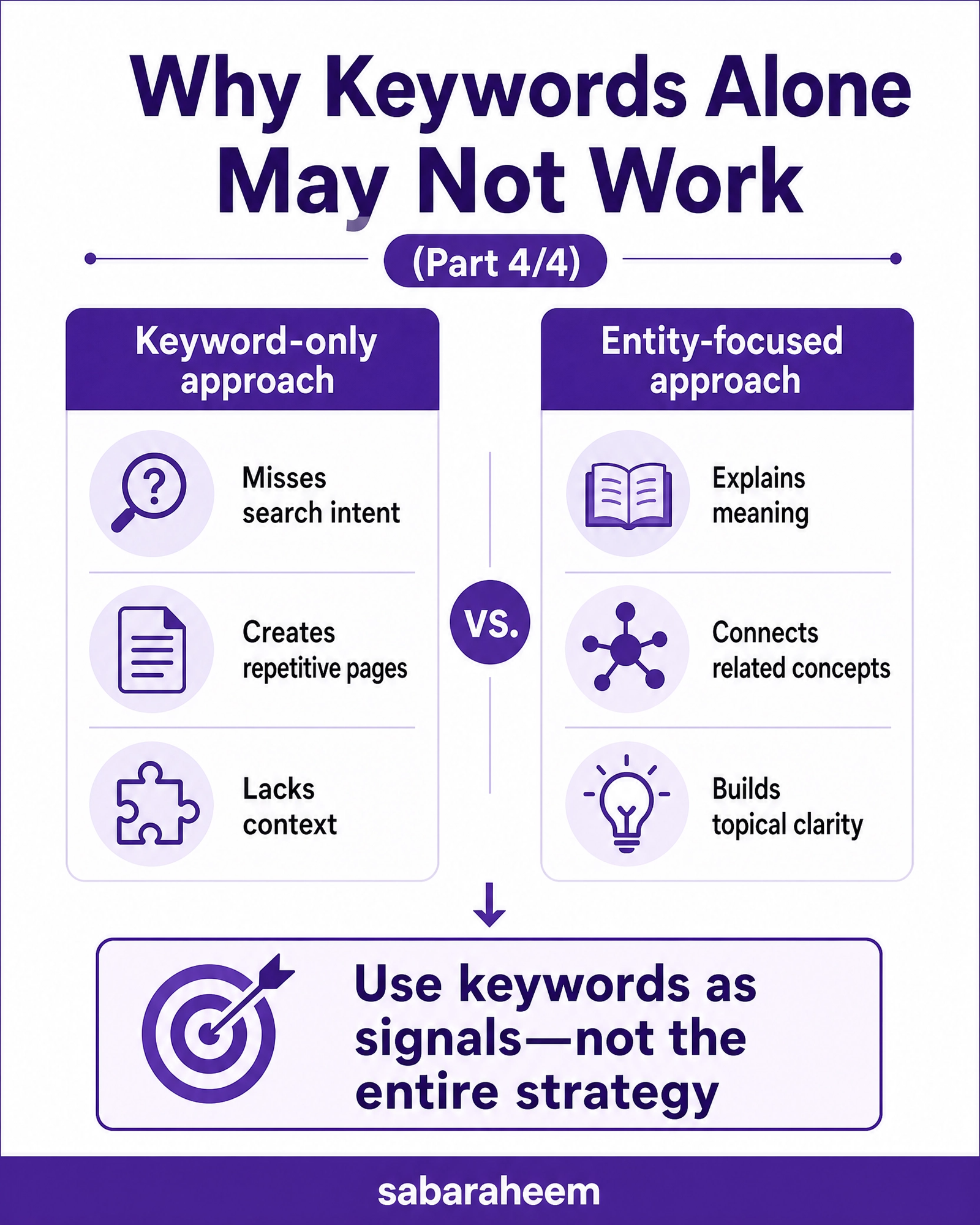
A cluster page addresses many keywords — but naturally, through comprehensive coverage. Keyword stuffing (repeating exact phrases unnaturally) triggers spam signals in 2026’s algorithm. The entity SEO guide explains why Google now evaluates topic coverage through entity recognition, not keyword frequency — use your cluster keywords naturally as part of expert-level explanations.
Mistake 6: Not tracking ranking spread across the full cluster
Most businesses track their primary keyword ranking and miss the fact that their cluster page is quietly ranking for 47 other keywords. Set up Search Console to track all impressions for a cluster page — not just the single keyword you optimized for. This is where the real ROI of clustering becomes visible.
Part IX: Your 30-Day Keyword Clustering Action Plan
Week 1: Research and Clustering
- Export all existing Google Search Console queries for your site
- Identify 3 topics where your site already has impressions but low click-through rate
- Run SERP similarity analysis on those keywords using free tools
- Group into preliminary clusters of 20–50 keywords each
Week 2: Architecture and Writing
- Build the complete content architecture for your first cluster page
- Write the direct answer paragraph and all H2 sections
- Create the FAQ section targeting 8–12 long-tail cluster keywords
- Add relevant data, tables, and case study references
Week 3: Technical Optimization
- Add FAQPage schema and Article schema (use Google’s Schema Markup Helper)
- Implement internal links to and from 3–5 existing pages
- Optimize meta title and description for primary cluster keyword
- Submit URL to Google Search Console for indexing
Week 4: Tracking Setup
- Create a Google Search Console filter for the cluster page
- Set up weekly tracking of impressions across all cluster keywords
- Manually test AI Overview citation in Google AI Mode and Perplexity
- Begin building spoke content that links to the cluster hub
Need help with keyword research and cluster architecture? Start with a free SEO audit at seoportfolio.in — get a detailed analysis of your site’s current keyword coverage gaps and a clear roadmap for your first cluster pages.
Frequently Asked Questions
What is keyword clustering in SEO?
Keyword clustering is the process of grouping semantically related keywords together and mapping them to a single comprehensive page, allowing that page to rank for dozens or hundreds of related search queries simultaneously. Instead of creating one page per keyword, clustering creates one authoritative hub page per topic cluster.
How many keywords should be in one cluster?
A typical keyword cluster contains 20–100 keywords, depending on topic breadth. A primary keyword (1), secondary keywords (5–10 with SERP overlap), sub-topic keywords (10–20), long-tail variations (20–50), and semantic/LSI terms (10–30). The upper limit is determined by user intent consistency — if keywords start returning different SERPs, they belong in separate clusters.
What’s the difference between keyword clustering and topical authority?
Keyword clustering is the tactical implementation of topical authority. Topical authority is the site-level signal Google uses to evaluate expertise in a niche. Keyword clusters are the individual page-level building blocks that, when networked through internal linking, create topical authority at the domain level. As explored in the entity SEO guide, topical authority is now evaluated through entity recognition — and keyword clusters built around entities outperform those built around keyword strings alone.
How long does it take to rank with keyword clustering?
A cluster page on an established domain with existing authority typically begins ranking within 4–12 weeks. A cluster page on a new or low-authority domain may take 6–12 months, regardless of content quality. During that waiting period, parasite SEO strategy on high-authority platforms allows you to rank for cluster keywords immediately while your own domain authority builds.
Does keyword clustering work for AI Overviews?
Yes — and cluster pages actually outperform narrow keyword-targeted pages in AI Overviews, because AI systems prefer comprehensive, authoritative sources that answer multiple related questions in one place. Combined with FAQ schema and direct answer formatting at the top of each section, cluster pages are the content format most likely to earn AI Overview citations. Track your cluster page’s AI visibility using the AI Mode brand tracking guide.
What tools are best for keyword clustering?
For free clustering: Google Search Console (existing query data) + manual SERP overlap testing. For paid clustering: Ahrefs Keyword Clustering, Semrush Keyword Strategy Builder, or Keyword Insights. For AI-assisted brainstorming: ChatGPT or Claude to identify semantic relationships between keywords before SERP testing. See the best AI SEO tools guide for 2026 for the complete tool stack.
Can small businesses do keyword clustering without paid tools?
Absolutely. The SERP overlap method requires only a browser. Google Search Console provides free query data. AnswerThePublic’s free tier generates sub-topic keywords. Google autocomplete reveals semantic variants. The free method is slower than automated tools — but the clustering principles are identical. A small business with one quality cluster page consistently outranks a competitor with ten thin, fragmented keyword pages.
How does keyword clustering prevent keyword cannibalization?
By deliberately assigning each keyword to exactly one page, clustering eliminates the scenario where multiple pages compete for the same query. Before clustering, you know which page owns which keywords. After clustering, Google has a clear answer to “which page should rank for this search?” — which is the core problem that cannibalization creates. The common SEO mistakes guide covers keyword cannibalization diagnosis and recovery in detail.
Conclusion: One Page. 100 Rankings. That’s the Cluster Advantage.
Every hour you spend creating thin, single-keyword pages is an hour you’re not spending building the cluster pages that compound in authority, coverage, and AI visibility over time.
The businesses dominating search results in 2026 — in every niche, at every budget level — share one characteristic: they understand that Google rewards depth over breadth, comprehensiveness over frequency, and topical authority over keyword stuffing.
Keyword clustering is how you operationalize that understanding. It’s how a single well-built page ranks for 100+ keywords. It’s how a website with 20 cluster pages outranks a website with 200 thin pages. It’s how your content earns AI Overview citations instead of being absorbed by them.
Start with one cluster. Build it properly. Watch what happens to your Search Console impressions over 90 days. Then build the next one.
Ready to identify your best keyword cluster opportunities? Get a free SEO audit at seoportfolio.in — a detailed analysis of your site’s current topical coverage gaps, keyword cannibalization issues, and the exact cluster pages that would deliver the highest ranking ROI for your specific niche.

Sharing my journey and learnings in Tech and AI. As a Digital Marketing Expert, I help brands boost their visibility and sales with smart personal branding and the latest AI tricks.

Leave a Reply