|
Getting your Trinity Audio player ready… |
If your SaaS content is getting traffic but not conversions, the problem isn’t your writing — it’s your funnel. A SaaS content marketing funnel maps every piece of content to a specific stage of the buyer journey, from the moment someone Googles their problem to the moment they hit “Start Free Trial.” Without that map, you’re publishing into a void.
In 2026, with Google’s AI Overview capturing 40%+ of informational queries and ChatGPT answering product-specific questions directly, SaaS companies that don’t align content to funnel stages are invisible. This guide fixes that.
The Problem: Why SaaS Content Fails to Convert
Most SaaS teams produce content. Very few produce funnel content. There’s a big difference.
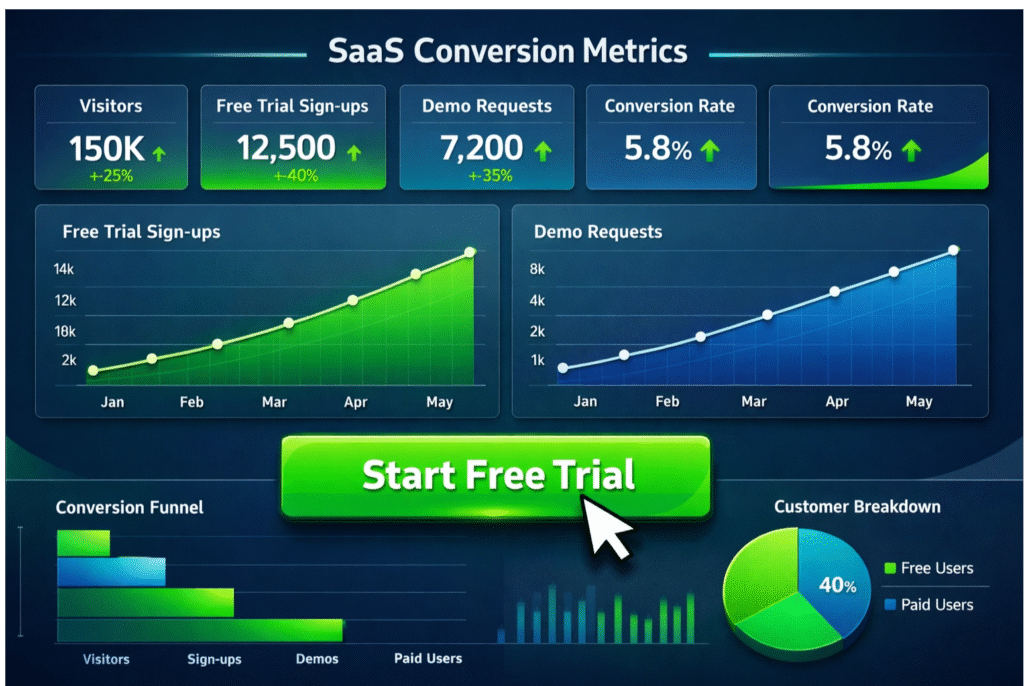
You’ll find SaaS blogs full of articles targeting high-volume keywords — “what is CRM software,” “best project management tools,” “how to improve team productivity.” These posts get clicks. Sometimes thousands of clicks. But check the conversion data and the numbers go quiet.
The reason? Awareness-stage content attracts awareness-stage readers — people who aren’t ready to buy. When every blog post leads nowhere, visitors browse and leave. Bounce rate climbs. CAC stays high. Content team wonders why ROI is always questioned.
If you’ve been making these exact mistakes, you’re not alone. See the most common SEO mistakes US businesses make in 2026 — many of them are funnel problems in disguise.
Why This Is Getting Worse in the AI Era
Here’s the uncomfortable reality: Google’s AI Overview now answers generic informational queries before users even reach your site. According to BrightEdge research, AI Overviews appear for over 84% of search queries in some niches as of 2025.
SaaS companies that rely purely on top-of-funnel blogging are already seeing organic traffic drop 15–30% year-over-year. Meanwhile, companies with full-funnel content strategies are growing organic pipeline by 40–60%.
This shift is not coming — it already happened. As explored in how Google AI Overviews changed citations, the content that gets cited by AI is structured, authoritative, and funnel-mapped. Generic TOFU blogs don’t make the cut anymore.
The gap between these two groups is the funnel. Let’s build yours.
The SaaS Content Marketing Funnel: Stage-by-Stage Breakdown
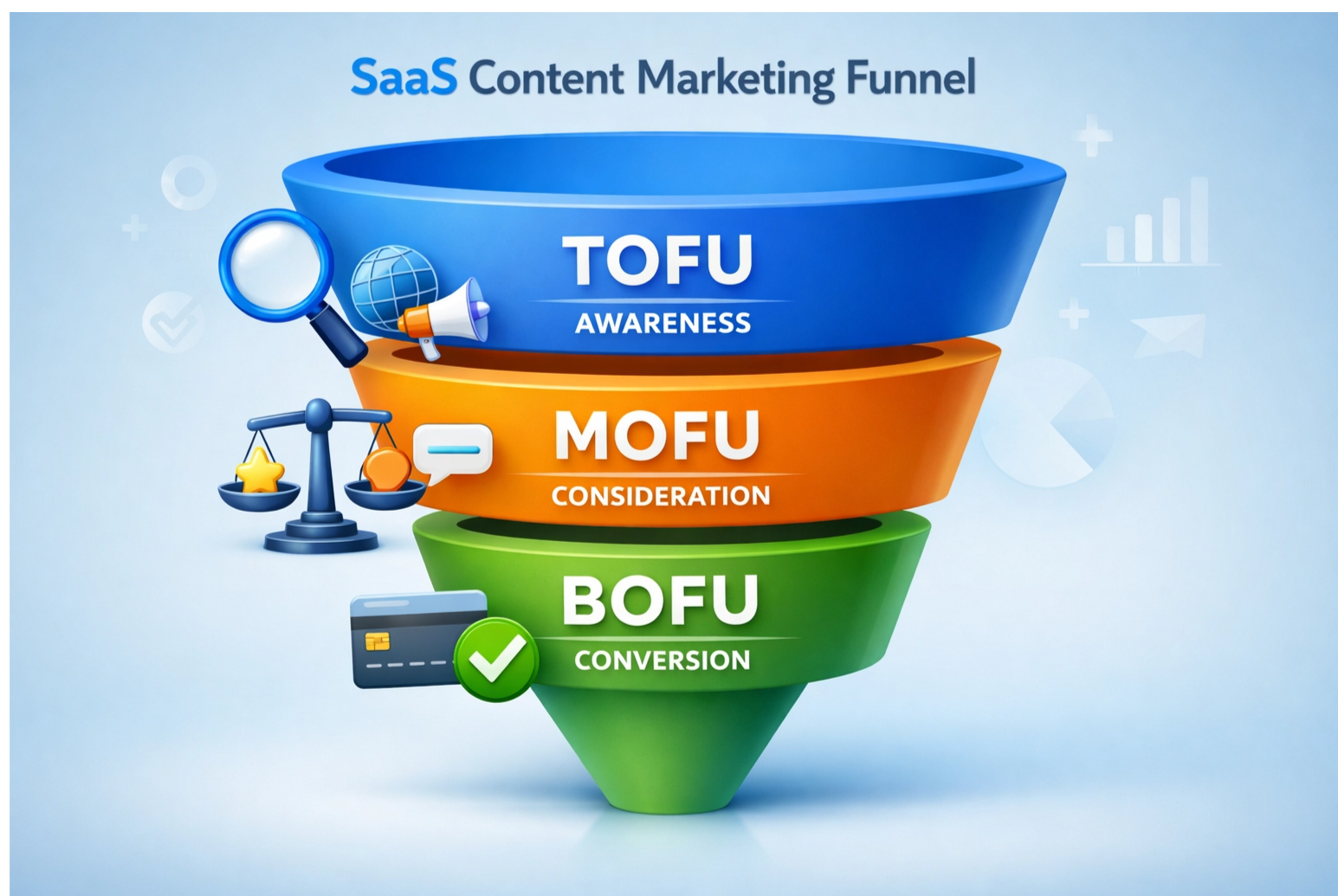
A SaaS content funnel has three core stages: TOFU (Top of Funnel), MOFU (Middle of Funnel), and BOFU (Bottom of Funnel). Each stage serves a different buyer mindset and requires different content types, keywords, and CTAs.
Stage 1: TOFU — Awareness Content (Problem-Aware Buyers)
At the top of the funnel, your buyer doesn’t know your product exists. They know they have a problem. They’re searching for education, not solutions.
Goal: Get found. Build brand awareness. Establish authority.
Content Types: Educational blog posts, how-to guides, glossary pages, YouTube explainers, infographics, podcast appearances.
Example Keywords: “what is customer churn,” “how to reduce SaaS churn,” “team collaboration challenges,” “project management for remote teams.”
This is where E-E-A-T matters most. Google rewards content from people who clearly understand the problem space. If you want to understand what a winning TOFU strategy looks like, the beginner’s guide to SEO is the best starting point — it explains how search engines discover, evaluate, and rank awareness-stage content.
TOFU content targets informational intent keywords with monthly search volumes typically ranging from 1,000 to 50,000+. Competition is often medium-to-high, but the long-term authority payoff is significant.
Stage 2: MOFU — Consideration Content (Solution-Aware Buyers)
At the middle of the funnel, your buyer knows their problem has solutions. They’re now evaluating options. This is where most SaaS companies underinvest — and where the biggest conversion opportunity exists.
Goal: Educate on solutions. Position your product as the best fit. Build trust.
Content Types: Comparison pages, use case articles, feature deep-dives, customer case studies, ROI calculators, webinars, email nurture sequences.
Example Keywords: “HubSpot vs Salesforce for small business,” “best CRM for SaaS companies,” “Slack alternatives for remote teams,” “project management software comparison 2026.”
MOFU content converts 3–5x better than TOFU content on a per-session basis, according to Demand Gen Report data. Yet most SaaS blogs publish 80% TOFU and 10% MOFU. Flip that ratio.
For MOFU to work in 2026, you need topical authority — not just one good comparison page. The fastest way to build it is through semantic SEO content clusters, which Google rewards with faster rankings and stronger SERP positioning across your full niche.
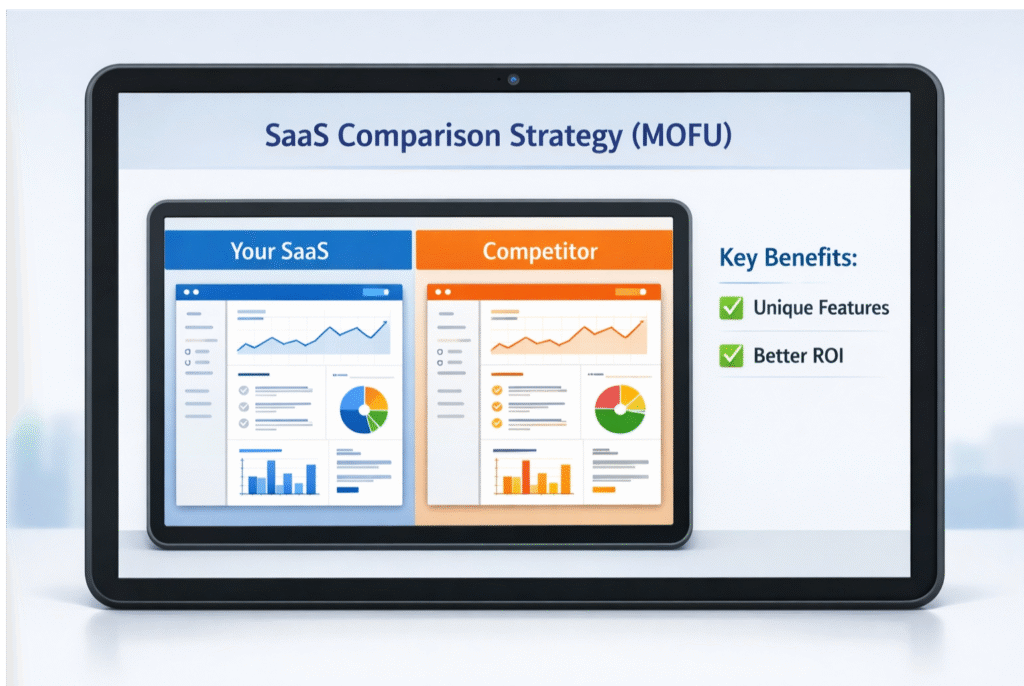
For AI-era optimization: MOFU comparison pages are highly cited in AI Overviews when they contain structured data, clear entity relationships, and factual product comparisons. Schema markup for SoftwareApplication and FAQPage dramatically improves AI visibility here.
Stage 3: BOFU — Conversion Content (Product-Aware Buyers)
At the bottom of the funnel, your buyer is comparing you specifically against alternatives. They’ve done their research. They want proof before they commit.
Goal: Remove objections. Prove value. Drive sign-ups, demos, or purchases.
Content Types: Landing pages, pricing pages, demo request pages, testimonial pages, case studies with specific ROI data, free trial pages, “[Brand] reviews” and “[Brand] alternatives” pages.
Example Keywords: “[YourSaaS] pricing,” “[YourSaaS] vs [Competitor],” “[YourSaaS] reviews 2026,” “buy [YourSaaS] for teams,” “get [YourSaaS] free trial.”
BOFU content has the lowest traffic volume but the highest conversion rate — often 8–15% vs. 0.5–2% for TOFU content. This is where content directly generates revenue.
Want to see what BOFU content looks like in the real world? The SEO case study: Ocean Massage Spa Karachi ranked #1 in 28 days shows exactly how bottom-of-funnel optimization — targeting high-intent, location-specific keywords — drives conversions faster than any TOFU campaign ever could.
SaaS Content Funnel Performance Benchmarks (2026)
| Funnel Stage | Content Type | Avg. Search Volume | Conversion Rate | Time to Rank | AI Overview Fit |
|---|---|---|---|---|---|
| TOFU | Educational Blog Posts | 5,000–50,000/mo | 0.5%–2% | 3–6 months | High |
| TOFU | How-To Guides | 2,000–20,000/mo | 1%–3% | 2–5 months | Very High |
| TOFU | Glossary / Definition Pages | 1,000–10,000/mo | 0.3%–1% | 1–3 months | Very High |
| MOFU | Comparison Pages (A vs B) | 500–5,000/mo | 3%–8% | 2–4 months | High |
| MOFU | Use Case Articles | 300–3,000/mo | 4%–9% | 2–4 months | Medium |
| MOFU | Customer Case Studies | 100–1,000/mo | 5%–12% | 1–3 months | Medium |
| BOFU | Pricing Pages | 200–2,000/mo | 8%–18% | 1–2 months | Low |
| BOFU | [Brand] vs [Competitor] | 200–3,000/mo | 10%–20% | 1–2 months | Medium |
| BOFU | Review / Testimonial Pages | 100–1,500/mo | 7%–15% | 1–2 months | Medium |
| BOFU | Free Trial Landing Pages | Paid + Organic | 12%–25% | Immediate | Low |
Benchmarks sourced from Demand Gen Report, HubSpot Research, and Content Marketing Institute SaaS studies.
Mapping Keywords to SaaS Funnel Stages

Keyword intent is the single most important variable in SaaS content strategy. Targeting the wrong intent at the wrong stage is like showing someone a checkout page before they know what the product does.
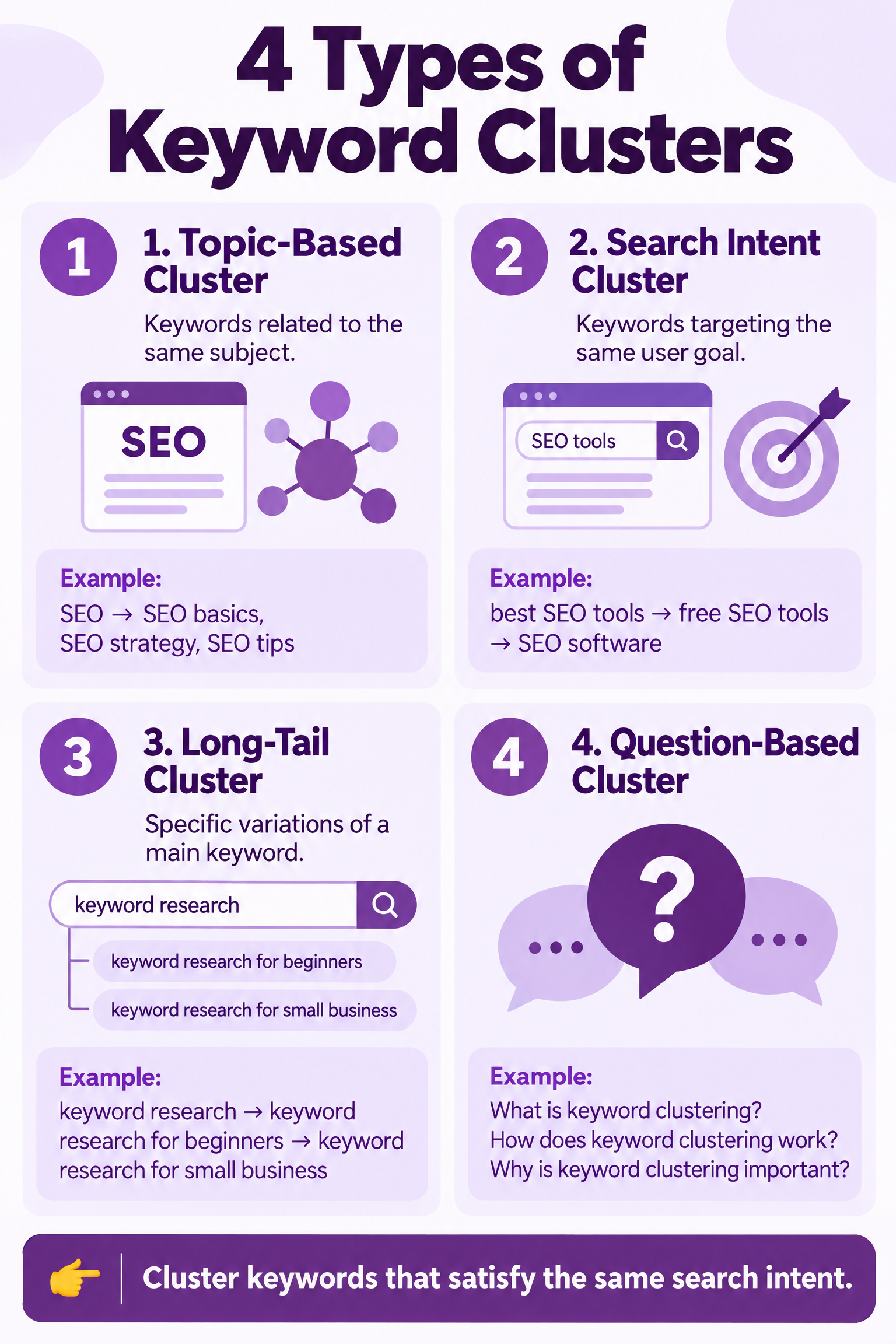
Informational Intent → TOFU: Keywords like “what is,” “how to,” “why does,” “guide to,” “examples of.” Build educational content clusters around these. Link them internally to MOFU content to move readers down the funnel.
Commercial Intent → MOFU: Keywords like “best,” “top,” “vs,” “alternatives,” “for [industry],” “with [feature].” These are your highest-leverage MOFU opportunities. For a deep dive on how to find and map these keywords to your SaaS funnel, read the complete guide on SaaS keyword research strategy 2026 — it covers buyer intent mapping, competitor gap analysis, and keyword clustering in full detail.
Transactional Intent → BOFU: Keywords like “buy,” “pricing,” “free trial,” “demo,” “sign up,” “[Brand] reviews,” “discount.” Optimize these pages for conversion, not just rankings. A/B test CTAs. Add social proof. Remove friction.
Tools to Build Your SaaS Content Funnel in 2026
You don’t need 20 tools. You need the right 5 used correctly.
Ahrefs or Semrush — For keyword research, competitor gap analysis, and funnel stage classification by intent.
Google Search Console — Your most honest traffic data. Use it to identify which existing pages sit at which funnel stage and optimize accordingly. For a complete guide on how to use it alongside other AI-era tools, see best AI SEO certification and tools to learn in 2026.
AnswerThePublic / AlsoAsked — For identifying TOFU question clusters and FAQ opportunities that appear in AI Overviews.
Clearscope or SurferSEO — For semantic keyword optimization within MOFU content to ensure topical completeness.
HotJar / Microsoft Clarity — For understanding how users behave on BOFU pages. Heatmaps reveal exactly where visitors hesitate before converting. UX behavior on BOFU pages ties directly into why UX is more important than UI in 2026 — the experience your funnel pages deliver determines whether someone converts or leaves.
SaaS Content Funnels in the AI Era: GEO, AEO, and AI Overview
In 2026, your SaaS content funnel must account for three new visibility layers beyond traditional Google rankings.
GEO (Generative Engine Optimization): AI systems like Google’s AI Overview, Perplexity, and ChatGPT pull content from authoritative, well-structured sources. To appear in these answers, TOFU and MOFU content needs clear entity relationships, factual accuracy, and schema markup. Use FAQ schema for definition pages and HowTo schema for guide content. For a complete breakdown of how this works, mastering modern search: SEO, AEO, and GEO strategies covers every layer in one place.
AEO (Answer Engine Optimization): AEO means structuring content so AI engines can extract precise answers. Use H2/H3 headers that mirror actual search queries. Write direct 40–60 word answer paragraphs immediately after each heading. Include numbered steps, data tables, and comparison lists — AI engines love structured, scannable data.
AI Overview Inclusion: Google’s AI Overview cites sources that provide the most complete and accurate answer to a query. For SaaS comparison content (MOFU), pages that include product-to-product feature tables, pricing data, and direct use-case comparisons have the highest inclusion rates. According to Authoritas, pages with structured data are 4.6x more likely to be cited in AI Overviews.
One more thing: ChatGPT now runs ads. That changes the full-funnel landscape for SaaS content, especially at the BOFU stage where AI-powered buying decisions are accelerating. Read how ChatGPT ads just changed the rules of marketing forever to understand what this means for your conversion content strategy.
Building Internal Links Between Funnel Stages
Your content funnel only works if content is connected. A reader landing on a TOFU blog post needs a natural path to MOFU content, and from there to a BOFU conversion page. Without internal links, each piece of content is an island.
The rule is simple: every TOFU post should link to at least one MOFU page. Every MOFU page should link to at least one BOFU page. Use contextual anchor text that matches search intent — not just “click here” or “learn more.”
For the full framework behind link building that supports your funnel — including how to earn backlinks that actually move authority through your content cluster — read link building strategies that actually work in 2026.
Frequently Asked Questions
What is a SaaS content marketing funnel? A SaaS content marketing funnel is a structured content strategy that maps blog posts, landing pages, case studies, and other content to specific stages of the buyer journey — awareness, consideration, and conversion. Each stage uses different keyword intent, content formats, and CTAs to move prospects closer to becoming paying customers.
How long does it take for SaaS content to drive conversions? TOFU content typically takes 3–6 months to rank and begins driving indirect conversions through brand awareness. MOFU comparison content often ranks in 2–4 months and drives direct MQLs. BOFU conversion pages can generate results within 4–8 weeks. For a real-world timeline with exact data, see how long do SEO results take — with a live case study.
What’s the best content type for SaaS conversions? Customer case studies and competitor comparison pages consistently deliver the highest conversion rates — typically 5–15% — compared to 0.5–2% for top-of-funnel blog posts. Case studies with specific ROI data are particularly effective at removing final buying objections.
How does AI search (ChatGPT, Google AI Overview) affect SaaS content marketing? AI search is reshaping TOFU content most significantly. Generic informational queries are increasingly answered by AI directly, reducing click-through to websites. SaaS companies should shift investment toward MOFU and BOFU content, and optimize TOFU content for AI citation (GEO/AEO). Learn how to track AI brand visibility in search engines so you know exactly how your funnel performs across both traditional and AI search.
Should SaaS companies create content for every funnel stage simultaneously? If resources are limited, start with BOFU content first — it drives revenue fastest. Then build MOFU comparison and use case content. TOFU educational content comes last. This reverse-funnel approach maximizes early ROI from content investment.
How many pieces of content do I need per funnel stage? A minimum viable SaaS content funnel: 10–20 TOFU posts, 5–10 MOFU comparison and use case pages, and 3–5 BOFU conversion pages. Quality and intent alignment matter more than volume. Always.
What is topical authority and why does it matter for SaaS funnels? Topical authority means Google recognizes your site as a trusted, comprehensive source on a specific subject. The new SEO strategy for 2026 explains how topical authority has replaced traditional link-only strategies — content clusters across funnel stages are now the primary ranking signal for competitive SaaS niches.
How do I measure SaaS content funnel performance? Track by stage: TOFU — organic impressions, clicks, new user sessions, branded search growth. MOFU — pages per session, demo form starts, email sign-ups, time on comparison pages. BOFU — free trial sign-ups, demo completions, MQL-to-SQL conversion rate, content-attributed revenue in your CRM.
Ready to Build a SaaS Content Funnel That Actually Converts?
A SaaS content marketing funnel is not a blog calendar. It’s a strategic system that connects your buyers’ questions to your product’s answers at every stage of their journey. In 2026, with AI reshaping search and buyers doing deeper independent research before contacting sales, that system is your most important growth asset.
Map your content to intent. Build BOFU first. Link your funnel together. Optimize for AI Overview. Track revenue — not just traffic.
Want a custom SaaS content funnel strategy? Visit seoportfolio.in for a free SEO audit and personalized content funnel roadmap — built for SaaS teams that want organic growth, not just organic traffic.

Sharing my journey and learnings in Tech and AI. As a Digital Marketing Expert, I help brands boost their visibility and sales with smart personal branding and the latest AI tricks.
Leave a Reply