Table of Contents
| LLM SEO best practices in 2026 focus on optimizing content for large language models rather than just traditional search algorithms. The 12 core practices are: write direct answers in 40-60 words per section, implement FAQ and Article schema, build topical authority through content clusters, establish named author credentials, ensure AI crawlers are unblocked, use entity-consistent brand language, cite named sources, write in declarative sentences, publish original data, maintain content freshness, build external citation footprint, and track your LLM citation rate weekly. |
Introduction: Why Traditional SEO Is No Longer Enough
Something important happened to search between 2024 and 2026. The people asking questions online did not just get smarter search engines. They got entirely different search engines. ChatGPT Search, Perplexity AI, Google AI Mode, and Gemini do not return a list of blue links. They read thousands of web pages simultaneously, synthesize the information, write an answer, and attribute it to specific sources.
You either get cited or you do not. And if you do not, you are invisible to a growing segment of your audience that never scrolls to the organic results below the AI-generated answer.
This is what LLM SEO is about. Large Language Model SEO is the practice of optimizing content so that AI systems not only understand it, but choose it as a trusted, citable source when generating answers. It is not a replacement for traditional SEO. It is the layer you build on top of it.
I have been testing LLM optimization across my own content since early 2025, including the experiment I documented in how I optimized my personal brand site like a client. The difference in AI citation rate before and after applying these practices was significant and measurable within 8 weeks. This guide gives you exactly what worked.
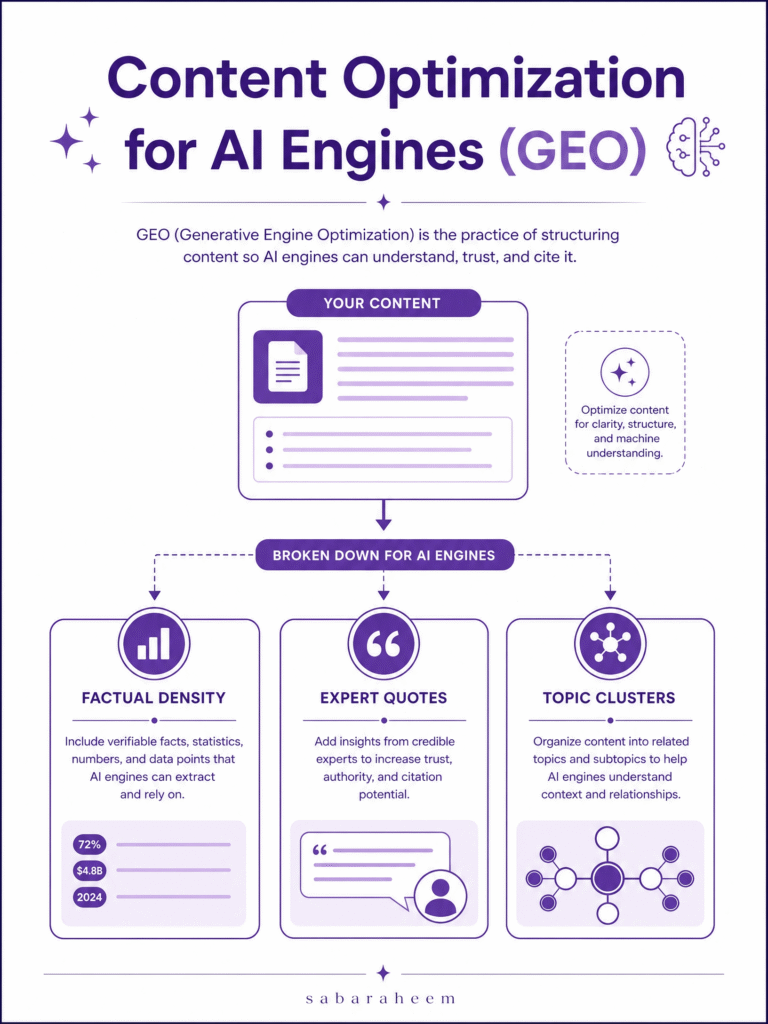
1. What Is LLM SEO and How Is It Different From Traditional SEO?
LLM SEO is the practice of structuring, writing, and distributing content so that large language models (ChatGPT, Gemini, Perplexity, Claude) select it as a reliable source when generating responses to user queries.
| Dimension | Traditional SEO | LLM SEO |
|---|---|---|
| Primary goal | Rank in the top 10 blue links | Get cited inside AI-generated answers |
| Algorithm evaluated | Keyword relevance, backlinks, technical signals | Content comprehension, factual accuracy, entity trust |
| Success metric | Position, CTR, organic traffic | Citation rate, AI share of voice, branded search lift |
| Content format | Keyword-optimised paragraphs | Direct-answer structured sections with schema markup |
| Authority signal | Backlink domain authority | Named author credentials, external citation footprint |
| Competition | Other websites for the same keyword | Every source the LLM was trained on or can retrieve |
| Traffic type | Direct clicks from SERPs | Indirect: brand awareness, branded searches, assisted conversions |
The critical insight is that LLM SEO and traditional SEO are not competing priorities. Content that earns LLM citations tends to also rank better organically, because both systems reward the same core quality signals. For the full picture of how these systems interact, see mastering the future of search: 2026 SEO changes and AI-first ranking.
2. How LLMs Actually Decide What to Cite
Before optimizing for LLMs, you need to understand how they evaluate content. The process is different for training-data LLMs versus retrieval-augmented LLMs, and both matter.
Training Data LLMs (ChatGPT without search, Claude)
These models cite content from their training datasets. For your content to appear in training data, it needed to be indexed and crawled before the training cutoff, have sufficient external citation weight to be included, and be factually consistent with information from other sources in the training corpus.
Practical implication: building long-term LLM visibility requires a consistent publishing history and a growing external citation footprint. Content published in 2023 and 2024 that earned external links is already baked into current models.
Retrieval-Augmented Generation LLMs (ChatGPT Search, Perplexity, Google AI Mode)
These models retrieve content from the live web for every query. They select sources based on recency, answer density, domain crawlability, and factual specificity. This is where the majority of practical LLM SEO optimization applies, because you can influence these signals directly.
| LLM Platform | Retrieval Method | Key Citation Signals | Update Speed |
|---|---|---|---|
| Google AI Mode | Google’s live index | E-E-A-T, schema, direct answers, topical authority | Days to weeks |
| Perplexity AI | Real-time web crawl | Recency, answer density, named sources, crawlability | Hours to days |
| ChatGPT Search | Bing index retrieval | Domain authority, content clarity, Bing indexation | Days to weeks |
| Gemini | Google index + Knowledge Graph | Entity recognition, schema, Google authority signals | Days to weeks |
| Microsoft Copilot | Bing index | Bing SEO signals, structured data, authority | Days to weeks |
Understanding which platforms your target audience uses most determines where to focus your LLM SEO effort. For a full breakdown of tracking and improving your brand visibility across all five platforms, see how to track brand visibility in AI mode.
3. The 12 LLM SEO Best Practices for 2026
These 12 practices are ordered by impact. Work through them in sequence for the fastest improvement in LLM citation rate.
| Practice #1 Why It Matters: LLMs extract ‘nuggets’ — self-contained answer units that respond to a specific question without requiring surrounding context. If your content does not contain these extractable units, it cannot be cited efficiently. This is the single highest-impact structural change you can make. How to Do It:Identify the implied question in every H2 headingWrite a direct, complete answer in 40 to 60 words as the very first sentence block under that headingDo not start with ‘great question,’ preamble, or background contextThe answer must stand alone — someone reading only that paragraph should have their question answeredThen provide your supporting explanation, data, and examples below the direct answerThis structure is what Google AI Mode extracts for AI Overviews and what Perplexity uses for its cited answer blocks. Every post on this site follows this format. The full content structure guide is in how to get cited in ChatGPT, Perplexity, and Google AI Overviews. |
| Practice #2 Implement FAQ Schema on Every Post Why It Matters: FAQ Schema is the highest-ROI technical action for LLM SEO. It explicitly labels question-answer pairs in machine-readable format, making it trivial for AI systems to extract and attribute your content. LLMs that process structured data are significantly more likely to cite pages with FAQ Schema than equivalent pages without it. How to Do It: Add FAQ Schema (JSON-LD format) to every blog post containing a question-answer sectionThe FAQ Schema questions should match the H3 headings in your People Also Ask and FAQ sectionsPair with Article Schema (establishes authorship and publish date) and Author Schema with sameAs linksValidate all schema using Google Rich Results Test before publishingIn WordPress: Rank Math and Yoast both generate FAQ Schema automatically from designated FAQ blocksFor the complete schema implementation guide covering all 7 schema types that matter for AI citation, see what is schema markup and how it helps businesses rank. |
| Practice #3 Build Topical Authority Through Content Clusters Why It Matters: A single post rarely earns consistent LLM citations. A tightly interlinked content cluster covering every angle of a topic does. LLMs recognise when a domain comprehensively covers a subject — and they weight those domains more heavily when generating answers on that subject. How to Do It:Build a pillar page covering your core topic comprehensively (this post is an example for LLM SEO)Surround it with 8 to 12 cluster posts covering specific subtopics, each linking back to the pillarInternal links should be contextual and use descriptive anchor text that mirrors search intentUse Google Trends to identify growing subtopics within your cluster before competitors doReview your cluster quarterly and add new posts as the topic evolvesThe topical authority cluster model is what drives consistent LLM citation over time. For the full methodology applied to competitive niches, see SaaS keyword research strategy: building topical authority clusters. The same framework applies to any industry. |
| Practice #4Establish Named Author Entity with Verifiable Credentials Why It Matters: LLMs are trained to evaluate content trustworthiness through author signals. Anonymous content or content attributed to a generic ‘Editor’ or ‘Team’ account carries significantly less citation weight than content attributed to a specific, verifiable human with documented expertise. How to Do It:Every post must have a named author with a real full nameAuthor bio must include specific, verifiable credentials (years of experience, certifications, client results)Implement Author Schema with sameAs properties linking to LinkedIn, Twitter, About pageThe author name must be consistent across all posts and all external platformsBuild external signals: guest posts, podcast appearances, conference talks — all under your real nameAuthor entity is the E-E-A-T signal that separates human expertise from AI-generated content in LLM evaluation. This is central to why your personal story is your strongest SEO and LLM strategy. |
| Practice #5Verify AI Crawlers Are Not Blocked Why It Matters: This is the silent killer of LLM SEO strategies. A site can have perfectly optimized content and still be completely invisible to every LLM if it has inadvertently blocked AI crawlers in its robots.txt file. This happens more often than you think — especially with older robots.txt files written before GPTBot and PerplexityBot existed. How to Do It:Open yourdomain.com/robots.txt in a browserSearch for: GPTBot, PerplexityBot, GoogleOther, CCBot, OAI-SearchBot, anthropic-aiIf any appear under a Disallow rule, remove that restriction immediatelyIf you use a CDN or WAF (Cloudflare, Akamai), ensure AI crawlers are not blocked at the firewall levelRetest monthly — security plugin updates can inadvertently add new Disallow rulesA full technical accessibility audit including robots.txt, schema validation, Core Web Vitals, and crawl health is part of the free SEO audit formula — this is usually the fastest way to identify what is silently blocking your LLM visibility. |
| Practice #6Use Consistent Brand Entity Language Why It Matters: LLMs build a mental model of your brand based on how it is described consistently across the web. If your website calls you a ‘digital marketing consultant,’ your LinkedIn says ‘SEO specialist,’ and your About page says ‘content strategist,’ LLMs are uncertain about what entity you represent and will avoid citing you for any of those terms. How to Do It:Define one precise, specific brand description and use it identically everywhereYour website About page, Google Business Profile, LinkedIn summary, Twitter bio, and author bio must all use this same descriptionAdd Organization Schema with a detailed ‘description’ field and sameAs links to all social profilesWhen guest posting or being featured, provide your standardised brand description to the host siteAudit your brand description consistency annually as your services evolveBrand entity consistency is foundational to the personal branding strategy that makes LLM citation reliable rather than occasional. LLMs cite sources they recognise as established entities — not sources they have to guess at. |
| Practice #7Cite Named Sources and Include Specific Data Why It Matters: LLMs evaluate factual credibility by checking whether the claims in your content are consistent with other sources they have processed. Vague claims (‘studies show,’ ‘many experts agree’) create no verifiable signal. Named sources with specific data (‘a 2025 Semrush study found that 47% of search queries trigger AI Overviews’) do. How to Do It:Every statistical claim must name the source: ‘According to [Source Name], [specific finding]’Include publication year for all cited data — LLMs deprioritize undated claimsPrefer primary sources: academic research, government data, industry reports, original surveysWhen you conduct original research, publish it with full methodology so LLMs can verify and cite itAvoid hedging phrases: ‘it depends,’ ‘many factors,’ ‘experts disagree’ — these reduce citation confidenceNamed-source content is what earns consistent LLM citations for informational queries. This practice directly connects to the authority-building framework in LLM SEO optimization software and tools guide, which covers how tools like Clearscope and MarketMuse evaluate your semantic authority. |
| Practice #8Write in Clear Declarative Sentences Why It Matters: LLMs process content through their language models. Passive voice, complex sentence structures, and ambiguous phrasing reduce the model’s confidence in accurately attributing meaning. Declarative, active-voice sentences in plain English are extracted and cited more reliably than complex academic or marketing prose. How to Do It:Lead every key claim with the subject performing the action: ‘Perplexity cites content published within 48 hours’ rather than ‘Content that has been recently published is cited by Perplexity’Keep sentences under 25 words wherever possibleOne idea per sentence — do not compound multiple claimsAvoid jargon without definition. Define technical terms the first time they appearRead every paragraph aloud. If you stumble, the LLM will too |
| Practice #9Publish Original Research and First-Person Data Why It Matters: LLMs heavily favor original data sources because training data contains millions of pages citing the same secondary sources. When you publish research only you could have conducted — a client survey, a tool experiment, an A/B test result — LLMs have no alternative source for that information and must attribute it to you specifically. How to Do It:Document your own results: traffic growth percentages, citation rate improvements, client outcomesPublish case studies with real numbers and specific timelinesRun a simple survey of your audience and publish the findingsTest something in your field and publish the results — even a 30-day experiment produces citable original dataLabel original data clearly: ‘In our analysis of 50 client sites…’ or ‘Based on our testing of…’Original data is the most powerful LLM citation accelerator available. It is also what creates the first-person authority that distinguishes human expertise from AI-generated content. The full case for first-person SEO is in why your personal story is your best SEO strategy. |
| Practice #10Maintain Content Freshness with Regular Updates Why It Matters: Perplexity and ChatGPT Search prioritize recently updated content for time-sensitive queries. Google AI Mode also weights freshness for evolving topics. A well-structured post from 2024 that has not been updated competes poorly against a less-structured 2026 post for AI retrieval, especially in fast-moving fields like SEO itself. How to Do It:Add a visible ‘Last Updated’ date to every post in your HTML and Article SchemaSchedule quarterly content reviews for your top 20 most-visited postsUpdate statistics with the current year’s data — AI systems flag outdated statisticsAdd a new section addressing developments since the original publicationResubmit updated URLs to Google Search Console and Bing Webmaster Tools after each updateUsing Google Trends to time your content refreshes to when annual search interest peaks is a high-leverage tactic covered in Google Trends for SEO: 11 expert hacks to dominate search in 2026. |
| Practice #11Build an External Citation Footprint Why It Matters: LLMs check whether your brand or content is cited elsewhere on the web. A brand mentioned in Search Engine Journal, cited in a Semrush report, or referenced in an industry forum has a stronger citation signal than an identical brand that exists only on its own website. External citations function as trust signals for LLM source selection. How to Do It:Publish guest posts on industry publications with DA 60 or aboveGet quoted in industry roundup posts and expert Q&A articlesSubmit data and research to news outlets — press coverage creates high-authority citationsParticipate authentically in Reddit and Quora discussions in your niche — these are increasingly cited by LLMsBuild consistent NAP (Name, Address, Phone) citations in directories for local businessesThe most systematic approach to building external citation footprint is ethical Parasite SEO — publishing expert content on platforms that LLMs already cite. The full 2026 strategy is in Parasite SEO 2026: does it still work and how to do it ethically. |
| Practice #12Track Your LLM Citation Rate Weekly Why It Matters: You cannot improve what you do not measure. Most businesses have no idea whether LLMs are citing them, how often, or with what accuracy. Building a weekly citation tracking routine turns LLM SEO from guesswork into a measurable, improvable strategy. How to Do It:Build a 20-keyword tracking list: brand queries, category queries, and problem queriesQuery each keyword in Google AI Mode, Perplexity, and ChatGPT Search every MondayLog: cited or not, citation position, competitor citations in the same answerTrack branded search volume in Google Search Console monthly as a proxy for LLM-driven brand awarenessSet up BrandMentions or Otterly.ai alerts for automated monitoring of your brand inside AI responsesThe complete tracking system including spreadsheet templates, metric definitions, and how to interpret your data is in how to track brand visibility in AI mode. Set this up in Week 1 of any LLM SEO strategy — measuring from the baseline makes all future improvements visible. |
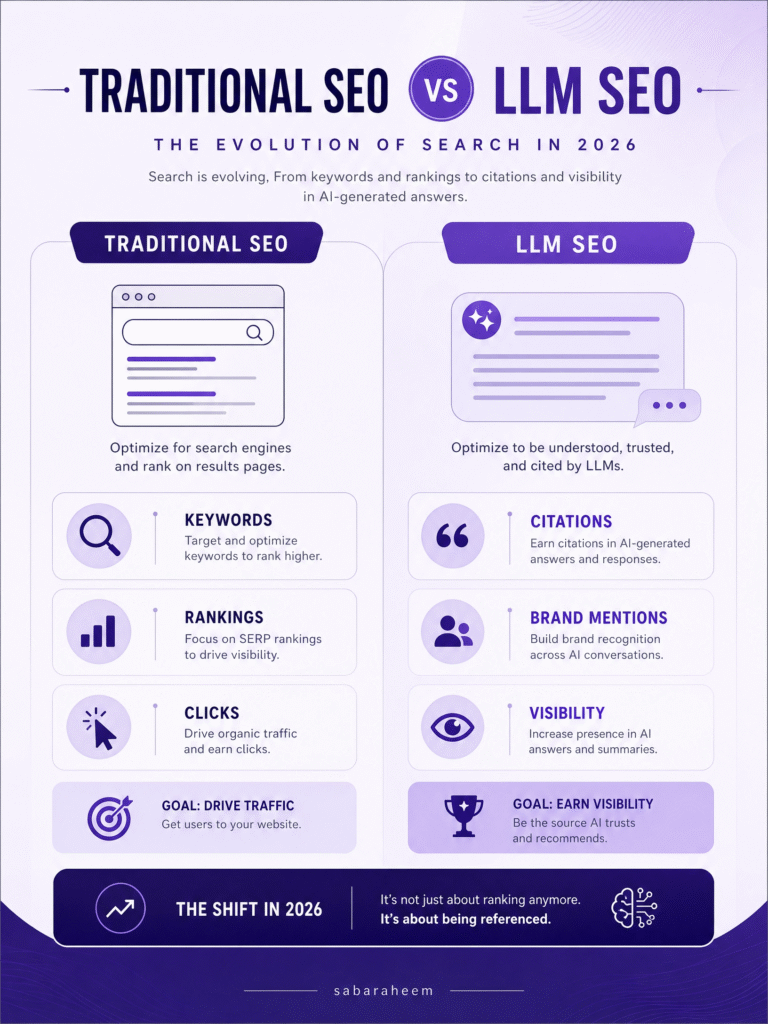
4. LLM SEO Implementation Checklist
Use this checklist to audit your current content and prioritise your implementation work. Column 3 shows the effort required versus the impact delivered.
| Practice | Where to Apply It | Effort vs Impact | Timeline |
|---|---|---|---|
| Direct 40-60 word answers | All blog posts and service pages | Low effort / High impact | Immediate |
| FAQ Schema implementation | All posts with Q&A sections | Low effort / High impact | Week 1 |
| AI crawler unblocking | robots.txt and server configuration | Low effort / Critical impact | Day 1 |
| Author Schema with sameAs | All blog posts | Low effort / High impact | Week 1 |
| Consistent brand entity language | All web properties and profiles | Medium effort / High impact | Week 1-2 |
| Named sources in all claims | All new and top-traffic content | Low effort / Medium impact | Ongoing |
| Content freshness updates | Top 20 highest-traffic posts | Medium effort / High impact | Quarterly |
| Topical authority cluster | Core service or expertise areas | High effort / Very high impact | Month 1-3 |
| External citation building | Guest posts, PR, forum participation | High effort / High impact | Ongoing |
| Original research publication | Quarterly data or experiment reports | High effort / Very high impact | Quarterly |
| LLM citation rate tracking | Weekly monitoring routine | Low effort / Essential | Week 1 |
| Article and Organization Schema | Homepage, about page, all blog posts | Low effort / Medium impact | Week 1 |
5. Best LLM SEO Tools in 2026
These tools directly support LLM SEO implementation and measurement. They are listed in order of most essential to most advanced.
| Tool | Primary LLM SEO Use | Cost (USD/month) | Recommended For |
|---|---|---|---|
| Google Search Console | Branded search volume tracking, indexation monitoring, schema validation | Free | Everyone — non-negotiable baseline |
| Rank Math / Yoast SEO | FAQ Schema, Article Schema, Author Schema generation in WordPress | Free to $99 | WordPress site owners |
| Otterly.ai | Brand mention monitoring inside ChatGPT, Gemini, Perplexity responses | From $49 | Brands prioritising AI citation tracking |
| BrandMentions | Real-time brand monitoring across web and AI platforms | From $49 | Businesses wanting citation alerts |
| Clearscope | Semantic completeness analysis — ensures content covers all LLM-associated terms | From $189 | Content teams optimising for LLM coverage |
| Ahrefs AI Visibility | Domain-level AI citation tracking, content gap analysis | From $129 | SEO teams with established sites |
| Semrush AI Toolkit | Integrated AI Overview tracking, brand monitoring, competitive AI share of voice | From $139 | Agencies and mid-market brands |
| Bing Webmaster Tools | Submit pages for Bing indexation (ChatGPT Search retrieval source) | Free | Everyone — essential for ChatGPT visibility |
For a deep review of the most effective LLM-specific tools with real usage examples, see best LLM SEO optimization software in 2026.
6. Your 30-Day LLM SEO Action Plan
Week 1: Technical Foundation (Highest Priority)
- Open robots.txt — verify GPTBot, PerplexityBot, GoogleOther, OAI-SearchBot are NOT blocked. Fix immediately if they are
- Submit sitemap to Google Search Console and Bing Webmaster Tools
- Add FAQ Schema and Author Schema to your 10 most-visited posts using Rank Math or Yoast
- Build your 20-keyword LLM tracking list and run Week 1 baseline queries
- Audit brand description consistency across all web profiles — standardise to one precise description
Week 2: Content Restructuring
- Rewrite the first paragraph of your top 10 posts to lead with a direct 40-60 word answer
- Convert all H2 headings in those posts to question format
- Add named source citations to every statistical claim. Remove all unsourced ‘studies show’ language
- Build or audit your topical cluster — identify gaps where you need supporting posts. See content marketing funnel for topical clusters
Week 3: Authority and Distribution
- Publish one high-quality LinkedIn article targeting a query where you want LLM citation
- Pitch two guest posts to industry publications with DA 60 or above — build external citation footprint
- Update your three highest-traffic posts with 2026 data, new sections, and refreshed publish dates
- Consider ethical Parasite SEO on platforms LLMs already cite — Reddit, Medium, LinkedIn for your topic area
Week 4: Measure and Scale
- Run Week 4 LLM tracking queries — compare citation rate against Week 1 baseline. Any improvement is a positive signal
- Check Google Search Console for branded search volume trend
- Set up Otterly.ai or BrandMentions automated monitoring for ongoing citation tracking
- For professional help building and executing your full LLM SEO strategy, work with me

People Also Ask
What is LLM SEO?
LLM SEO is the practice of optimizing website content so that large language models — including ChatGPT, Perplexity, Gemini, and Google AI Mode — select it as a trusted, citable source when generating answers to user queries. It combines traditional SEO foundations with additional signals: direct-answer content structure, schema markup, named author credentials, entity consistency, and external citation footprint. For the full context on how LLM SEO fits into the 2026 search landscape, see mastering 2026 SEO changes and AI-first ranking.
How do I get my content cited in ChatGPT?
ChatGPT in search mode retrieves content from Bing’s index. To get cited: submit your sitemap to Bing Webmaster Tools, ensure GPTBot is not blocked in robots.txt, structure content with direct 40-60 word answers under question-format headings, implement Article and FAQ Schema, and build Bing domain authority through quality backlinks and consistent publishing. ChatGPT training data citations require long-term authority building through external citations and consistent content history.
Is LLM SEO the same as GEO (Generative Engine Optimization)?
They are closely related and largely overlapping. GEO (Generative Engine Optimization) is the broader term for optimizing across all generative AI platforms. LLM SEO specifically focuses on large language model citation signals. Both prioritize direct-answer structure, entity recognition, schema markup, and external citation footprint over traditional keyword density signals. In practice, the two terms describe the same set of optimization practices.
How long does it take to see LLM SEO results?
For Perplexity AI with real-time crawling: content restructuring improvements can produce citation changes within 48 to 72 hours. For Google AI Mode: typically 4 to 8 weeks after content and schema updates. For ChatGPT search mode via Bing: 2 to 4 weeks after Bing indexation of updated content. Training data citations take months to years as they require model retraining cycles. Focus on retrieval-augmented platforms for fastest measurable results.
What content structure does Perplexity prefer to cite?
Perplexity consistently cites content that: answers the query in the first 100 to 150 words of the page, was published or updated recently, uses specific named sources and data points, loads quickly and is accessible to its crawler (PerplexityBot), and comes from a domain that has established topical relevance in the query area. FAQ-format pages and original research posts earn the highest Perplexity citation rates.
Frequently Asked Questions
Do I need to choose between traditional SEO and LLM SEO?
No. The two are complementary and increasingly convergent. Content that ranks well in traditional search tends to earn more LLM citations, because both systems reward quality, structure, and authority. LLM SEO adds a layer of additional signals on top of the traditional foundation: direct-answer formatting, schema markup, entity consistency. The brands succeeding in 2026 treat them as a unified strategy. For the full integrated approach, see the future of search: AI-first SEO strategy for 2026.
What is the biggest LLM SEO mistake businesses make?
The single most common and most damaging mistake is publishing AI-generated content at volume without human expertise, original data, or first-person authority. LLMs are trained on the internet and can identify content patterns that match their own output. AI-generated content without distinctive human expertise earns low citation weight because it provides no information that the LLM does not already have. Original research, personal case studies, and named expertise are what LLMs cite.
Does link building still matter for LLM SEO?
Yes, for two reasons. First, backlinks are a proxy for external citation authority — the same signal LLMs use to evaluate domain trustworthiness. Second, content on high-authority linked domains is more likely to be included in LLM training datasets and retrieval indices. The link building approach that accounts for LLM signals specifically is covered in link building strategies that actually work in 2026.
How does voice search relate to LLM SEO?
Voice search queries are processed by the same LLMs that power AI Mode, ChatGPT, and Perplexity. The direct-answer formatting that earns LLM citations is identical to the content format voice assistants read aloud. Optimizing for LLM citation and optimizing for voice search are effectively the same practice. See how to do voice search SEO in 2026 for the implementation details.
What is the difference between LLM SEO and traditional keyword SEO?
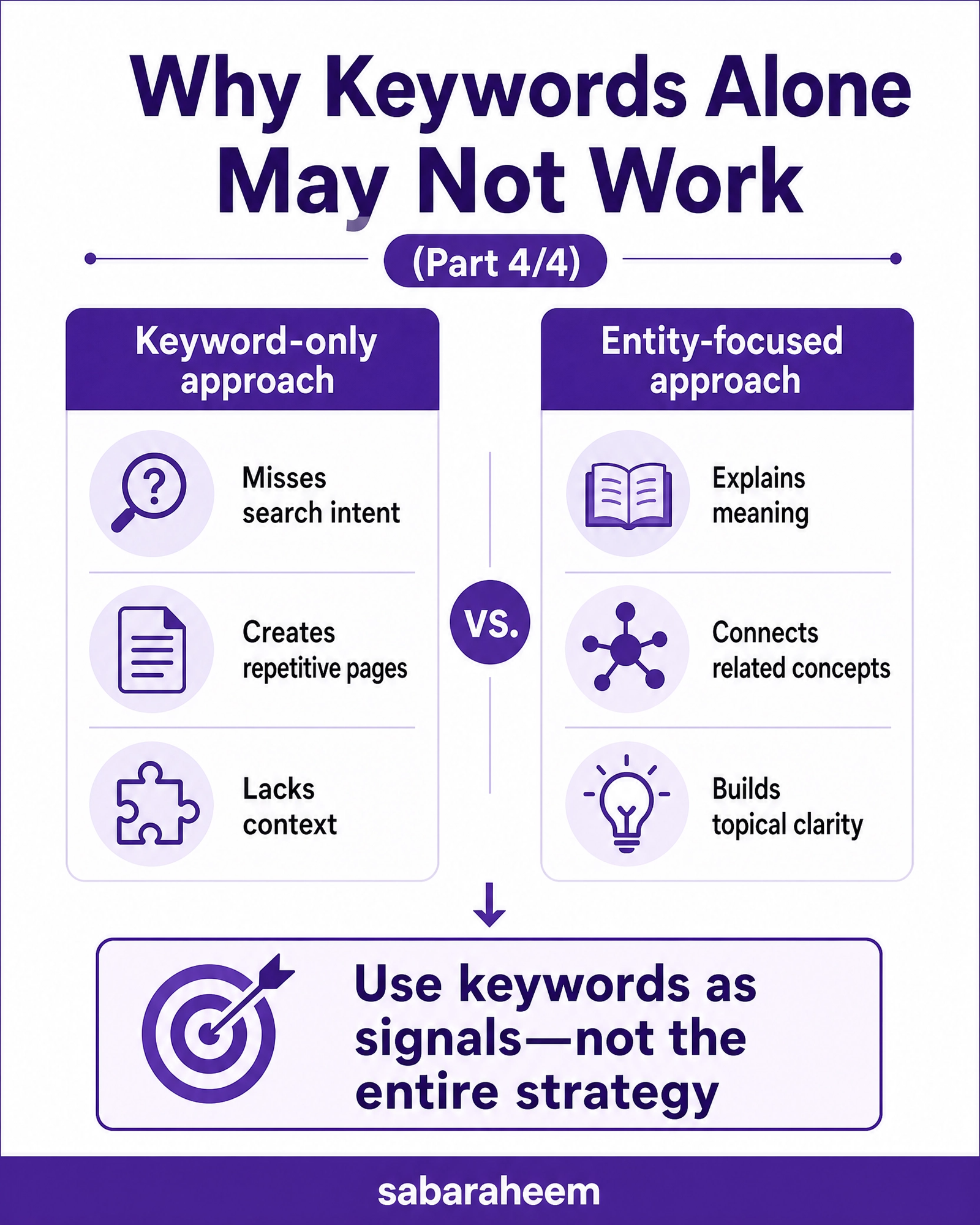
Traditional keyword SEO optimizes for term frequency, keyword placement, and link authority to rank in the blue-link results page. LLM SEO optimizes for content comprehension, answer extractability, entity recognition, and external citation footprint to earn citations inside AI-generated answers. The key distinction: keyword SEO tries to appear in a list of results. LLM SEO tries to become the answer itself. For the full strategic comparison including data on how citation rates differ from ranking positions, see ranking on Google vs getting cited in AI answers: 2026 data.
| Ready to Get Cited in AI Search Engines?Get a free SEO and LLM readiness audit — see exactly where you stand and what to fix first.>>> Get Your Free LLM SEO Audit <<<Or book a strategy session to implement your LLM SEO system with expert guidance |

Sharing my journey and learnings in Tech and AI. As a Digital Marketing Expert, I help brands boost their visibility and sales with smart personal branding and the latest AI tricks.

Leave a Reply