The most effective SaaS link building strategy in 2026 is earning backlinks through original product data, integration partnerships, and digital PR — not mass guest posting. SaaS startups that consistently earn 5–10 high-authority backlinks per month from industry publications, SaaS review platforms, and niche communities grow their domain authority 3–4x faster than those chasing volume. This guide shows you the exact framework.
The Problem: Why SaaS Startups Get Link Building Wrong
You launched your SaaS. You built a solid product. You started a blog. You even tried guest posting on a few sites.
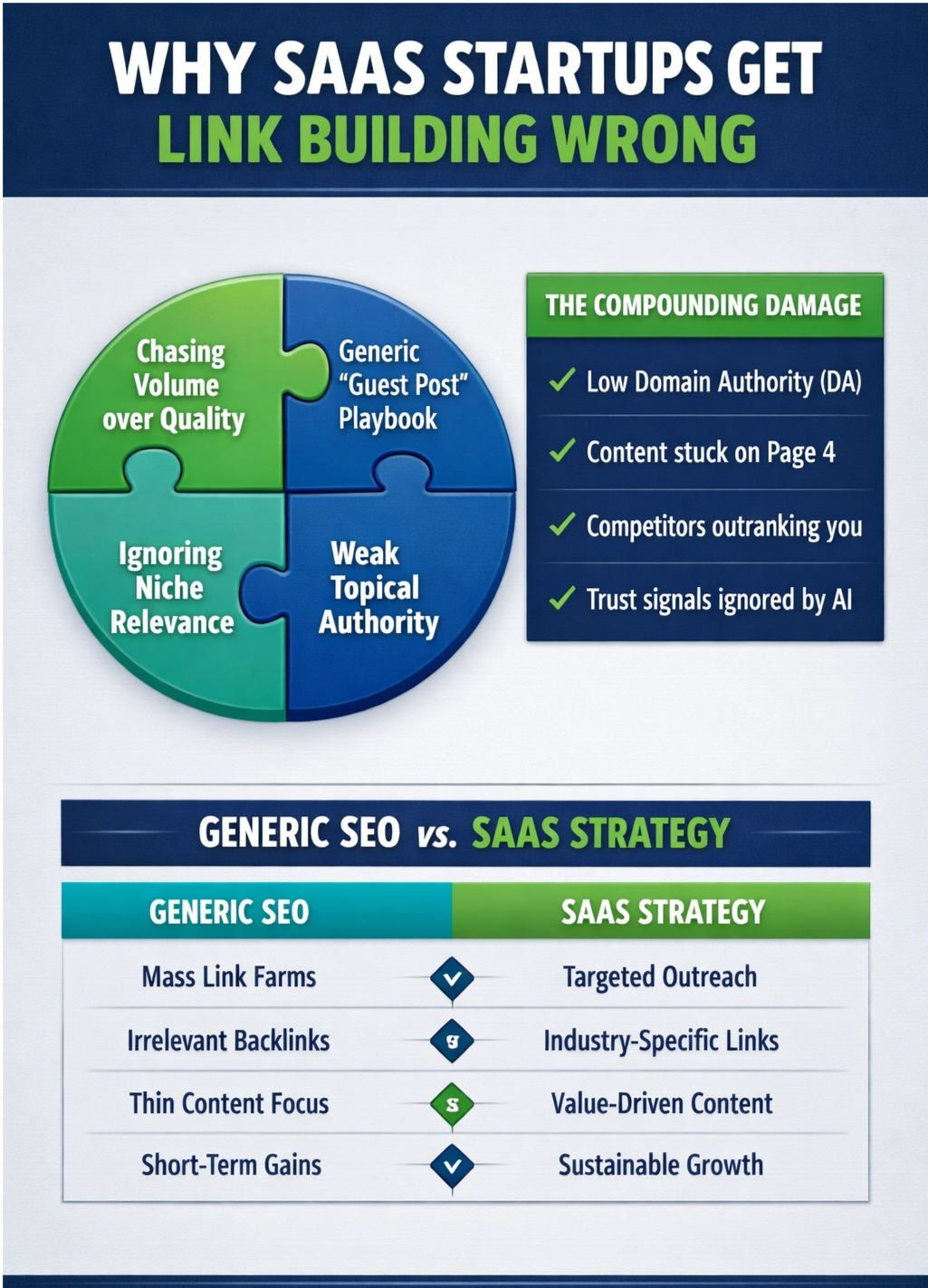
Six months later? You have 40 backlinks from random tech blogs nobody reads, your domain rating is stuck at 12, and your competitor — who launched three months after you — is outranking you for every keyword that matters.
This is the standard SaaS link building story. And it’s painful because the startup team did “everything right” by the advice they found online. The problem isn’t effort. It’s strategy.
SaaS link building has a completely different landscape from e-commerce, local business, or general content sites. Your buyers are sophisticated. Your niche is competitive. The sites that matter — G2, Capterra, TechCrunch, Product Hunt, niche SaaS newsletters — have entirely different link acquisition rules than the generic “write a guest post and pitch it” playbook teaches.
If your link building strategy isn’t built specifically for SaaS, you’re playing the wrong game. For a full picture of the most common SEO mistakes SaaS companies make in 2026, many of them trace back to treating SaaS SEO like any other website — and link building is no exception.
Why This Problem Is Destroying SaaS Growth
Here’s the compounding damage that wrong link building does to SaaS startups.
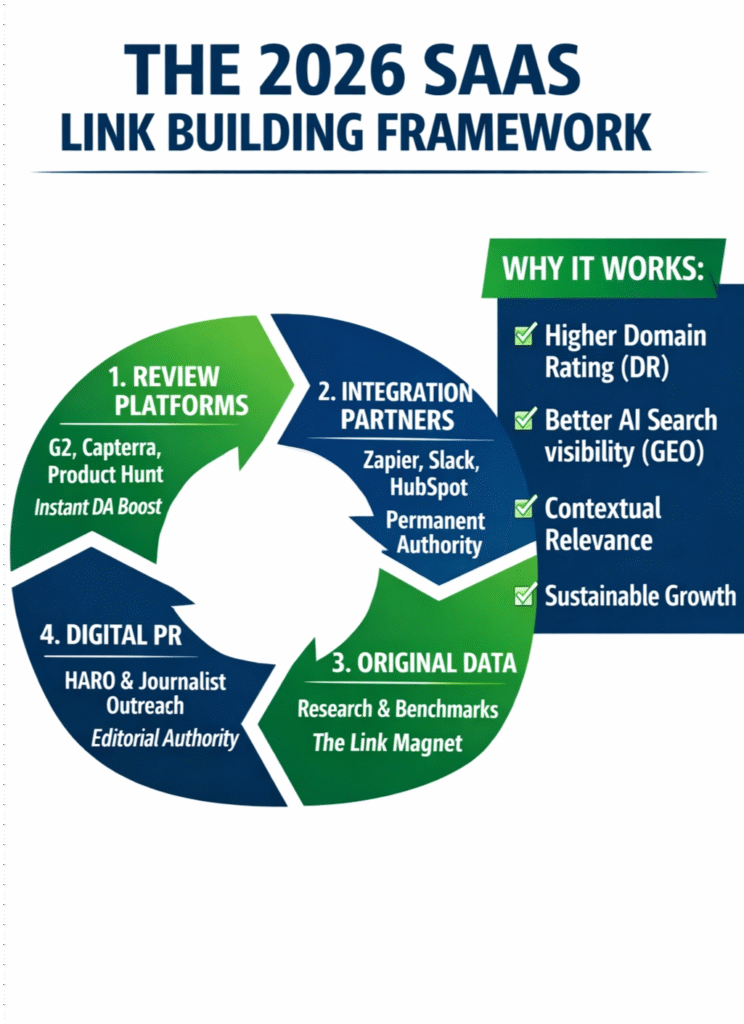
Low domain authority means every content piece you publish starts from scratch, competing against established SaaS blogs with DR 60+ that rank within days of publishing. Your well-researched article on “best CRM for startups” sits on page 4. Theirs sits on page 1. They get the demo requests. You get nothing.
Worse, Google’s 2026 Helpful Content updates are now assigning topical authority scores at the site level, not just the page level. SaaS sites with weak backlink profiles from irrelevant domains are being deprioritized even when their content is genuinely better. The algorithm is reading your link profile as a trust signal — and a profile full of random tech blogs says “startup with no real authority.”
Meanwhile, SaaS companies that consistently earn links from review platforms, SaaS-specific publications, integration partners, and industry data sources are compounding their authority every month. The gap between them and you widens automatically.
As covered in the SaaS growth engine playbook for 2026, organic search authority is now one of the five pillars of sustainable SaaS growth — and link authority is the foundation that makes all your content work faster, rank higher, and convert better.
The Solution: SaaS Link Building Framework for 2026
This is not a generic backlink guide. Every strategy below is built specifically for SaaS startups — with the unique challenges of low brand recognition, technical audiences, and competitive niches in mind.
Strategy 1: SaaS Review Platform Links (Highest ROI, Most Overlooked)
Before you do anything else, claim and fully optimize your listings on every major SaaS review platform. These are do-follow or high-authority links that also directly influence buying decisions.
Priority platforms: G2, Capterra, GetApp, Software Advice, TrustRadius, Product Hunt, AlternativeTo, Slant, SaaSHub.
Each fully completed profile on these platforms earns you a backlink from a domain with DR 70–90+. That’s instant domain authority transfer before you’ve written a single guest post.
But the link is only step one. Review platforms also feed directly into AI search results — when someone asks ChatGPT or Perplexity “what’s the best [your category] software,” these platforms are cited as sources. Your presence there is now a GEO (Generative Engine Optimization) signal, not just an SEO one.
How to maximize review platform links:
Get your first 10–15 genuine customer reviews within the first 60 days of launch. Platforms with active, recent reviews rank higher in their own search and get cited more in AI Overviews. Automate review requests post-onboarding. A single email to customers asking for an honest G2 review takes 10 minutes to set up and compounds for years.
Strategy 2: Integration Partner Links (Free, High-Authority, Permanent)
This is the most underutilized link building strategy in SaaS — and it’s completely free.
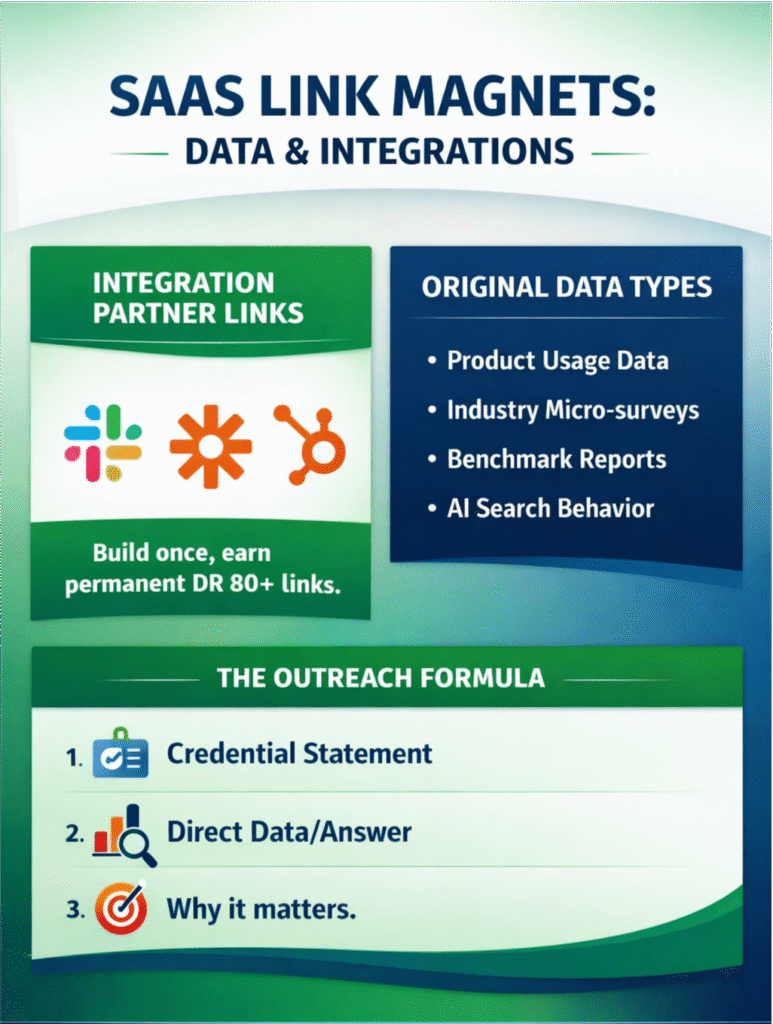
Every tool your SaaS integrates with has an “integrations” or “marketplace” page. HubSpot’s integration directory. Zapier’s app directory. Slack’s App Directory. Notion’s integrations page. These pages have domain ratings of 80–92. Every listing you earn is a permanent, contextually relevant, high-authority backlink.
The SaaS integration link building process:
Step 1 — Build integrations with the top 5–10 tools your target customers already use. Even a basic Zapier integration qualifies for listing.
Step 2 — Submit your app to every relevant directory. Zapier, Make (formerly Integromat), Pabbly, and native integration pages for HubSpot, Salesforce, Slack, Notion, Airtable.
Step 3 — Reach out to integration partners about co-marketing. “We integrate with your tool — would you feature us in a ‘tools that work with [Partner]’ blog post?” This turns one integration into multiple backlinks — from their app directory AND their blog.
One SaaS startup in the project management niche earned 23 high-authority backlinks purely through integration partnerships in their first quarter, without a single guest post pitch. Their domain rating jumped from 8 to 31.
Strategy 3: Original SaaS Data and Research (The Link Magnet)
The fastest way to earn links from publications you can’t outreach into is to produce data they want to cite.
SaaS journalists, newsletter writers, and industry bloggers constantly need fresh statistics. If you produce them, they link to you. This is how SaaS companies like HubSpot, Drift, and Intercom built their domain authority early — not by pitching guest posts, but by publishing research that became the cited source.
What data can a SaaS startup publish?
You don’t need 10,000 survey respondents. You need one unique data angle. Options:
- Product usage data: “We analyzed 500+ [your product category] workflows across our user base. Here’s what high-performing teams do differently.”
- Industry micro-survey: 50–100 responses from your LinkedIn audience on a specific SaaS pain point. Small sample, but unique primary data.
- Benchmark report: Aggregate anonymized data from your platform into a quarterly benchmark. “SaaS [Category] Performance Benchmarks: Q1 2026.”
- AI search behavior data: How your users are using AI tools alongside your product. Highly linkable in 2026.
Once published, distribute to SaaS newsletters (Lenny’s Newsletter, SaaStr, Product Hunt newsletter), relevant subreddits, and LinkedIn. Tag journalists who cover your niche. The links follow the citations.
This approach connects directly to what the SaaS keyword research strategy 2026 calls “data-backed TOFU content” — content that earns links AND ranks for awareness keywords simultaneously.
Strategy 4: HARO and Journalist Outreach for SaaS
HARO (Help A Reporter Out), Qwoted, and SourceBottle connect journalists with expert sources daily. SaaS founders and marketers who respond consistently earn 2–5 high-authority links per month from tech publications, business media, and industry blogs — completely free.
How to make HARO work for SaaS specifically:
Monitor queries in these categories: technology, business, software, startups, SaaS, productivity, marketing tech. Respond within 2 hours of query publication — journalists often take the first 3–5 good responses.
Your response formula for SaaS HARO: one-line credential statement + direct answer with specific data or example + one-sentence “why this matters for their readers.” Keep it under 150 words. Journalists don’t read essays.
Build a bank of SaaS-specific angles you can deploy quickly: your product’s approach to a common pain point, a counterintuitive insight from your customer data, a specific metric from your product’s impact on users.
Over 6 months of consistent HARO responses, a SaaS startup can realistically earn backlinks from Forbes, Inc, Entrepreneur, TechCrunch, and dozens of niche SaaS publications — all editorially earned, all permanent, all carrying genuine authority.
Strategy 5: SaaS Community and Newsletter Links
SaaS buyers live in specific communities. Product Hunt, Indie Hackers, Hacker News, SaaStr, specific Slack communities, LinkedIn SaaS groups. These communities also produce content — newsletters, roundups, community posts — that earn and pass link authority.
High-value SaaS community link opportunities:
Product Hunt launch: A successful Product Hunt launch earns a permanent link from producthunt.com (DR 91) plus coverage from SaaS newsletters that round up notable launches. One launch = 5–15 backlinks from credible sources if your product resonates.
Indie Hackers milestone posts: Document your growth journey honestly. “We hit $10k MRR in 90 days — here’s exactly what we did.” Indie Hackers posts rank on Google, get shared widely, and earn links from startup-focused media that covers founder stories.
SaaS newsletter features: Identify the top 10 newsletters in your SaaS niche. Offer exclusive data, early access, or a genuinely interesting founder story. Newsletter writers constantly need content. Many link to featured tools in their archives.
Hacker News “Show HN”: If your product has a technical angle or solves a genuine developer/startup problem, a successful Show HN post drives traffic and earns links from blogs that cover “interesting tools from HN.”
These community links are often undervalued because they’re not from traditional “SEO sites” — but they drive referral traffic from actual SaaS buyers and build the kind of brand authority that AI systems now use to determine trustworthiness.
Strategy 6: The Skyscraper Technique — SaaS Edition
The general link building strategies that actually work in 2026 cover the skyscraper technique in detail. For SaaS, the approach needs two specific modifications.
Standard skyscraper: Find content with many backlinks → create better version → outreach to sites linking to original.
SaaS skyscraper modification 1 — Add product angle: Don’t just make a better general guide. Make a guide that includes your product’s unique perspective or data. “The Ultimate Guide to SaaS Onboarding (Including Benchmark Data from 500+ SaaS Products)” — the data makes it uniquely citable.
SaaS skyscraper modification 2 — Target SaaS-specific linkers: When doing outreach for the SaaS skyscraper, prioritize: SaaS tools that link to your niche content, SaaS VCs who publish portfolio resources, SaaS aggregator blogs, and SaaS-focused media over generic tech blogs.
One relevant link from a SaaS VC’s “resources” page (typical DR 50–70) outperforms 20 links from general tech blogs. Always build for relevance first.
Strategy 7: Broken Link Building — SaaS Niche Targeting
Broken link building works especially well in SaaS because the space moves fast. Tools shut down, pivot, or rebrand constantly — leaving thousands of broken links across SaaS review sites, comparison blogs, and tool roundups.
The SaaS broken link building process:
Step 1 — Use Ahrefs or Check My Links to find broken links on: SaaS comparison blogs in your category, “alternatives to [competitor]” pages, “[category] tools” roundup articles.
Step 2 — Create a page that replaces what was lost. If a competing SaaS shut down and there are 15 links pointing to their “how to onboard users” guide, create a better version of that guide.
Step 3 — Reach out to every site linking to the broken resource. Personalize every message. Explain what broke, why your resource replaces it, and why their readers benefit.
The SaaS niche has unusually high broken link density in comparison content and tool roundups — which means unusually high opportunity for startups willing to do the systematic work.
SaaS Link Building Performance Benchmarks (2026)
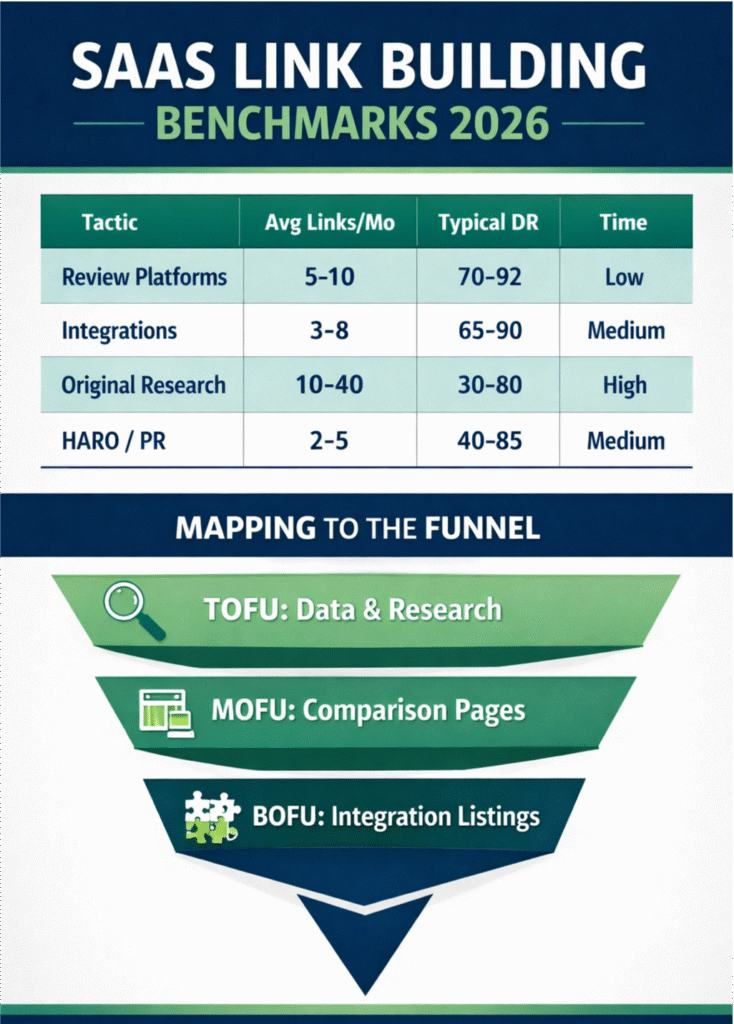
| Link Building Tactic | Avg. Links/Month | Typical DR Range | Time Investment | Cost | AI Overview Impact |
|---|---|---|---|---|---|
| SaaS Review Platforms | 5–10 (one-time setup) | 70–92 | Low (setup only) | Free | Very High |
| Integration Partner Directories | 3–8 (one-time) | 65–90 | Medium | Free | High |
| Original Research / Data Reports | 10–40 per report | 30–80 | High (creation) | Free–Low | Very High |
| HARO / Journalist Outreach | 2–5/month | 40–85 | Medium (daily) | Free | Medium |
| Community / Product Hunt | 5–20 (launch) | 50–91 | Medium | Free | Medium |
| Skyscraper Technique (SaaS) | 3–8/campaign | 35–70 | High | Free–Low | Medium |
| Broken Link Building | 2–6/month | 30–65 | High | Free | Low |
| Integration Partner Blog Posts | 1–3/partner | 40–75 | Medium | Free | High |
Benchmarks based on SaaS startup link building campaigns across B2B software niches, 2025–2026.
Mapping Link Building to Your SaaS Funnel
Link building doesn’t exist in isolation — it powers your entire SaaS content marketing funnel. Here’s how to align them.
TOFU content + link building: Your educational TOFU content earns links from industry bloggers who cover SaaS pain points. Original data and research published for awareness audiences becomes citation material for journalists. Every link to your TOFU content raises your domain authority, which then makes your MOFU and BOFU pages rank faster without additional link building.
MOFU content + link building: Comparison pages and use case content earn links from SaaS communities and review roundups. When someone publishes “best alternatives to [competitor]” and your comparison page is the most comprehensive resource, you get the link and the referral traffic.
BOFU content + link building: Case studies and ROI data earn links from VCs, accelerators, and startup blogs that cover SaaS success stories. A well-documented case study (“How [Customer] reduced churn by 34% using [Your SaaS]”) becomes a citation in content about churn reduction strategy.
Internal Link Architecture for SaaS Authority Building
Strong internal linking multiplies the impact of every backlink you earn. When a high-authority external link points to your TOFU blog post, proper internal linking passes that authority to your MOFU comparison pages and BOFU trial pages.
The framework is simple: every new blog post links to your most important conversion pages. Every high-traffic TOFU page links to relevant MOFU content. Use the topical authority building strategy to cluster your content semantically, so Google understands your full SaaS niche depth — not just individual pages.
For AI search optimization: internally connected content clusters are more likely to be cited as comprehensive sources in AI Overviews. A site with 20 internally linked SaaS articles covering keyword research, content funnels, link building, and growth strategy signals deeper expertise than 20 isolated posts. Learn how mastering SEO, AEO, and GEO ties internal linking to AI search visibility.
90-Day SaaS Link Building Action Plan
Month 1 — Foundation: Claim and fully complete all SaaS review platform profiles (G2, Capterra, Product Hunt, AlternativeTo, SaaSHub). Submit to all relevant integration directories. Set up HARO and begin responding to 3–5 queries daily. Audit competitor backlink profiles in Ahrefs to identify top opportunity categories.
Month 2 — Content & Outreach: Publish your first original data piece or benchmark report. Begin HARO earning first media links. Identify 15 broken link opportunities in your SaaS niche. Reach out to 5 integration partners about co-marketing blog collaboration.
Month 3 — Scale: Launch Product Hunt if not done already. Execute broken link building campaign. Pitch first Skyscraper content to identified prospects. Begin building journalist relationships in your SaaS niche for ongoing HARO and direct coverage. Document all results — this becomes your link building case study for future authority building.
Frequently Asked Questions
How many backlinks does a SaaS startup need to start ranking? There’s no fixed number, but quality matters far more than quantity. A SaaS startup with 30–50 backlinks from DR 50+ relevant sources (review platforms, integration directories, niche publications) will typically outrank a competitor with 300 backlinks from generic blogs. Focus on earning 5–10 high-authority links per month consistently rather than chasing volume. Most SaaS startups see meaningful ranking movement after hitting 40–60 quality referring domains.
What’s the fastest link building strategy for a new SaaS? Review platform listings and integration partner directories give you the fastest legitimate high-authority links — often within days of submission. For earned media links, HARO can produce results within the first month if you’re responding consistently. Avoid any “quick” strategies involving paid links, PBNs, or link farms — Google’s 2026 updates detect these patterns faster than ever, and a manual penalty will cost you far more time than patient, legitimate link building. See why white-hat link building is the only viable long-term approach.
Should SaaS startups do guest posting? Yes, but strategically. Guest posting on SaaS-specific publications (SaaStr blog, Indie Hackers, specific SaaS niche blogs your buyers read) earns relevant, valuable links. Mass guest posting on generic “tech blogs” wastes time and produces links Google partially ignores. Target 2–3 quality SaaS-relevant guest placements per month over 10 low-quality ones. One post on a publication your buyers actually read is worth more than ten on sites they’ve never heard of.
How does link building affect SaaS trial conversions? Indirectly but significantly. Higher domain authority means your trial pages, comparison pages, and case studies rank higher — putting your product in front of buyers who are actively searching. Review platform links drive direct referral traffic from high-intent buyers. Media coverage from HARO and digital PR builds the brand trust that makes buyers more willing to start a trial when they finally land on your page. The SEO results timeline case study shows how authority-building through links directly correlates with conversion rate improvements over time.
What anchor text should SaaS startups use for backlinks? Aim for a natural anchor text distribution: 40–50% branded (your product name or company name), 20–30% naked URLs (just your domain), 15–20% topical/descriptive phrases (“SaaS project management tool,” “team collaboration software”), and 10–15% generic (“learn more,” “read here”). Avoid exact-match keyword anchors like “best CRM software” as your primary anchor — this looks manipulative. Natural distributions that mirror how people organically reference things are what Google’s 2026 algorithm rewards.
How do I know if a link is actually helping my SaaS rankings? Track referring domain growth monthly in Ahrefs or Semrush. Cross-reference new link acquisitions with ranking changes for target keywords in Google Search Console. A quality link from a relevant high-DR site typically shows ranking impact within 4–8 weeks. Monitor your domain rating trend — consistent growth of 2–4 DR points per month indicates a healthy link building program. If your referring domains are growing but DR is flat, your new links are coming from low-authority sources. Adjust targeting accordingly. For tracking your AI search visibility alongside traditional rankings, see how to track AI brand visibility in search engines.
Does link building work differently for B2B SaaS vs B2C SaaS? Yes, meaningfully. B2B SaaS link building prioritizes: industry publications your buyers’ decision-makers read, SaaS-specific review platforms where procurement teams research tools, LinkedIn thought leadership that earns citations, and integration partner ecosystems (where B2B buyers discover complementary tools). B2C SaaS benefits more from: consumer tech media, Product Hunt, general startup coverage, and community platforms. The core principles — earn links from relevant, authoritative sources through genuine value creation — remain the same. Execution and target publications differ significantly.
What AI and GEO implications does link building have in 2026? AI systems like ChatGPT and Google’s AI Overview increasingly use backlink profiles as a trust and authority signal when deciding which sources to cite. A SaaS site cited in authoritative publications (through earned media links) is more likely to appear in AI Overviews than one relying purely on on-page optimization. Review platform presence (G2, Capterra, Product Hunt) directly feeds AI product recommendation responses. Building authority through legitimate link earning is now simultaneously a traditional SEO strategy and a GEO/AEO strategy. For the full framework, read what is the new SEO for AI.
Stop Building Links. Start Earning Authority.
The SaaS startups winning in 2026 are not the ones with the biggest link building budget. They’re the ones who understood that links are a byproduct of being genuinely valuable — to their customers, to their industry, and to the publications and platforms that serve both.
Build your integration ecosystem. Publish original data. Show up consistently on HARO. Get your product on every relevant review platform. Document your results and share them authentically in SaaS communities.
Authority compounds. Every high-quality link you earn today makes the next one easier. Every citation from a media outlet makes the next journalist more likely to include you. Every review on G2 makes the next buyer more likely to trust you.
That compounding effect is the real SaaS link building strategy. Everything else is just tactics in service of it.
Want a custom SaaS link building audit? Visit seoportfolio.in — get a free SEO audit showing exactly where your link profile is weak and which strategies will move your domain authority fastest.

Sharing my journey and learnings in Tech and AI. As a Digital Marketing Expert, I help brands boost their visibility and sales with smart personal branding and the latest AI tricks.

Leave a Reply