|
Getting your Trinity Audio player ready… |
Table of Contents
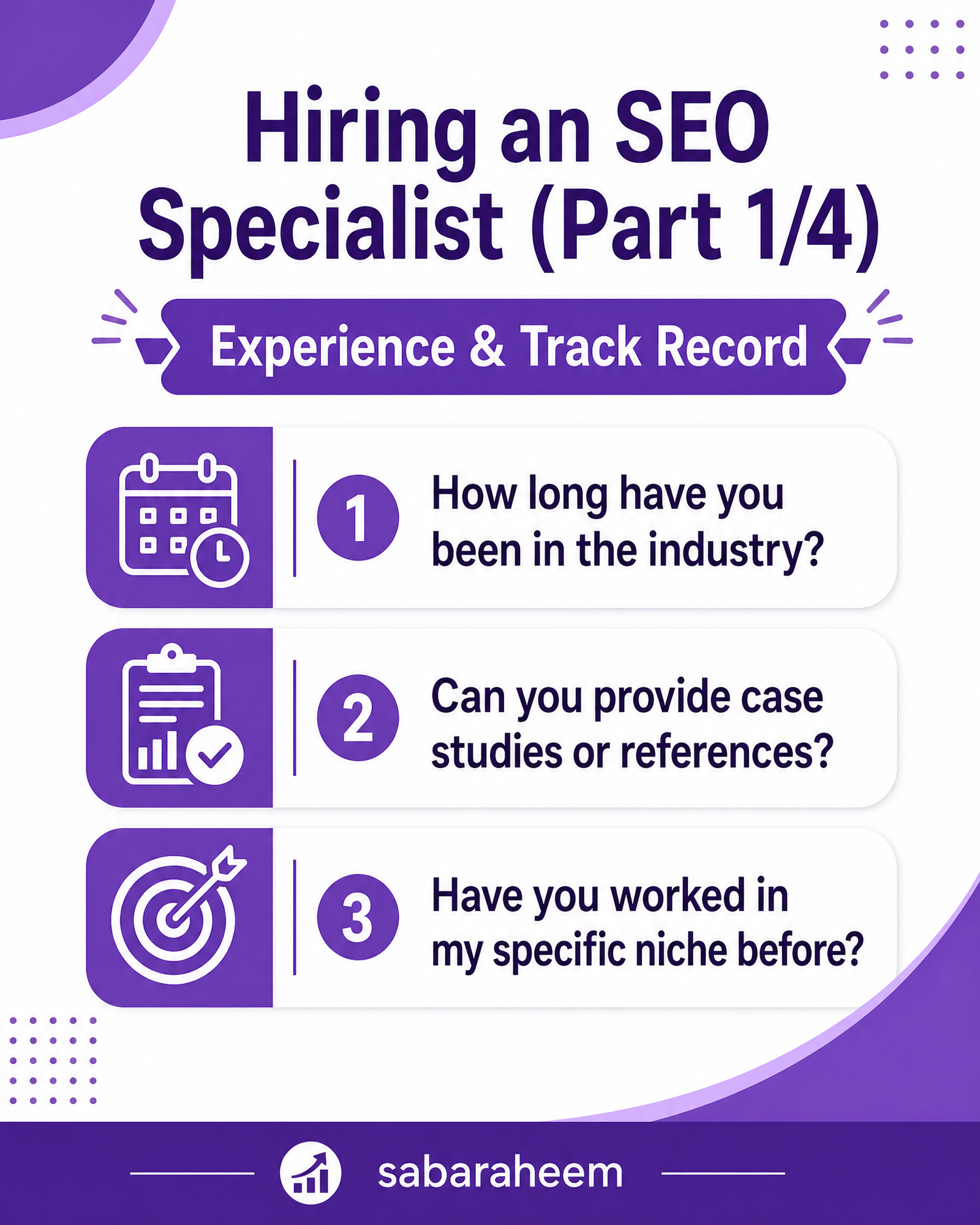
Before hiring an SEO specialist, ask these three questions first: Can you show me a real case study with Google Search Console data? What does your monthly reporting include and what decisions will it drive? How are you approaching AI Overviews and GEO in 2026? If they cannot answer all three clearly, keep looking. The rest of this guide gives you 15 questions in full, with what good and bad answers look like for each one — so you can walk into any SEO conversation knowing exactly what you are evaluating.
| The most important questions to ask an SEO specialist before hiring are about their process, their reporting, their timeline expectations, their 2026 AI search strategy, and their past results with real data. Guarantees of specific rankings are a red flag. Honest timelines and documented processes are green flags. |
| 63%of businesses say they hired the wrong SEO person at least once | 3-6months realistic timeline for meaningful SEO results | 34%of Google SERPs now show AI Overview — ask if they address this | $0cost of a free SEO audit before committing to anything |
Why This Decision Is Harder Than It Looks
Hiring an SEO specialist is genuinely difficult — more than hiring for most other roles. The reason is that SEO results take months to appear, the terminology is full of jargon that sounds impressive but means nothing, and almost anyone can claim to be an SEO expert without any formal credential or licensing requirement.
A web developer you hire either builds the website or they do not. A designer either produces the work or they do not. An SEO specialist can spend six months on your website, deliver polished reports, and produce no meaningful results — and by the time you realise this, you have paid thousands of dollars and lost months of opportunity.
The questions in this guide are not about catching people out. They are about finding the specialist who is genuinely competent, honest about what SEO can and cannot do, and built for the way search actually works in 2026 — not 2018.
Before you hire anyone, get a baseline read of where your site currently stands. The free SEO audit at seoportfolio.in will show you your site’s technical health, ranking opportunities, and current gaps — giving you the context you need to evaluate any SEO proposal intelligently.
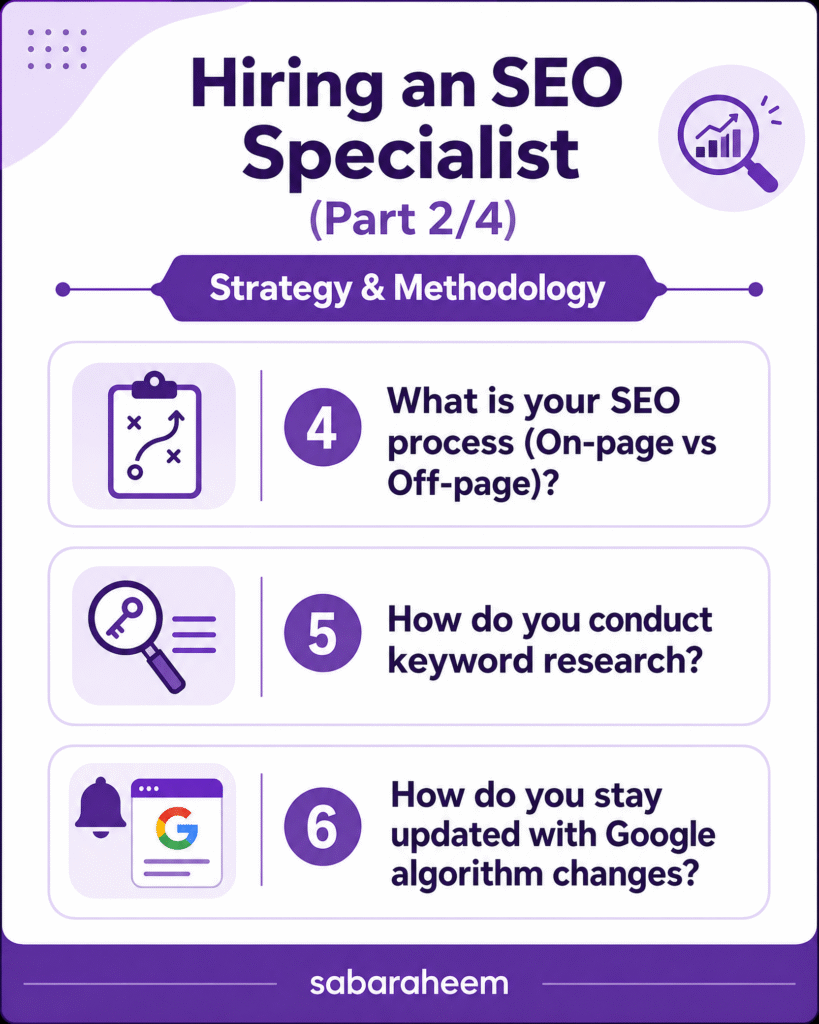
15 Questions to Ask Before Hiring an SEO Specialist
Question 1: Can you show me a real case study with actual data?
| Good answer looks like:Yes — here is a client we worked with for 8 months. Their organic traffic went from 420 to 1,900 monthly sessions. Here is the GSC screenshot showing keyword growth and here is what we did technically and content-wise to get there. | Red flag looks like:I have worked with many clients and they are all happy. I cannot share specifics due to confidentiality. But trust me, results were great. |
Why this matters: Any competent SEO specialist who has been working for more than six months should have at least one case study they can show you — ideally with Google Search Console screenshots, traffic graphs, and a before-and-after comparison. This is the single most reliable signal of competence. Polished PDFs with logos and client names but no actual numbers are not case studies. They are marketing material.
Question 2: What does your SEO process look like from month one to month six?
| Good answer looks like:Month 1 is a full audit and strategy. Month 2 we fix technical issues and begin on-page work. Month 3 we start content production. Month 4 onwards we focus on link acquisition and track ranking movement against targets we set in month 1. | Red flag looks like:We just do everything at once and see what works. SEO is different for every client so we cannot really plan it out ahead of time. |
Why this matters: A professional SEO specialist should be able to describe their process clearly without jargon overload. Month one should typically include a technical audit, keyword research, and competitor analysis. Months two and three should move into on-page implementation and content strategy. Months four through six should introduce link building and track early ranking movement. If they cannot map out a process, they do not have one.
Question 3: How do you handle AI Overviews and GEO in 2026?
| Good answer looks like:We now structure content with direct-answer paragraphs in the first 100 words, implement FAQ and Article schema on all key pages, and track AI Overview appearances alongside traditional rankings. GEO is now part of every content brief we produce. | Red flag looks like:AI search is still new and nobody really knows how to rank in it yet. We focus on traditional Google SEO which is what really matters. |
Why this matters: This question separates specialists who are current from those still running 2018 strategies. Google AI Overview now appears on 34 percent of all search result pages. Any SEO specialist working in 2026 should have a clear answer about how they structure content for AI citation, implement schema markup, and approach Generative Engine Optimization as a discipline alongside traditional SEO.
Question 4: What metrics do you track and what does your monthly report include?
| Good answer looks like:Our monthly report covers organic traffic from GA4, keyword movement from GSC with context on why rankings changed, work completed that month, issues identified, and priorities for the next 30 days. We walk through it with you on a call. | Red flag looks like:We send you a ranking report each month showing all your keywords and their positions. Green means up, red means down. |
Why this matters: Reporting is where you find out whether a specialist is working for you or working for the appearance of working for you. A good report shows organic traffic trends, keyword ranking changes with context, clicks and impressions from Google Search Console, Core Web Vitals status, and a section explaining what was done and what will be done next. A report that only shows keyword rankings going up without context for what drove that change is not useful.
Question 5: How long will it take to see results?
| Good answer looks like:For a site in your position and niche, we would expect to see keyword movement in months two and three, meaningful traffic growth from months four to five, and compounding results from month six onward. We will set specific milestone targets in month one. | Red flag looks like:We can get you to Page 1 in 30 days. We have a proven system that works fast. Most clients see results very quickly with us. |
Why this matters: Honest SEO specialists set realistic expectations. Meaningful organic traffic growth typically takes three to six months for a site with basic authority. Competitive niches or new domains can take 9 to 12 months before significant movement. Anyone who promises Page 1 rankings in 30 days is either lying or planning to use tactics that will eventually penalise your site.
Question 6: Do you do your own work or outsource it?
| Good answer looks like:Our content is written by our in-house team with subject matter expertise. We handle technical SEO internally. For link outreach we use a vetted partner we have worked with for three years, and we review every link before it goes live. | Red flag looks like:We have a full team that handles everything. We cannot really go into the specifics of our internal processes. |
Why this matters: Many SEO agencies outsource significant portions of their work — content writing, link building, technical fixes — to third-party providers, sometimes offshore. This is not automatically bad, but you deserve to know it. Hidden outsourcing means the quality control may be different from what you were sold. Ask directly: who actually writes the content? Who builds the links? Who does the technical work?
Question 7: What happens if my rankings drop after a Google algorithm update?
| Good answer looks like:When a major update hits, we first check if your site was affected against the update’s known signals. If you dropped, we diagnose whether it is a content quality issue, technical issue, or link profile issue — and we give you a recovery roadmap within two weeks of the update stabilising. | Red flag looks like:Algorithm updates are out of our control. We cannot guarantee rankings because Google changes things all the time. You just have to be patient. |
Why this matters: Google updates its algorithm thousands of times per year, including major updates that can significantly shift rankings. A good SEO specialist monitors updates, communicates proactively when one affects your site, and has a documented process for diagnosing and recovering from ranking drops. A weak specialist either disappears when results go negative or blames Google without offering a recovery plan.
Question 8: What is your link building strategy?
| Good answer looks like:We focus on digital PR, guest posting on relevant industry publications, and resource link building. Every link is editorially placed — meaning someone chose to link to the content because it was useful, not because we paid for placement. We can show you examples of links we have built for similar clients. | Red flag looks like:We have a network of high DA websites where we place links. We can get you 50 links per month. More links means better rankings. |
Why this matters: Link building is one of the most abused areas of SEO. Bad links from irrelevant or spammy sites can penalise your domain. Good links from relevant, authoritative sites build genuine ranking power. Ask specifically what types of links they build, how they acquire them, and whether they can show you examples of links they have built for previous clients.
Question 9: Have you worked with businesses in my industry before?
| Good answer looks like:We have not worked specifically in your industry, but we have worked in adjacent sectors. In the first two weeks we do a deep dive into your competitive landscape — your top five competitors, what keywords they rank for, what content they produce, and where the gaps are. | Red flag looks like:Yes, we have worked with hundreds of clients across all industries. We know exactly what to do for any type of business. |
Why this matters: Industry experience is not mandatory — a skilled SEO generalist can learn any niche quickly. But if they have worked in your sector before, they already understand your audience’s search behaviour, your competitors’ strategies, and the content topics that perform in your space. This shortens the ramp-up time significantly. What matters more is whether they ask intelligent questions about your business even without industry experience.
Question 10: What does success look like at 3 months, 6 months, and 12 months?
| Good answer looks like:At 3 months we expect technical issues resolved, 15 to 20 target keywords in the top 30, and baseline content published. At 6 months, 8 to 10 keywords in the top 10, measurable organic traffic increase of 30 to 50 percent. At 12 months, consistent organic leads or sales that you can trace back to SEO activity. | Red flag looks like:By 3 months you will see improvement. By 6 months results will be significant. By 12 months you will be dominating your market. |
Why this matters: This question reveals whether the specialist can set realistic, measurable targets tied to your business goals. Success for a local restaurant is very different from success for a national e-commerce brand. A specialist who asks about your revenue goals, customer acquisition costs, and conversion rates before answering this question is operating at a genuinely strategic level.
Question 11: How do you approach keyword research and content strategy?
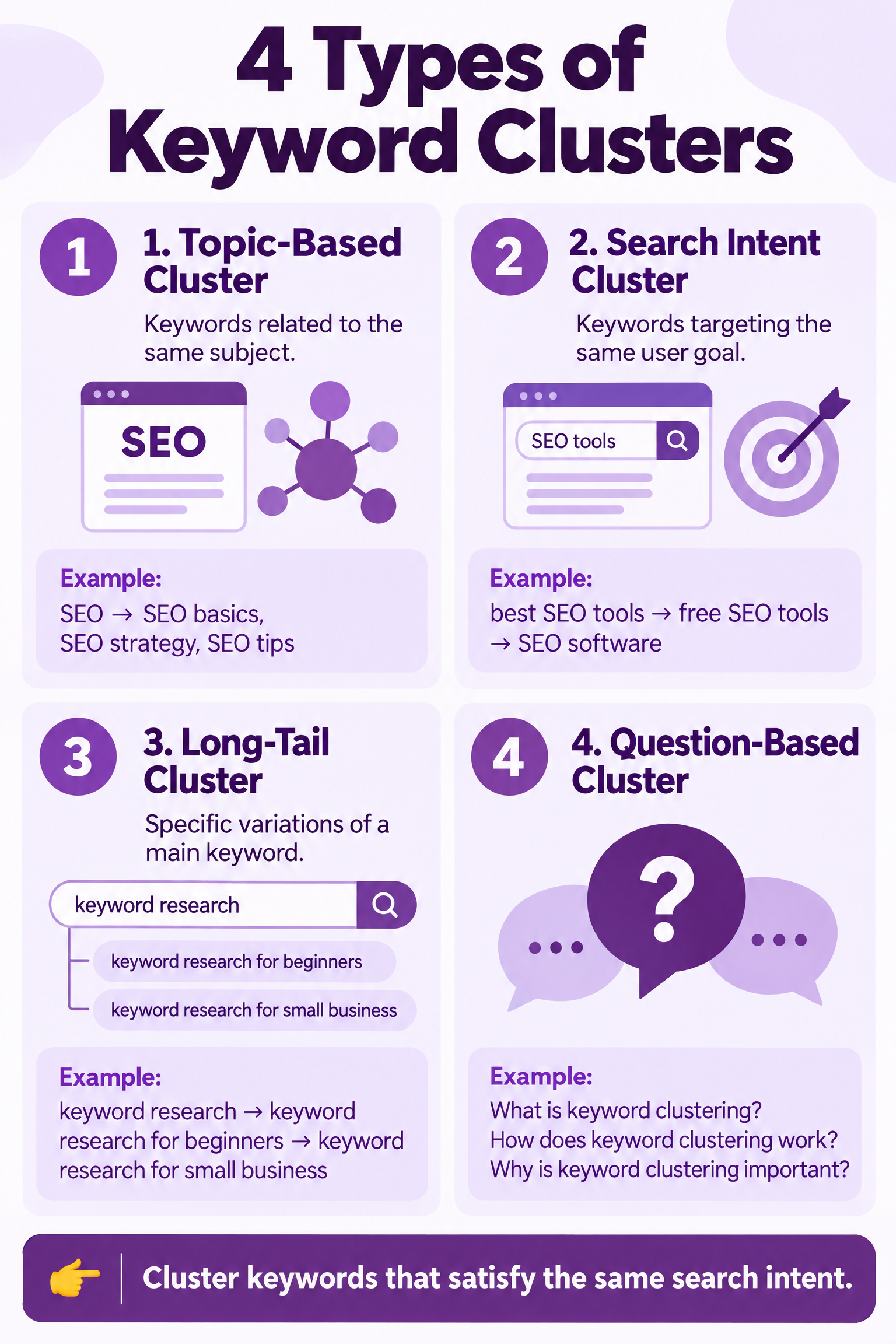
| Good answer looks like:We map keywords to search intent first — informational, commercial, or transactional. Then we build topic clusters where a pillar page covers the broad topic and supporting articles cover subtopics. Every keyword we target has a clear reason for being on your site connected to a user problem your business solves. | Red flag looks like:We use a tool to find all the keywords with high volume and low competition. Then we make sure your pages have those keywords in the right places. |
Why this matters: Keyword research in 2026 is about search intent, entity relationships, and topic clusters — not just monthly search volume. A specialist who still picks keywords based on volume alone is behind the times. Ask them how they decide which keywords to target, how they group related keywords, and how they turn keyword research into a content plan.
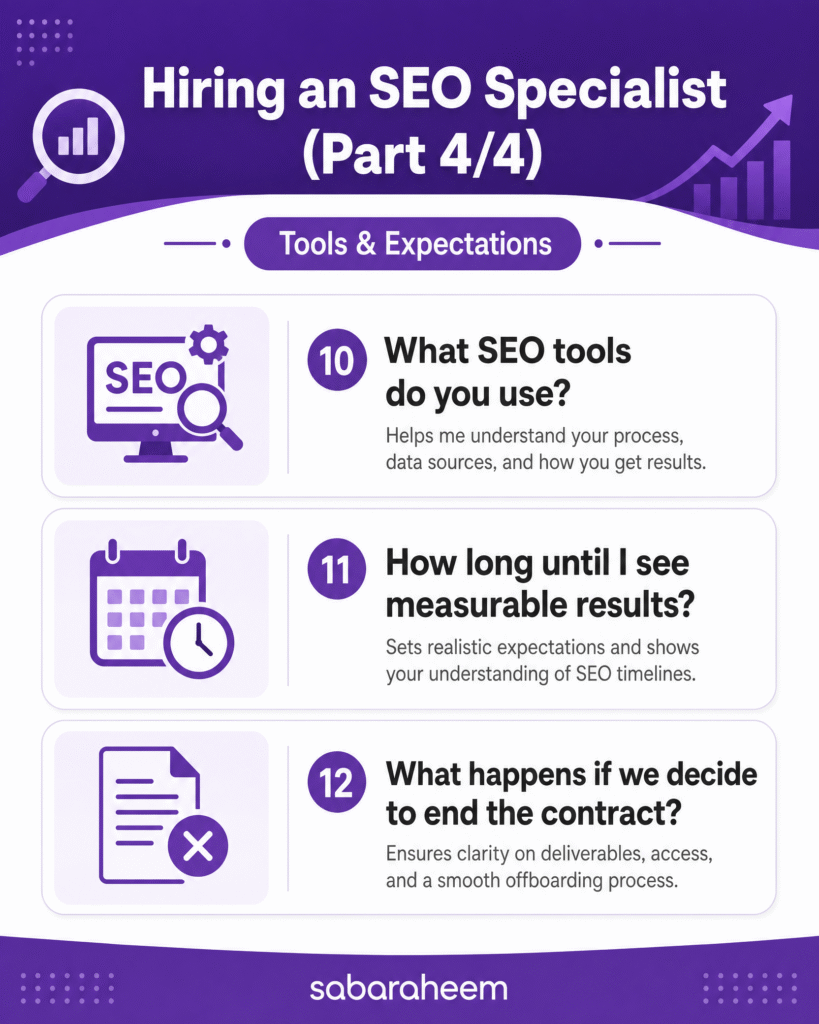
Question 12: What is your contract term and what happens if I want to leave?
| Good answer looks like:We work on a three-month initial agreement, after which it moves to monthly with 30 days notice to exit. If at the three-month review our agreed milestones have not been met, we discuss options before asking you to continue. | Red flag looks like:We require a 12-month contract because SEO takes time. You cannot expect results if you do not give us at least a year. There is no early exit. |
Why this matters: SEO requires time to show results, so some contract commitment is reasonable. But a specialist who requires a 12-month lock-in with no exit clause is taking on no accountability for their results. A fair arrangement is typically a three-month minimum with monthly rolling after that, or a six-month commitment with a clear performance review clause.
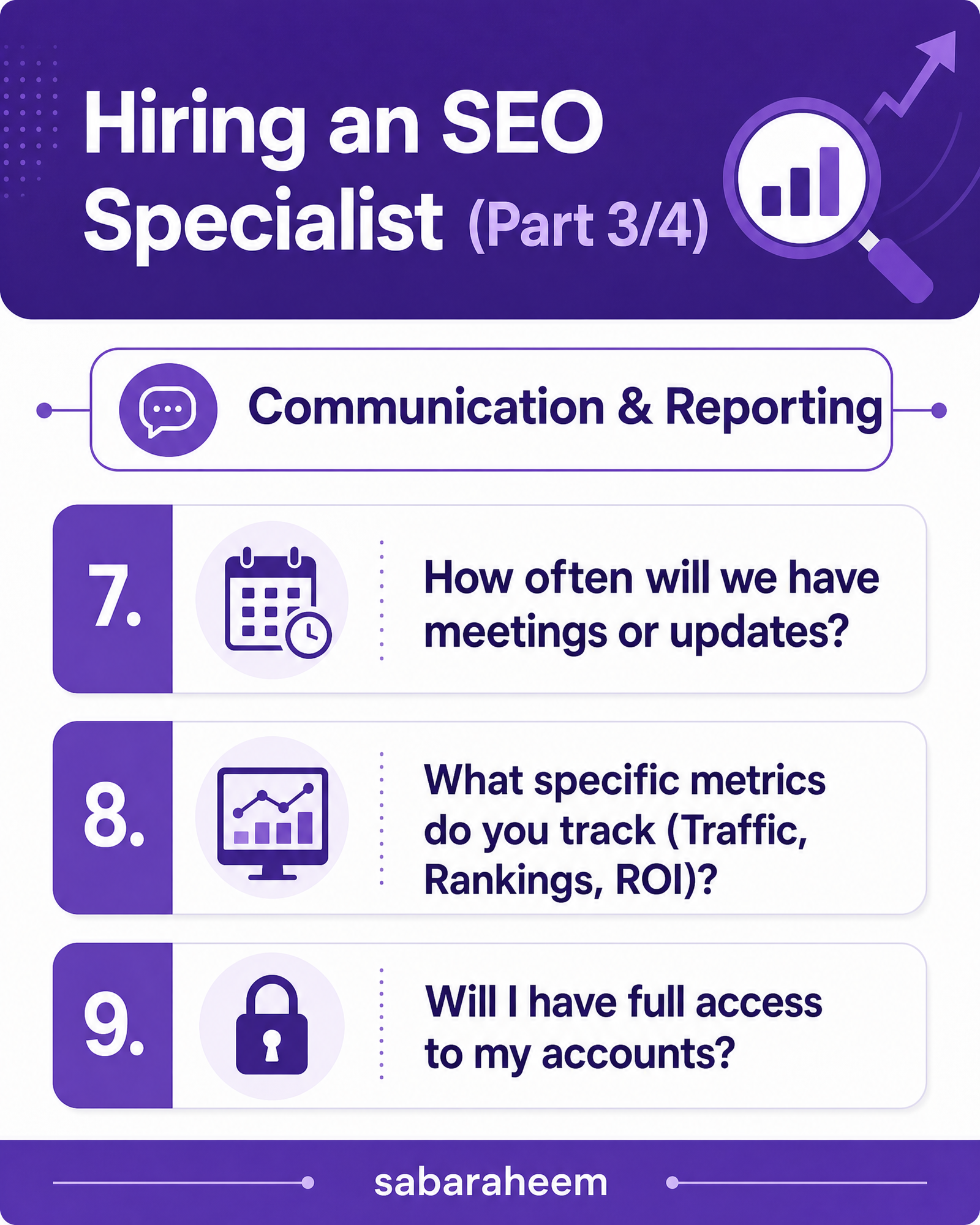
Question 13: Will you make changes directly to my website or provide recommendations for my developer?
| Good answer looks like:For content and on-page changes we work directly in WordPress or your CMS. For technical fixes that require backend changes we document them clearly with specific code snippets and coordinate with your developer. We track implementation status in our project management tool. | Red flag looks like:We will send you a document with all the changes and your developer can do them. We do not have access to client websites. |
Why this matters: This sounds like an administrative question but it matters practically. Some SEO specialists make changes directly in your CMS and can move quickly. Others produce recommendation documents and wait for your development team to implement. The second approach is slower but may be necessary if you have a complex or sensitive codebase. Either approach is fine as long as expectations are clear upfront and the implementation actually happens.
Question 14: How do you stay current with SEO changes in 2026?
| Good answer looks like:I follow Google Search Central updates, read Search Engine Journal and Moz regularly, and actively test new strategies on personal projects before applying them to client sites. In the last six months the biggest shift I adapted to was structuring content for AI Overview citation — we now start every content brief with a direct-answer paragraph. | Red flag looks like:I have been doing SEO for ten years so I know how it works. The basics do not change that much. Good content and good links always win. |
Why this matters: The SEO landscape changes continuously. Google’s algorithm updates, the emergence of AI Overviews, the rise of GEO, and the shift toward entity-based ranking all happened in the last two years. A specialist who is not actively staying current is using a playbook that may already be outdated. Ask specifically what sources they read, what changes they noticed most in the last six months, and how they adapted their strategy.
Question 15: What are your fees and what exactly do I get for that price?
| Good answer looks like:Our monthly retainer at this level includes a monthly strategy call, three blog posts or content updates, on-page optimisation of five pages, backlink prospecting and outreach, and a monthly report delivered by the 5th of each month. Here is what is not included and would be quoted separately. | Red flag looks like:It is $1,500 per month for full SEO. We handle everything — do not worry about the details. |
Why this matters: Pricing transparency is a basic professionalism signal. A specialist who is vague about what their retainer includes, or who quotes a price without breaking down the deliverables, is setting up a relationship where expectations will diverge. Ask for a written scope of work that specifies exactly what activities are included each month, how many hours they allocate, and what is considered extra.
Freelance SEO Specialist vs Agency — Which Should You Hire?
Once you have found candidates who pass the question test above, you may still be deciding between a freelancer and an agency. Here is how they compare:
| Factor | Freelance SEO Specialist | SEO Agency |
| Cost | $500 to $2,500 per month typically | $1,500 to $10,000+ per month |
| Accountability | Direct — one person responsible | Shared — account manager + team |
| Specialisation | Deep in specific areas (content, technical, local) | Broad — multiple specialists in one team |
| Communication | Direct, faster, more personal | Through account manager, may be slower |
| Scalability | Limited by one person’s capacity | Scales with your needs and budget |
| Best For | Small businesses, specific campaigns, startups | Established businesses, multi-service needs |
| AI / GEO readiness | Varies — ask specifically about 2026 strategy | Varies — many agencies still use 2020 playbooks |
| Recommendation: For most small to mid-sized businesses, a skilled freelance SEO specialist delivers better value than an agency at the same budget level — because your money goes to one experienced person rather than being split across account managers, junior staff, and agency overhead. The key is asking the right questions to verify competence. |
What Should I Expect to Pay? SEO Pricing Guide for 2026
Understanding realistic pricing helps you identify proposals that are either too cheap to be credible or too expensive to justify:
| Service Level | Monthly Cost (AUD) | What Is Included | Right For |
| Basic SEO | $500 to $1,000 | On-page + reporting | Small local businesses just starting SEO |
| Mid-Level SEO | $1,000 to $2,500 | On-page + content + link building | Growing businesses in competitive niches |
| Full SEO + GEO | $2,500 to $5,000 | Technical + content + GEO + AI visibility | Businesses targeting AI search and top rankings |
| Enterprise SEO | $5,000 and above | Full strategy + dedicated team | Large sites, e-commerce, national campaigns |
| Project-based (one-off audit) | $300 to $1,500 | Audit report + recommendations | Businesses who want a starting point |
Any proposal significantly below the ranges above should trigger additional questions about what is actually being delivered and whether any of the work is being outsourced to low-cost providers. Any proposal significantly above these ranges should come with a detailed scope of work and named specialists doing the work.
Green Flags and Red Flags Quick Reference
| Green Flags — Hire Them | Red Flags — Walk Away |
| Shows you real case studies with GSC dataExplains strategy in plain languageSets realistic timelines (3 to 6 months)Asks about your business goals firstKnows what E-E-A-T and GEO meanSends monthly reports with contextHas a documented process and contractAsks to audit your site before quoting | Guarantees Page 1 rankings in 30 daysCannot explain their process clearlyUses the phrase ‘secret SEO technique’Talks about rankings before understanding your businessHas no portfolio or shows competitor metrics onlyCharges very low prices with vague deliverablesAvoids discussing AI search or 2026 strategyNo contract — just a verbal agreement |
What People Search When Hiring an SEO Specialist
These are real queries people search on Google before making this decision:
- What questions to ask an SEO agency before hiring
- How to tell if an SEO specialist is good
- Red flags when hiring an SEO company
- What should an SEO specialist deliver each month
- How much does a good SEO specialist cost in 2026
- Freelance SEO vs agency which is better
- How long does SEO take to work
- Can SEO specialists guarantee Page 1 rankings
- What is a realistic SEO timeline for a small business
- How to check if my SEO is actually working
Frequently Asked Questions — Hiring an SEO Specialist
How do I know if an SEO specialist is actually good?
Ask for real case studies with Google Search Console data. A competent SEO specialist can show you before-and-after traffic graphs, keyword ranking changes, and a clear explanation of what they did to produce those results. If they cannot show you real data for at least one past client, they either have not produced results worth showing or they are too junior to have a meaningful track record.
Should I hire a freelancer or an SEO agency?
For most small to mid-sized businesses, a skilled freelance SEO specialist offers better value per dollar at the same budget level, because your money goes to one experienced practitioner rather than being spread across agency overhead and junior staff. The critical difference is in how you verify competence — with a freelancer you are hiring one person, so their answers to the questions in this guide matter more.
Is it a red flag if an SEO specialist guarantees rankings?
Yes — it is the most reliable red flag in SEO. No one can guarantee specific Google rankings because Google’s algorithm is not controlled by any third party. A specialist who guarantees rankings is either using manipulative short-term tactics that will eventually penalise your site, or they are making a promise they cannot keep to win your business. Honest specialists set realistic milestone targets instead of guarantees.
What should be in a monthly SEO report?
A good monthly SEO report should cover organic traffic trends from GA4, keyword ranking movement with context, clicks and impressions from Google Search Console, Core Web Vitals status, work completed that month, issues identified and their priority, and planned work for the next 30 days. A report that only shows keyword positions without explaining what drove changes or what comes next is not useful for decision-making.
How long should I commit to an SEO specialist before expecting results?
A minimum of three months before making a meaningful assessment, with the understanding that significant traffic results typically take five to six months. SEO compounds over time — a good specialist will show you early signals in months two and three (ranking movement, impressions growth in GSC) even if full traffic impact takes longer. Avoid 12-month lock-ins without a performance review clause built into the contract.
Do I need an SEO specialist who knows about AI search and GEO in 2026?
Yes — this is now non-negotiable. Google AI Overviews appear on 34 percent of all search result pages. Any SEO specialist working in 2026 who cannot explain how they structure content for AI citation, implement schema markup for AI readability, or track AI brand visibility is working from an outdated strategy that will underperform as AI search continues to grow.
Further Reading seoportfolio. in
Free SEO Audit Report — seoportfolio.in/seo-audit-formula
Is SEO Dead? What You Need to Know About Search in 2026 — seoportfolio.in/is-seo-dead
LLM SEO in 2026: Complete Guide to AI Search and GEO — seoportfolio.in/llm-seo-geo-guide
15 Proven SEO Techniques in Digital Marketing — seoportfolio.in/15-seo-techniques
How Personal Branding Builds Entity Authority in AI Search — seoportfolio.in/personal-branding-entity-authority
How Are You Tracking AI Brand Visibility? — seoportfolio.in/ai-brand-visibility
SEO and Web Optimization Service — seoportfolio.in/seo-web-optimization
Work With Me — seoportfolio.in/work-with-me
Ready to Work With an SEO Specialist You Can Trust?
Start with a free website audit at seoportfolio.in/seo-audit-formula — you will get a clear picture of where your site stands before committing to anyone. No sales pitch, no obligation.
Sources and References
BrightEdge AI Overview Research (2026) · Search Engine Journal Hiring Guide · Moz State of SEO Report (2026) · Google Search Central Documentation · seoportfolio.in client data and case studies

Sharing my journey and learnings in Tech and AI. As a Digital Marketing Expert, I help brands boost their visibility and sales with smart personal branding and the latest AI tricks.
Leave a Reply