|
Getting your Trinity Audio player ready… |
Table of Contents
| SEO (Search Engine Optimization) in digital marketing is the practice of improving a website so it appears higher in search engine results, like Google, when people search for relevant terms. Unlike paid ads, SEO traffic is free and ongoing. For example, a bakery optimizing its website for ‘best cupcakes in Sydney’ so it appears on the first page when local customers search for that exact phrase. SEO includes four main types: on-page SEO, off-page SEO, technical SEO, and local SEO. |
Introduction: SEO Explained Without the Jargon
If you have ever Googled something and clicked one of the first few results without thinking twice, you have just experienced SEO working exactly as intended. You did not see an ad. You did not pay for that result to appear. The website simply earned its position by being relevant, useful, and properly structured for Google to understand.
That is the entire concept of SEO in one sentence: making your website the kind of result Google wants to show people.
Most explanations of SEO get tangled up in technical terminology before explaining the basic idea clearly. This guide does it the other way around. We start with what SEO actually is, in plain language, then walk through real-world examples that make the concept concrete rather than abstract.
1. What Does SEO Actually Mean?
SEO stands for Search Engine Optimization. It is the process of improving your website so that search engines like Google, Bing, and increasingly AI-powered search tools, understand what your site is about and show it to people searching for related topics.
Think of Google as a librarian with access to billions of books (websites). When someone walks in and asks a question, the librarian needs to quickly figure out which books are most likely to have the answer, and which ones are trustworthy enough to recommend confidently. SEO is the practice of making your website easy for that librarian to understand, trust, and recommend.
| The Simplest Way to Understand SEO:If a customer typed a question into Google about the exact problem your business solves, would your website show up in the first few results? SEO is everything you do to make the answer to that question ‘yes.’ |
SEO vs. Paid Advertising: The Key Difference
| Factor | SEO (Organic) | Paid Advertising (PPC) |
|---|---|---|
| Cost per click | Free once ranking is achieved | You pay for every click, ongoing |
| Time to results | Weeks to months to build ranking | Immediate — ads appear as soon as you launch |
| Longevity | Results persist even if you pause work temporarily | Traffic stops the moment you stop paying |
| Trust factor | Users often trust organic results more than ads | Users sometimes skip or distrust ad placements |
| Long-term cost efficiency | Becomes cheaper per visitor over time | Cost stays constant or increases with competition |
Most successful digital marketing strategies use both. Paid ads for immediate visibility while SEO is being built, and SEO for sustainable, long-term traffic that does not disappear the moment the budget runs out.
2. Why SEO Matters in Digital Marketing
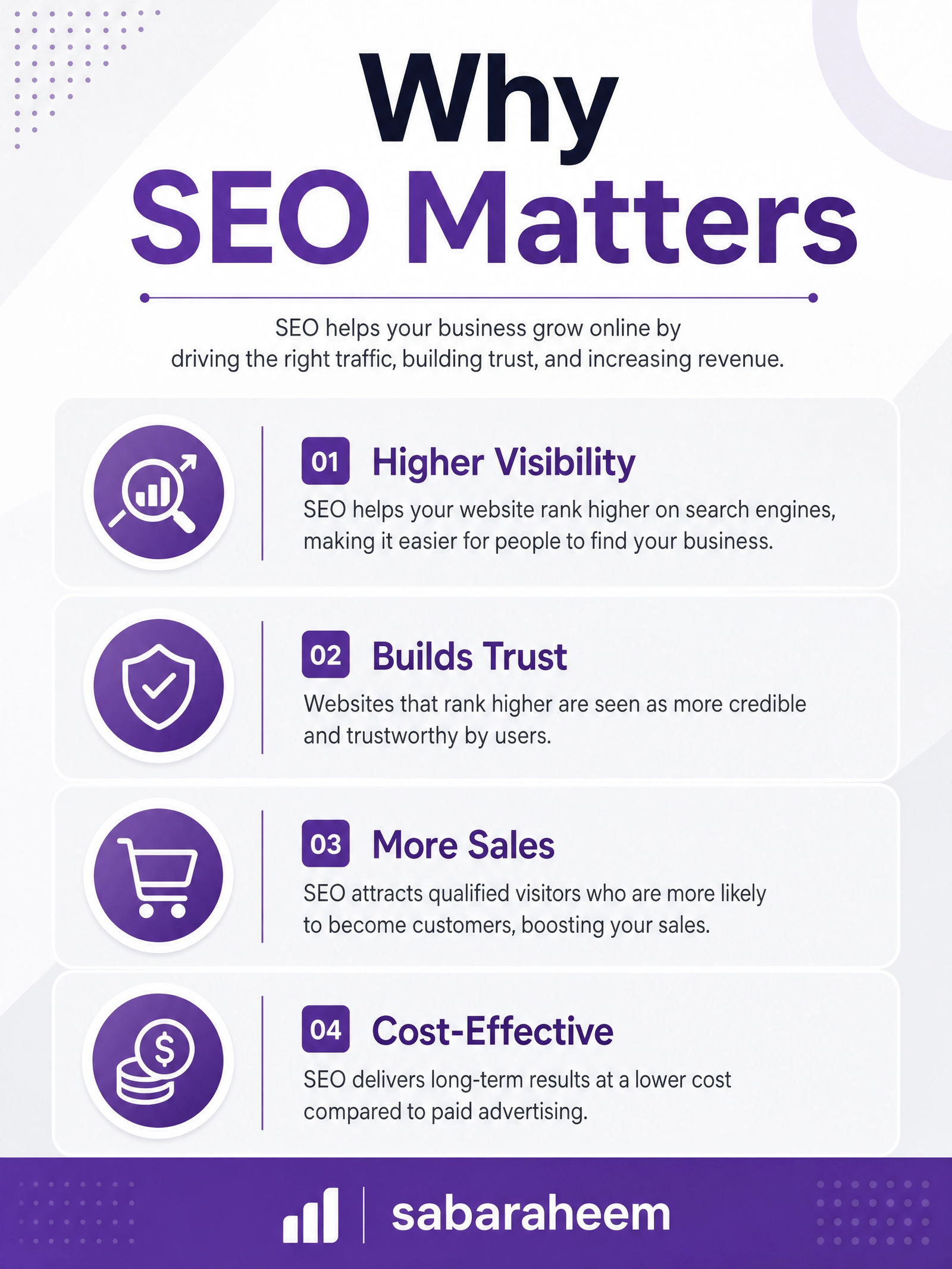
- Most online experiences start with a search engine: The overwhelming majority of website visits begin with someone typing a question or phrase into Google. If you are not visible there, you are invisible to that entire pool of potential customers.
- It builds long-term, compounding value: Unlike ads that stop the moment you stop paying, a well-optimized page can continue earning traffic for years with periodic maintenance.
- It targets people actively looking for what you offer: Someone searching ’emergency plumber near me’ already has the problem and the intent to solve it. SEO puts you in front of exactly that high-intent audience.
- It builds credibility: Appearing high in organic search results signals trustworthiness to users, simply because Google has effectively vouched for your relevance.
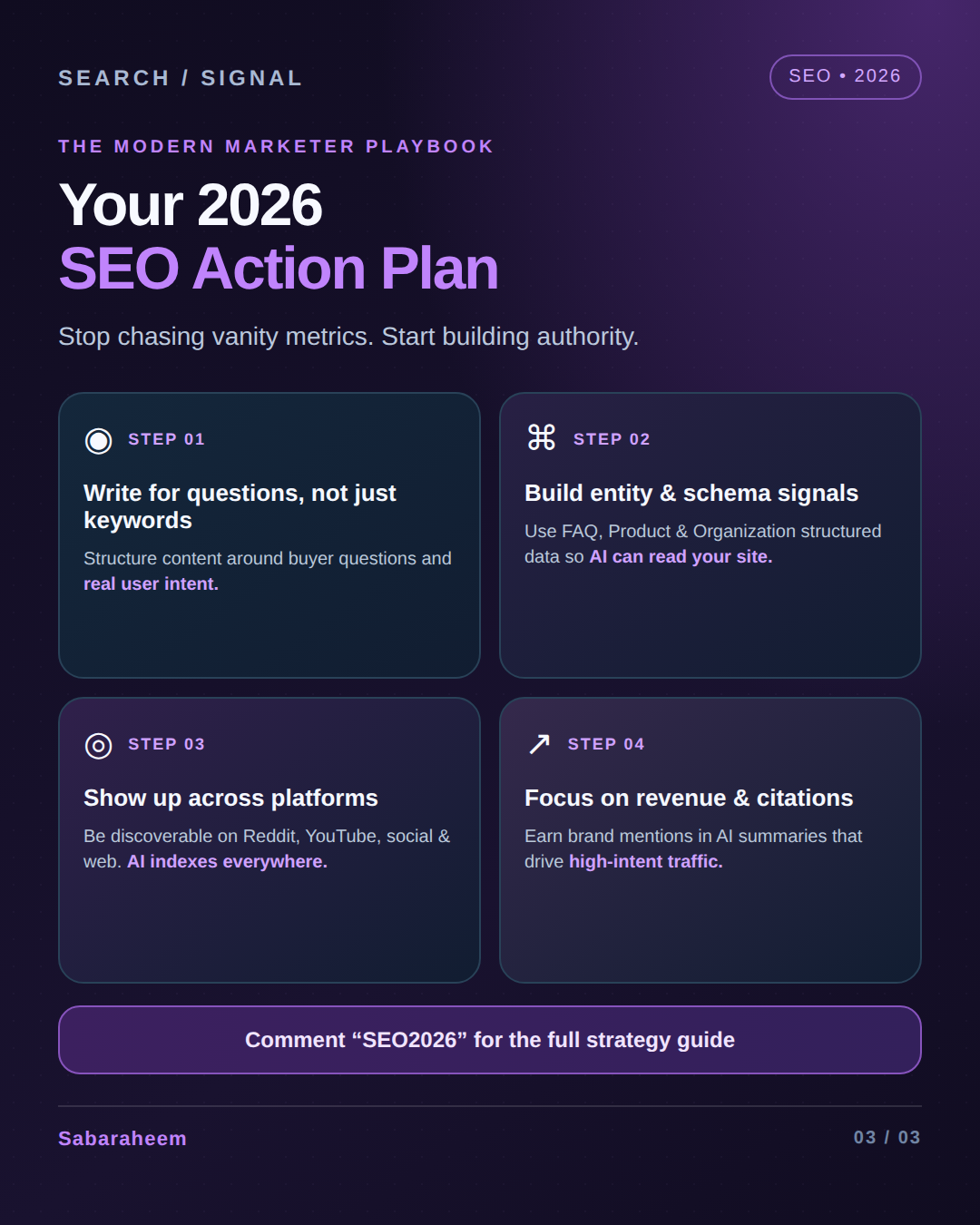
- It is now connected to AI search visibility: Strong SEO foundations also improve your chances of being cited in AI-generated answers from tools like ChatGPT and Google AI Mode. For the full picture on this connection, see the future of search: mastering 2026 SEO changes
3. The 4 Main Types of SEO
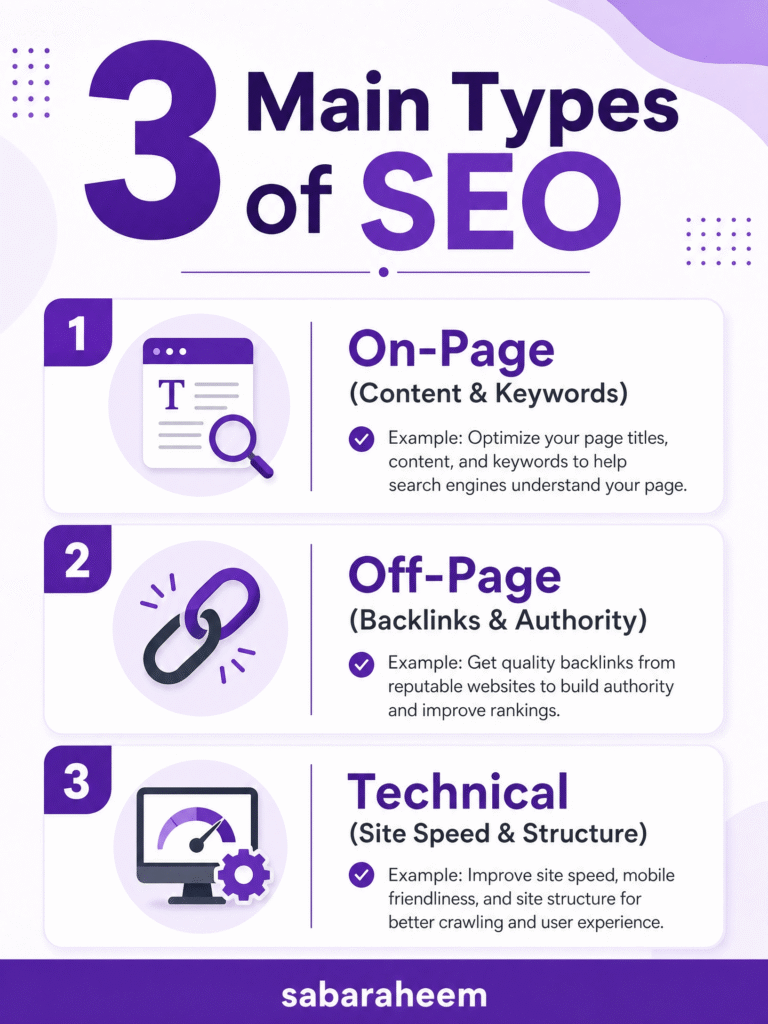
SEO is not one single activity. It is a combination of four distinct disciplines that work together. Understanding each type helps clarify what ‘doing SEO’ actually involves.
| On-Page SEOFocus: Everything you control directly on your own web pages: content quality, keyword usage, headings, page titles, meta descriptions, and internal linking Real Example: A bakery writes a detailed blog post titled ‘Best Cupcake Flavours for a Birthday Party in Sydney’ that naturally includes the phrases people actually search for, with clear headings and helpful information |
| Off-Page SEO Focus: Activities that happen outside your own website but influence how Google views your authority, primarily backlinks from other reputable websites Real Example: A local food blogger writes a glowing review of the bakery and links back to their website. That link acts as a vote of confidence in Google’s eyes |
| Technical SEO Focus: The behind-the-scenes structure of your website: page speed, mobile-friendliness, site security (HTTPS), crawlability, and structured data markup Real Example: The bakery’s website loads in under 2 seconds, works perfectly on mobile phones, and uses schema markup so Google can clearly identify their business hours, address, and menu items |
| Local SEO Focus: Optimizing specifically to appear in local search results and Google Maps for businesses serving a specific geographic area Real Example: When someone searches ‘cupcakes near me,’ the bakery appears in the Google Maps 3-pack because their Google Business Profile is complete, verified, and has consistent reviews |
If you run a business with a physical location or service area, local SEO is often the highest-impact starting point. We cover the complete local SEO troubleshooting process in why is your business not ranking on Google Maps.
4. Real-World SEO Examples: Before and After
Concepts become clearer with concrete examples. Here are three realistic before-and-after scenarios showing what SEO actually changes in practice.
| Example 1 A Local Bakery Trying to Attract Birthday Cake Customers Before SEO: The bakery’s website has one page with the text ‘We make delicious cakes’ and a phone number. It does not appear anywhere in Google search results for cake-related searches in their city. which After SEO: The bakery adds a dedicated page titled ‘Custom Birthday Cakes in Sydney,’ includes photos, pricing ranges, customer reviews, and a complete Google Business Profile. Within 8 weeks, the bakery starts appearing on page 1 for ‘birthday cakes near me’ searches in their suburb. Lesson: Specific, well-structured content that directly answers what a searcher is looking for performs dramatically better than vague, generic text. |
| Example 2: A Freelance Web Developer Trying to Get Client Inquiries Before a SEO: The developer’s portfolio site has no blog, no case studies, and a generic ‘About Me’ page. They rely entirely on word-of-mouth referrals for new clients. After SEO: The developer publishes case studies describing specific projects, writes a few helpful guides answering common client questions, and builds Author Schema linking their name to LinkedIn and a few guest articles. Within 4 months, they start ranking for ‘freelance web developer for small business’ and receive inbound inquiries from search traffic for the first time. Lesson: Demonstrating real, documented expertise through content is what search engines and potential clients both respond to. This connects directly to building entity authority, covered in |
| Example 3: An E-commerce Store Selling Outdoor Gear Before SEO: Product pages have thin, copied manufacturer descriptions. Page load times are slow, and the site is not optimized for mobile shopping. After SEO: The store rewrites product descriptions with original, detailed content answering common buyer questions, compresses images to improve load speed, and ensures the mobile checkout experience is smooth. Organic traffic to product pages increases by 65% over six months, with a corresponding increase in conversions from search traffic. Lesson: Technical performance and original content work together. Fixing one without the other limits how much improvement is possible. |
These examples reflect the same pattern across every successful SEO case: identify what people are actually searching for, create genuinely useful content or pages that address it directly, and remove the technical barriers that prevent search engines and users from accessing that content easily.

5. How SEO Fits Into the Bigger Digital Marketing Picture
SEO does not operate in isolation. It is one channel within a broader digital marketing strategy that typically also includes social media, email marketing, paid advertising, and content marketing. The strongest results come from these channels reinforcing each other.
| Digital Marketing Channel | How It Connects to SEO |
|---|---|
| Content Marketing | The blog posts, guides, and resources you create for SEO purposes are also your content marketing assets shared on social media and in email newsletters |
| Social Media Marketing | Social shares and engagement can indirectly support SEO by driving traffic and earning brand mentions that contribute to off-page authority |
| Paid Advertising (PPC) | Paid ads can validate which keywords convert well, informing which terms to prioritize in your organic SEO strategy |
| Email Marketing | SEO-driven blog content gives you material to share in newsletters, keeping subscribers engaged between purchases |
| Personal Branding | A recognized personal brand strengthens E-E-A-T signals that directly improve how search engines evaluate your content’s trustworthiness |
If you want to understand how all of this connects to the most current shift in SEO, where AI search engines are changing how visibility works entirely, the complete guide to AI-first SEO strategy for 2026 is the natural next step after understanding these fundamentals.
6. How to Get Started With SEO: A Simple First Step Checklist
- Identify what your customers actually search for. Think about the exact phrases someone would type into Google when looking for what you offer.
- Make sure your website clearly and specifically answers those searches, rather than using vague, generic language.
- Claim and fully complete your Google Business Profile if you serve a local area.
- Check that your website loads quickly and works properly on mobile phones, since most searches happen on mobile devices
- Start publishing helpful, specific content that addresses real questions your potential customers have
- For a full structured starting point, get a free SEO audit to see exactly where your website currently stands and what to prioritize first

People Also Ask
What is SEO in simple words?
SEO, or Search Engine Optimization, is the process of improving a website so that it appears higher in search results when people search for related topics. In simple terms, it is making your website easy for Google to find, understand, and recommend to people searching for what you offer.
What is an example of SEO in digital marketing?
A common example: a local restaurant creates a page on its website titled ‘Best Italian Restaurant in Melbourne’ with specific details about their menu, location, and customer reviews. When someone searches for that exact phrase, Google is more likely to show that restaurant’s page because the content directly and specifically matches what the searcher is looking for.
What are the 4 types of SEO?
The four main types of SEO are: on-page SEO (optimizing content and structure on your own website), off-page SEO (building authority through backlinks and external mentions), technical SEO (improving site speed, mobile-friendliness, and crawlability), and local SEO (optimizing for location-based searches and Google Maps visibility).
Is SEO free or does it cost money?
The traffic SEO generates is free in the sense that you do not pay per click the way you would with paid advertising. However, SEO requires investment of time, content creation effort, and often professional expertise to do effectively. Most businesses either invest staff time or hire an SEO professional, making it a cost of effort and expertise rather than a direct cost per visitor.
How long does SEO take to work?
Most SEO efforts begin showing measurable results within 3 to 6 months, though this varies based on competition level, website history, and how much work is needed. Highly competitive industries or brand new websites typically take longer. Local SEO for less competitive searches can sometimes show results within weeks.
Frequently Asked Questions
Do I need to hire an SEO expert or can I do it myself?
Basic SEO fundamentals, such as writing clear, helpful content and setting up a Google Business Profile, can absolutely be done by a business owner without specialist expertise. More technical aspects, such as site speed optimization, schema markup implementation, and competitive keyword strategy, often benefit from professional expertise, particularly in competitive industries.
What is the difference between SEO and SEM?
SEO (Search Engine Optimization) refers specifically to improving organic, unpaid search rankings. SEM (Search Engine Marketing) is a broader term that includes both SEO and paid search advertising (PPC). SEM is the umbrella strategy; SEO is one component within it, alongside paid search campaigns.
Can small businesses compete with large companies in SEO?
Yes, particularly through local SEO and highly specific content. A large national company cannot easily out-rank a well-optimized local business for searches like ‘plumber in [specific suburb]’ because local relevance and proximity are significant ranking factors. Specificity and genuine local presence are major advantages smaller businesses have. This local-specific advantage is covered in detail in why is your business not ranking on Google Maps.
Does SEO still matter with the rise of AI search tools?
Yes, and arguably more than before. The foundational principles of SEO — creating genuinely useful, well-structured, relevant content — are the same signals that AI search tools like ChatGPT and Google AI Mode use to decide what to cite in their answers. Strong traditional SEO is now also the foundation for being visible in AI-generated search results. The connection between traditional SEO and AI visibility is explained fully in the future of search: AI-first SEO strategy for 2026.
What is the very first thing I should do to improve my website’s SEO?
Start by clearly identifying the exact phrases your ideal customers would type into Google when looking for what you offer, then ensure your website has a page that directly and specifically answers that search. This single step, done well, often produces more improvement than any number of technical tweaks done without this foundation in place. From there, a free SEO audit will show you exactly what to prioritize next.
| Ready to See Where Your Website Stands?Get a free SEO audit and a clear, prioritized roadmap for improving your search visibility.>>> Get Your Free SEO Audit <<<Or book a strategy session to build your full SEO plan with expert guidance |

Sharing my journey and learnings in Tech and AI. As a Digital Marketing Expert, I help brands boost their visibility and sales with smart personal branding and the latest AI tricks.
Leave a Reply