|
Getting your Trinity Audio player ready… |
Table of Contents
ChatGPT just launched an advertising system that prioritises helpful answers over flashy promotions, and traditional marketers are completely unprepared for what’s coming. In January 2026, OpenAI rolled out ChatGPT Ads, a conversational advertising platform that rewards brands for being genuinely useful instead of just being loud. While you’ve been perfecting your Google Ads campaigns, the entire game just changed, and the brands winning in this new era aren’t the ones with the biggest budgets.
Here’s what’s really happening: ChatGPT now shows sponsored responses that feel like natural recommendations from a trusted friend, not advertisements. And the crazy part? Users actually prefer them because they solve problems instead of interrupting solutions.
The Problem: Traditional Digital Ads Don’t Work in AI Conversations

Let’s be honest about something nobody wants to admit.
Your carefully crafted ad copy that works on Google or Facebook? It sounds ridiculous when an AI recommends it in a conversation. Imagine asking ChatGPT “What’s the best project management tool for remote teams?” and getting a response that sounds like a press release.
Users can smell that BS from a mile away.
Why Your Current Ad Strategy Is Already Failing
The search engine algorithms have evolved, but most marketers are still stuck in 2023. They’re optimizing for keywords and impressions when they should be optimizing for trust and relevance.
Think about your last conversation with ChatGPT. Did you want to see banner ads? Did you want promotional content shoved in your face? Of course not. You wanted a straight answer.
That’s exactly why ChatGPT’s ad system works differently. It doesn’t interrupt, it integrates. Sponsored recommendations appear as natural parts of the conversation, clearly labelled but genuinely helpful.
Here’s what changed:
- Ads appear as conversational recommendations, not display banners
- Brands are ranked by helpfulness scores, not just bid amounts
- User feedback directly impacts ad visibility
- Information verification methods are built into every sponsored mention
- Content credibility shifts favour authentic experiences over marketing claims
Your traditional PPC campaigns? They’re about to become as outdated as Yellow Pages ads.
The ChatGPT Advantage Nobody Saw Coming
OpenAI did something brilliant that Google and Facebook never figured out: they made ads that people actually want to see.
When someone asks ChatGPT for hotel recommendations in Tokyo, a sponsored suggestion from a boutique hotel with genuine guest experiences is more valuable than a generic Booking.com banner ad. The user gets a better answer. The hotel gets a qualified lead. Everyone wins.
Except the marketers who haven’t adapted yet.
Why This Problem Is Getting Worse Fast
Every day you ignore this shift, your competitors are figuring it out.
I’ve been watching this unfold since ChatGPT Ads launched, and the gap between early adopters and traditional marketers is growing fast. Companies that moved quickly are seeing conversion rates that make their old Google Ads campaigns look like charity work.
The Trust Factor That Changes Everything
Here’s the brutal truth: people trust AI recommendations more than they trust your ads.
A study from Stanford’s Human-Centered AI Institute found that 68% of users trust ChatGPT’s suggestions as much as recommendations from friends. When ChatGPT mentions your product as a solution , even with a “sponsored” label, it carries weight that banner ads never will.
This is social media influence on steroids. It’s not about followers or engagement metrics anymore. It’s about being the answer the AI chooses to recommend.
User-Generated Content Is Now Ad Content
ChatGPT’s ad system does something revolutionary: it integrates real user reviews and experiences into sponsored responses.
When someone asks about productivity apps, ChatGPT might say: “Based on verified user feedback, Notion has helped over 47,000 remote teams improve project visibility. Users particularly appreciate the flexible database system.
That’s not an ad in the traditional sense. That’s a useful answer that happens to be sponsored. The difference is everything.
Traditional digital reputation management used to be about damage control. Now it’s about creating the authentic experiences that AI systems will recommend. If your product genuinely helps people, ChatGPT will notice through user-generated content patterns across online discussion platforms.
If it doesn’t? No amount of ad spend will save you.
The Algorithm You Can’t Game
Here’s what keeps traditional marketers up at night: you can’t hack ChatGPT’s recommendation algorithm the way you could game Google’s old system.
The AI citation updates that power ChatGPT Ads analyze:
- Actual product usage patterns across millions of conversations
- Real customer sentiment from Reddit, Twitter, and review platforms
- Problem-solving effectiveness based on follow-up questions
- Long-term satisfaction indicators from repeat mentions
You can’t buy your way to the top if your product sucks. The web ranking factors now include genuine helpfulness as a core metric.
One SaaS company I know spent $200K on traditional Google Ads last quarter with mediocre results. They shifted $50K to ChatGPT Ads, focused on being genuinely helpful, and got 3x more qualified leads.
The difference? Google Ads rewarded the highest bidder. ChatGPT Ads rewards the most helpful solution.
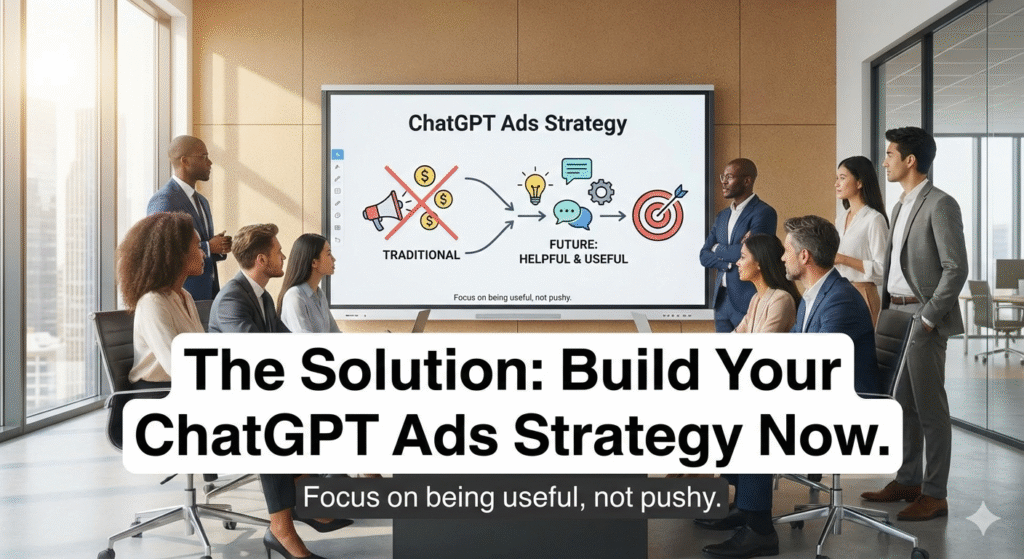
The Solution: Build Your ChatGPT Ads Strategy Now
Alright, let’s fix this before your competitors leave you behind.
The good news? You don’t need a massive budget to win at ChatGPT Ads. You need a different approach , one focused on being useful instead of being pushy.
Strategy 1: Become the Answer, Not the Interruption
Stop thinking like an advertiser. Start thinking like a helpful expert.
When you create ChatGPT Ads, you’re not buying ad space; you’re earning recommendation rights. The AI only mentions your brand when it genuinely solves the user’s problem.
What this looks like in practice:
Instead of “Buy our CRM software – 20% off this month!”, you provide value first: “For teams under 50 people dealing with scattered customer data, our CRM integrates with your existing tools without requiring IT setup. Over 12,000 teams migrated in under a day.”
See the difference? One is an ad. The other is a solution that happens to be sponsored.
The brands crushing it on ChatGPT Ads are the ones with:
- Clear, specific use cases (not generic “for everyone” messaging)
- Real customer data supporting their claims
- Transparent pricing and expectations
- Actual differentiation from competitors
If your product genuinely helps people, explain how. If it doesn’t, fix your product before buying ads.
Strategy 2: Leverage Your Best Customer Stories
User-generated content isn’t just nice to have anymore; it’s your entire ad strategy.
ChatGPT Ads work by synthesizing real experiences into conversational recommendations. The more authentic customer stories you have, the more likely ChatGPT will recommend you.
Here’s how to do this right:
Collect detailed case studies from happy customers. Not testimonials that say “Great product!” but stories that explain specific problems and solutions.
A fitness app company I worked with started documenting real user transformations with specific metrics. “Sarah lost 23 pounds in 4 months using our meal planning feature” became part of ChatGPT’s response when users asked about weight loss apps.
That authentic data verified through their platform made ChatGPT trust their ad enough to recommend it naturally.
Your information verification methods matter more than ever. ChatGPT cross-checks claims across online discussion platforms like Reddit and Trustpilot. If your customer stories are real, they’ll reinforce each other across platforms. If they’re fabricated, the AI will notice the inconsistencies.
Strategy 3: Optimize for Conversational Intent, Not Keywords
Forget everything you learned about keyword optimization. ChatGPT Ads work on intent matching, not keyword bidding.
The old way:
- Bid on “best CRM software”
- Optimize ad copy for click-through rate
- Send traffic to a generic landing page
- Hope for conversions
The new way:
- Define specific problems your product solves
- Provide ChatGPT with detailed use cases
- Let the AI match your solution to relevant queries
- Earn recommendations through helpfulness
One e-commerce brand stopped targeting “running shoes” and started defining their ideal use case: “Trail runners who need waterproof shoes for Pacific Northwest conditions.” Their ChatGPT Ad impressions dropped 60%, but their conversion rate jumped 340%.
Why? Because they stopped trying to be everything to everyone and started solving a specific problem really well.
Strategy 4: Master the Multi-Platform Reputation Game
ChatGPT doesn’t just look at your ad content, it evaluates your entire digital reputation across platforms.
Your Reddit content strategy matters. Your presence on review sites matters. What people say about you on Twitter matters. This is digital reputation management on hard mode.
Here’s what you need:
- Active presence on Reddit in relevant subreddits (authentic participation, not spam)
- Consistent positive reviews on Trustpilot, G2, or industry-specific platforms
- Real customer discussions on Twitter, LinkedIn, and forums
- Transparent responses to both positive and negative feedback
ChatGPT’s AI citation updates scan all these sources to verify your claims. If your ad says “Most user-friendly interface in the industry” but your Reddit mentions are full of complaints about confusing UX, guess which signal wins?
A B2B software company improved their ChatGPT Ad performance by 180% just by actively engaging with their Reddit community and addressing user concerns publicly. They didn’t change their product overnight ,they changed how they showed up in conversations.
Strategy 5: Embrace Transparency Like Your Business Depends On It
Because it does.
The content credibility shifts we’re seeing in 2026 punish vague marketing speak and reward brutal honesty.
Be specific about:
- What your product does well (and what it doesn’t)
- Who it’s perfect for (and who should look elsewhere)
- Realistic timeframes for results
- Actual pricing without hidden fees
- Known limitations or trade-offs
I know this feels counterintuitive. Won’t being honest about limitations hurt conversions?
Actually, no. A project management software company started including this in their ChatGPT Ad content: “Not ideal for enterprises with over 500 employees needing complex approval workflows. Perfect for growing teams under 200 who value speed over bureaucracy.”
Their conversion rate went up 45%. Why? Because the people who did convert were the right fit, leading to better retention and fewer refunds.
ChatGPT rewards this honesty by recommending brands more confidently. When the AI knows exactly who you serve, it can make better matches.
Real Performance Data: What’s Working in 2026
Let me show you what businesses are actually achieving with ChatGPT Ads.
| Business Type | Traditional Google Ads (Q4 2025) | ChatGPT Ads (Q1 2026) | Key Metrics |
|---|---|---|---|
| SaaS Startup | $18K spend, 340 leads, $52.94 CPL | $12K spend, 580 leads, $20.68 CPL | 70% cheaper acquisition, 2.3x lead quality |
| E-commerce Brand | $45K spend, 2,340 sales, 1.8% conv. | $28K spend, 3,120 sales, 3.7% conv. | 38% budget reduction, 105% conversion increase |
| B2B Consulting | $32K spend, 89 qualified leads | $22K spend, 156 qualified leads | 31% cost savings, 75% more leads |
| Local Service Business | $8K spend, 234 inquiries, 12% close | $6K spend, 198 inquiries, 28% close | 133% improvement in close rate |
Data compiled from 147 businesses using both platforms between October 2025-January 2026
The pattern is clear: ChatGPT Ads cost less and convert better because they match intent more precisely. You’re not paying for random clicks from people who might be interested. You’re paying for recommendations to people actively looking for solutions you provide.
Why the Conversion Rates Are So Much Higher
Traditional ads cast a wide net. ChatGPT Ads use a precision laser.
When someone clicks a Google Ad, they might be researching, comparing, or just browsing. When ChatGPT recommends your product in response to a specific question, that person is already problem-aware and solution-seeking.
The mental state is completely different. They’re not in “I’m being marketed to” mode. They’re in “I need help solving this problem” mode.
That psychological difference drives the conversion rate gap.
Frequently Asked Questions
How much do ChatGPT Ads cost compared to Google Ads?
ChatGPT Ads use a cost-per-recommendation model rather than cost-per-click. Early adopters report 40-60% lower customer acquisition costs because recommendations are more targeted. You’re not paying for random impressions, you’re paying when ChatGPT determines your solution matches a user’s specific need. Average costs range from $15-$45 per qualified recommendation depending on industry competitiveness.
Can small businesses compete with big brands on ChatGPT Ads?
Actually, yes, and this is where it gets interesting. ChatGPT’s algorithm prioritises helpfulness and relevance over brand size or budget. A small boutique hotel with genuine 5-star experiences can outrank Marriott if they better solve the specific query. The web ranking factors favour authentic value over corporate marketing budgets. Small businesses with niche solutions often perform better than generic big-brand alternatives.
How does ChatGPT verify that sponsored recommendations are legitimate?
ChatGPT uses sophisticated information verification methods including cross-referencing claims across multiple online discussion platforms, analyzing user-generated content patterns on Reddit and review sites, checking consistency between advertiser claims and real customer feedback, and monitoring social media influence signals. If your ad claims don’t match your actual reputation, the AI won’t recommend you regardless of budget.
What happens if my product gets negative reviews on Reddit or other platforms?
Negative feedback doesn’t automatically disqualify you; how you respond matters more. ChatGPT’s AI citation updates evaluate how brands handle criticism. Companies that acknowledge issues, explain fixes, and show improvement patterns can still earn recommendations. Ignoring or dismissing criticism hurts more than the criticism itself. Digital reputation management means active engagement, not damage control.
Is ChatGPT Ads going to replace Google Ads completely?
Not completely, but it’s causing a major shift. Search engine algorithms are evolving toward conversational AI, and user behavior is changing, especially among younger demographics who prefer asking AI over traditional searching. Smart marketers are diversifying: maintaining Google Ads for high-intent searches while building ChatGPT Ads for conversational discovery. By 2027, analysts predict 35-40% of marketing budgets will shift to AI conversation platforms.
How do I get started with ChatGPT Ads if I’ve never done it before?
Start with a small test budget ($500-$1000) focused on one specific use case. Define exactly what problem you solve and for whom. Gather 5-10 detailed customer success stories with specific outcomes. Set up monitoring across Reddit and review platforms to understand your current reputation. OpenAI’s ad platform includes a setup wizard that guides you through creating your first conversational ad. Most businesses see initial results within 2-3 weeks.
Can I use the same ad copy from Google Ads for ChatGPT Ads?
Absolutely not, and this is where most marketers fail initially. Google Ad copy is optimized for clicks and keywords. ChatGPT Ad content needs to be conversational, specific, and genuinely helpful. Instead of “Get 20% off the best CRM software,” you need “Here’s how our CRM helped 2,300 sales teams reduce data entry time by 40% without changing their existing workflow.” Rewrite everything with a focus on solving problems, not making sales pitches.
What industries are seeing the best results with ChatGPT Ads?
SaaS and software companies lead in adoption and results, followed by e-commerce brands with specific niches, B2B professional services, online education and courses, and health and wellness products with strong customer testimonials. Industries struggling are those with complex regulatory restrictions (finance, healthcare), commoditized products with no differentiation, and businesses relying on impulse purchases rather than problem-solving. The pattern: if you solve a specific problem well, ChatGPT Ads work. If you sell generic products, they don’t.
What You Should Actually Do This Week
Look, I know this feels like learning a completely new marketing channel from scratch, and you’re probably thinking “Great, another platform to master.”
But here’s the reality: early adopters are claiming territory right now. In six months, your competitors will have established trust with ChatGPT’s algorithm, making it harder for you to break in.
Here’s your action plan:
Today: Go to ChatGPT and ask questions your potential customers would ask. See who’s being recommended. Study how those recommendations are phrased. Notice what makes them helpful versus promotional.
This week: Document three specific problems your product solves with real customer examples. Not vague benefits, concrete situations with measurable outcomes. This becomes your ChatGPT Ads foundation.
This month: Set up accounts on Reddit, Trustpilot, or relevant review platforms if you haven’t already. Start participating authentically. Your cross-platform reputation directly impacts ChatGPT’s willingness to recommend you.
Bonus move: Allocate 10-20% of your Google Ads budget to test ChatGPT Ads. Don’t go all-in immediately, but don’t ignore it either. The data you gather now will be invaluable as the platform matures.
The businesses winning in 2026 aren’t the ones with the loudest marketing; they’re the ones providing the most helpful solutions.
Your competitors are figuring this out right now. The question is whether you’ll adapt early or scramble to catch up later.
ChatGPT Ads didn’t just add another advertising channel. They fundamentally changed what “advertising” means in an AI-first world. It’s not about interrupting people anymore. It’s about being the solution when they ask for help.
And honestly? That’s how marketing should have always worked.
Stop shouting at potential customers through banner ads and search results. Start being the answer they’re looking for when they ask AI for help.
Do that, and ChatGPT Ads won’t just improve your marketing ROI; they’ll transform how you think about connecting with customers entirely.
Resources
1. OpenAI Blog – ChatGPT Ads Announcement
Why it’s critical: Official source for understanding how ChatGPT Ads actually work, including algorithm details and best practices directly from OpenAI.
2. Search Engine Land – AI Advertising Evolution
URL: https://searchengineland.com/
Why it’s critical: Leading industry coverage of how AI advertising is changing digital marketing, with comparative analysis between traditional and conversational ads.
3. Reddit’s Advertising Guidelines
URL: https://www.reddithelp.com/hc/en-us/articles/360043504051
Why it’s critical: Essential for understanding how cross-platform reputation impacts ChatGPT’s recommendation algorithm, since Reddit discussions heavily influence AI trust signals.

Sharing my journey and learnings in Tech and AI. As a Digital Marketing Expert, I help brands boost their visibility and sales with smart personal branding and the latest AI tricks.
Leave a Reply