|
Getting your Trinity Audio player ready… |
Table of Contents
A revenue-first B2B SaaS marketing engine in 2026 requires four things working simultaneously: a bowtie funnel that treats expansion as equally important as acquisition, NRR above 100% as a north-star metric, AI-first content distribution through GEO and AEO, and multi-touch revenue attribution that sales actually trusts. US startups that align all four are achieving CAC payback under 12 months. Those still running MQL-focused campaign tactics are stretching past 18.
Why Most SaaS Marketing Is Failing in 2026 — And What’s Actually Working
The Uncomfortable Truth About B2B SaaS Marketing Right Now
Most B2B SaaS marketing guides will tell you to pick better keywords, post more on LinkedIn, and run tighter paid campaigns. That advice isn’t wrong. It’s just incomplete. And incomplete strategies in 2026 mean one thing: CAC climbs while NRR sits flat and your pipeline looks busy but your ARR growth stalls.
Here’s what the competitor blogs won’t say directly: the core problem isn’t channel selection. It’s that most SaaS marketing teams are optimizing for the wrong outcomes. They chase MQLs and demo bookings while their customers churn at month three, their expansion revenue is an afterthought, and their AI search visibility is zero.
According to Directive Consulting’s 2026 SaaS benchmark report: the average CAC payback for US B2B SaaS companies that lack proper revenue attribution is 18+ months — nearly double the 10-month benchmark of high-performing counterparts.
The US SaaS market hit $300 billion in 2025 (Statista) and is projected to reach $344 billion by 2027. That growth is real. But so is the competition. The average B2B SaaS buyer in 2026 evaluates 7+ vendors, consumes 13+ pieces of content, and increasingly starts that research process in an AI chat window — not Google.
This guide synthesizes what’s working across the competitive landscape in 2026 and combines it with the SEO and content systems we’ve built at seoportfolio.in. You’ll get the full blueprint — not just tactics, but the architecture.
FOUNDATION The Bowtie Funnel: Why Acquisition Is Only Half the Game
Stop Running a Traditional Funnel. Start Running a Bowtie.
Every competitor blog talks about the buyer funnel. Very few talk about what happens after the sale — which is exactly where the biggest revenue opportunity in B2B SaaS lives in 2026.
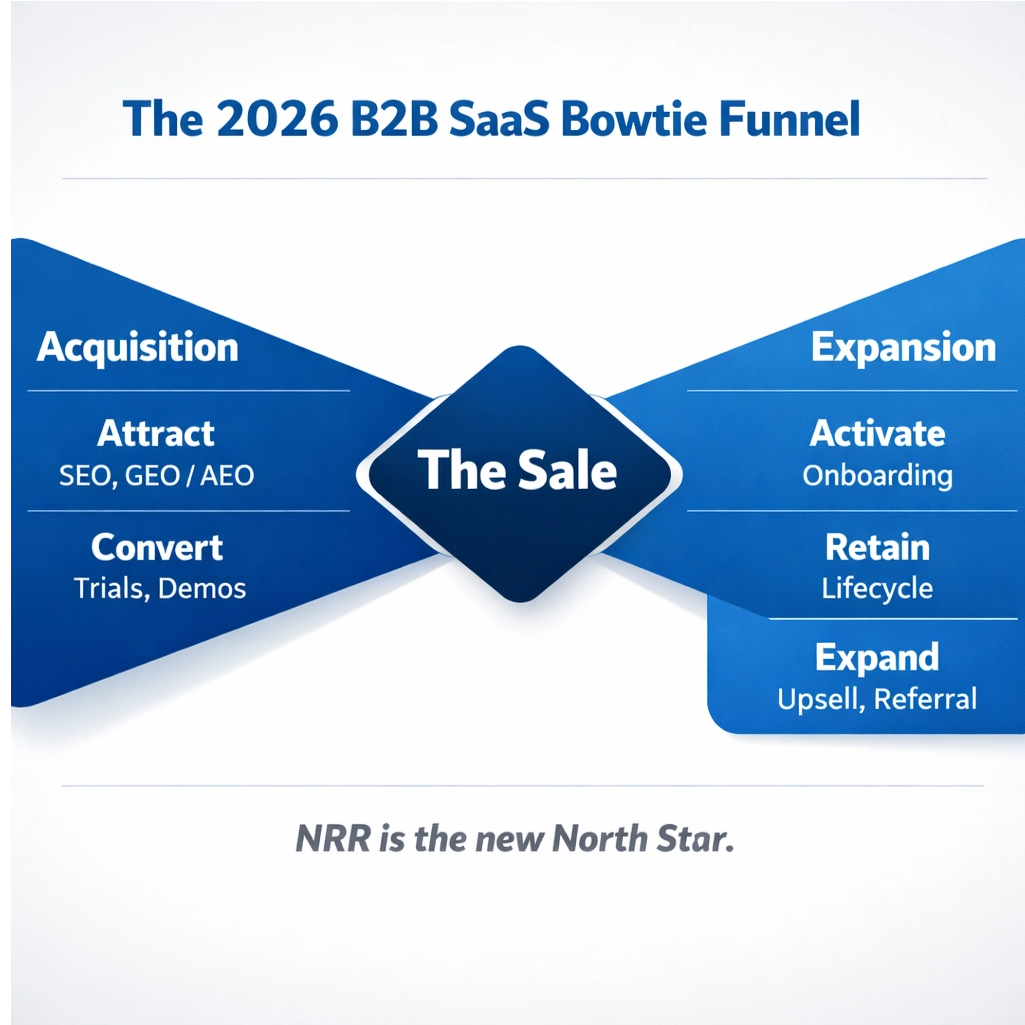
The bowtie funnel model treats post-sale expansion — activation, adoption, retention, upsell, and referral — as revenue-generating marketing activities, not just customer success tasks. In subscription businesses, this distinction is worth millions.
Net Revenue Retention (NRR) above 120% means you can grow ARR without acquiring a single new customer. Expansion alone drives growth. The best US B2B SaaS companies in 2026 treat NRR as a marketing metric, not just a CS metric.
The 5 Stages of the 2026 B2B SaaS Bowtie
- Attract: Content, SEO, GEO/AEO, paid search — get the right ICP to your door
- Convert: Free trials, demos, pricing pages, comparison content — convert intent to signup
- Activate: Onboarding sequences, in-app guides, role-based templates — get users to first value in 14 days or fewer
- Retain: Lifecycle emails, feature education, QBRs, community — reduce churn to below 5% annually
- Expand: Upsell triggers, seat expansion, cross-sell campaigns, referral programs — grow revenue from existing customers
CRITICAL INSIGHT: If a customer doesn’t experience clear value within the first 14 days of signup, they are 3x more likely to churn within 90 days (Directive Consulting, 2025). Your onboarding sequence is a marketing asset, not just a CS task. Design it accordingly.
For the full content strategy mapped to each bowtie stage, read: Content Marketing Funnels for SaaS: From Awareness to Conversion.
STRATEGY NRR-First Marketing: The Metric That Separates Good from Great
Why NRR Is the Most Important Number in Your Marketing Dashboard
Most SaaS marketing dashboards are full of green arrows that lead nowhere. Impressions up. Traffic up. MQLs up. ARR flat. Sound familiar?
The companies that break this pattern in 2026 are the ones that have replaced vanity metric dashboards with NRR-first measurement systems. Net Revenue Retention measures whether your existing customers are growing in revenue, staying flat, or shrinking — and it’s the single best indicator of whether your product and marketing are actually working together.
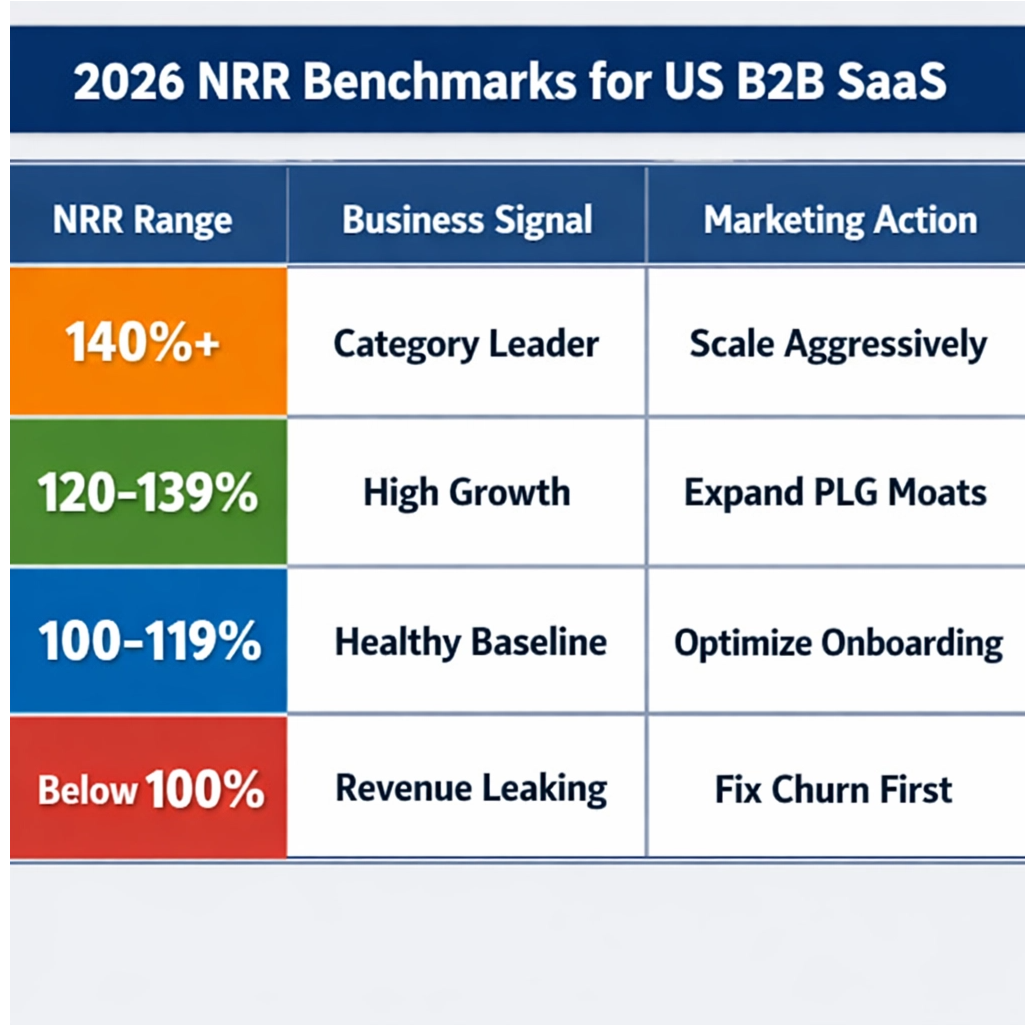
NRR Benchmarks for US B2B SaaS (2026)
| NRR Range | Business Signal | Marketing Action | Priority |
|---|---|---|---|
| 140%+ | Category leader | Scale acquisition aggressively | Invest heavily |
| 120–139% | High growth | Expand PLG + content moats | Scale steadily |
| 100–119% | Healthy baseline | Optimize onboarding + upsell flows | Fix retention gaps |
| 85–99% | Revenue leaking | Pause CAC-heavy channels, fix churn first | Urgent attention |
| Below 85% | Structural problem | Stop acquisition spend, rebuild product-market fit signals | Stop, diagnose |
Benchmarks based on Directive Consulting, 42DM SaaS Benchmarks 2026, and LinkedIn SaaS Metrics Analysis 2024.
Action: Calculate your NRR this week. If it’s below 100%, every dollar you spend on new customer acquisition is essentially filling a leaky bucket. Fix retention before scaling acquisition.
CHANNELS The 2026 B2B SaaS Channel Stack: What to Run, What to Cut
Digital Marketing for B2B SaaS: Which Channels Actually Build ARR in 2026
Here’s the honest answer most agencies won’t give you: in 2026, no single channel wins. The US B2B SaaS companies hitting $1M–$10M ARR fastest are running a deliberate channel mix — with percentages that shift based on ARR stage, not just industry benchmarks.
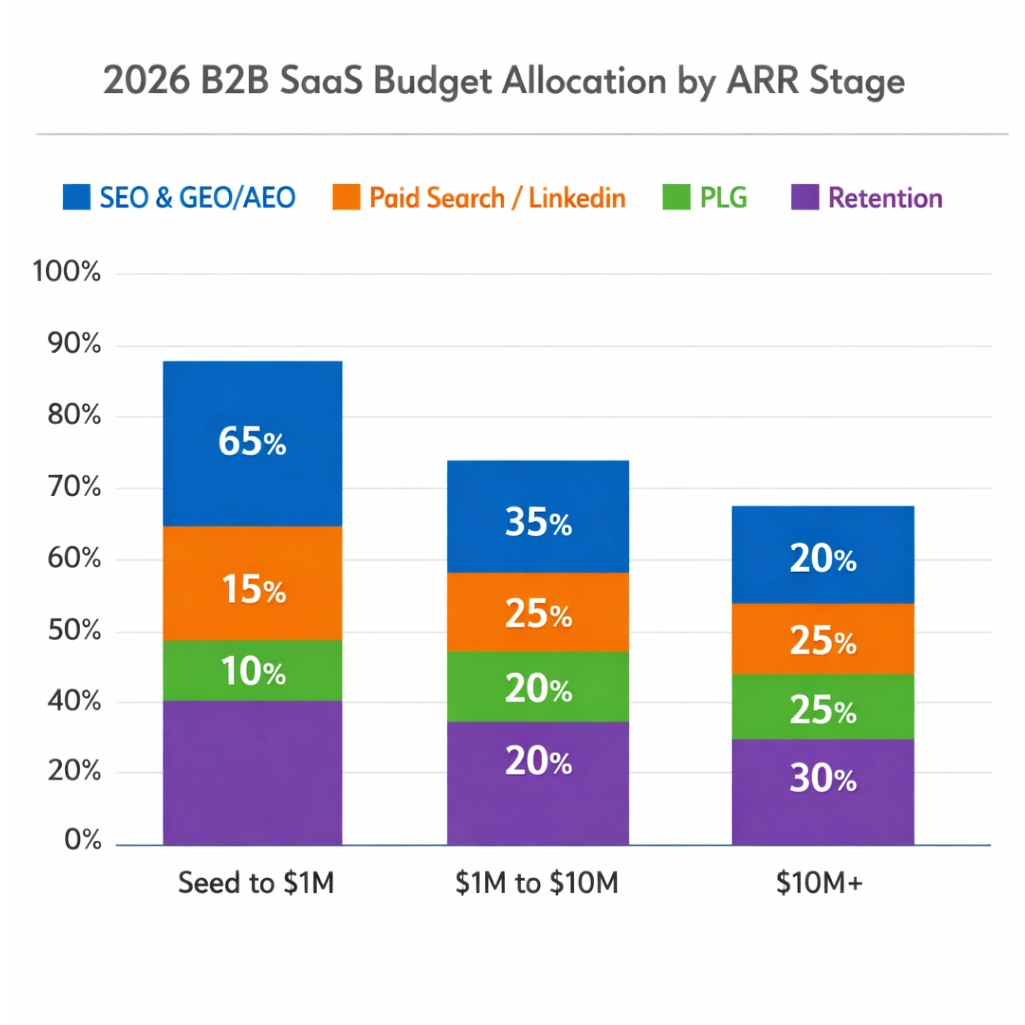
Budget Allocation by ARR Stage (2026 Benchmarks)
| Channel | Seed–$1M ARR | $1M–$10M ARR | $10M+ ARR |
|---|---|---|---|
| SEO + GEO/AEO Content | 60–70% | 40–50% | 30–35% |
| Paid Search / LinkedIn Ads | 20–30% | 30–40% | 35–40% |
| Product-Led Growth (PLG) | Experiment 10% | 15–20% | 20–25% |
| Community + Partnerships | Founder-led (free) | 5–10% | 10–15% |
| Lifecycle / Retention Marketing | Minimal | 10% | 15–20% |
Sources: Gravitate Design B2B SaaS Marketing Guide 2026, SaaS Hero Budget Allocation Study, 42DM Benchmarks.
The Channel Most SaaS Companies Underinvest In
LinkedIn advertising deserves specific attention at the $1M+ ARR stage. When narrowed by job title, company size, and industry, LinkedIn delivers the best cost-per-company-influenced metric in B2B at $200–$250, with 113% ROAS when campaigns follow a clear ICP and lead with problem-framing, not product-first messaging (SaaS Hero, 2026).
The mistake is running LinkedIn ads without an organic content foundation. LinkedIn organic thought leadership from named executives — not the company page — builds the trust layer that makes paid campaigns 2–3x more efficient.
The integration of organic and paid is one of the core principles behind our content marketing approach at seoportfolio.in. Build the organic trust layer first. Then paid amplification multiplies it.
AI SEARCH GEO & AEO: The SaaS Visibility Layer Your Competitors Are Missing
How to Win B2B SaaS Visibility in the AI Search Era
73% of US B2B SaaS buyers used AI-assisted search — ChatGPT, Perplexity, or Google AI Overviews — during vendor discovery in 2025 (Forrester). That number is growing every quarter. If your SaaS brand doesn’t appear in AI-generated answers for your category queries, you are invisible at the exact moment your buyers are forming their shortlists.
Generative Engine Optimization (GEO) and Answer Engine Optimization (AEO) are no longer optional add-ons to your SEO strategy. They are the new first page.
The mechanics of this shift are well documented — Google AI Overviews just changed how citations work. The brands winning AI citations are not necessarily the ones with the highest DA or the most backlinks. They’re the ones with the clearest, most structured, most authoritative answers.
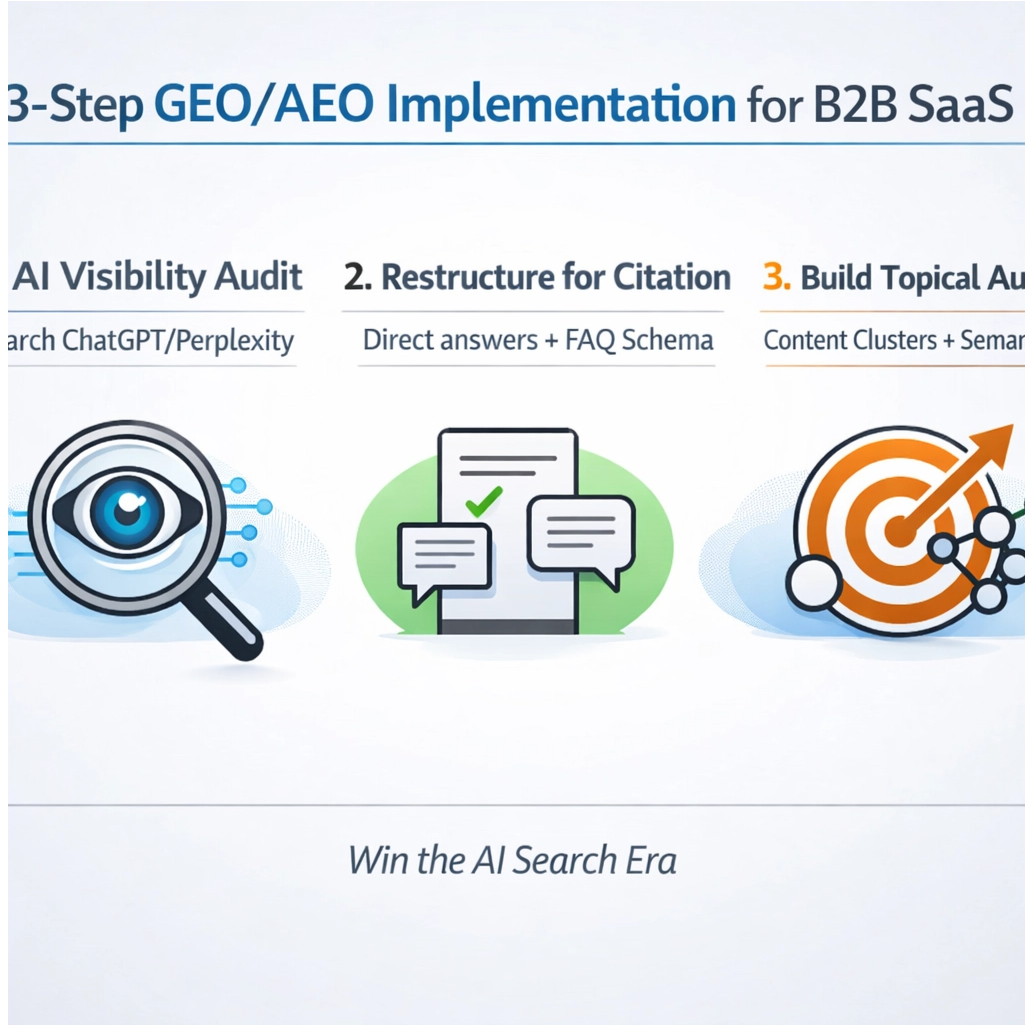
3-Step GEO/AEO Implementation for B2B SaaS
STEP 1 Run Your AI Visibility Audit
Search your top 20 buyer queries across ChatGPT, Perplexity, and Google AI Overviews. Document which competitors appear and what format their cited content uses. This audit takes 2 hours and gives you a complete picture of your AI visibility gap — and a roadmap to close it.
Not sure how to measure your AI presence over time? Read: How to Track AI Brand Visibility
STEP 2 Restructure Content for AI Citation
Every B2B SaaS content page should follow this structure in 2026: a direct answer to the primary query in the first 50 words, followed by structured depth (using H2/H3 headings, data points, and numbered lists), closed with a FAQ section using schema markup. This format is designed to satisfy both Google’s crawlers and LLM comprehension models simultaneously.
STEP 3 Build Topical Authority Through Content Clusters
AI engines and Google’s 2026 algorithms both reward topical depth over keyword volume. Instead of targeting individual keywords, build content clusters: a cornerstone page on a broad category topic, supported by 8–12 cluster articles covering related subtopics. Each internal link between cluster pages signals semantic authority.
See the full framework for this in: Keyword Research Strategies for SaaS Companies Beyond Search Volume
In 2026, appearing in a Google AI Overview or a ChatGPT response for a buying-stage query is worth more pipeline than ranking #3 for the same keyword in traditional results. Build for AI citation. Traditional rankings follow.
ATTRIBUTION Revenue Attribution: The System That Aligns Marketing and Sales
How to Build Attribution That Your Sales Team Actually Trusts
The most expensive gap in B2B SaaS marketing isn’t a channel problem. It’s an attribution problem. Marketing claims credit for pipeline that sales doesn’t recognize, and sales ignores marketing data as a result. This misalignment costs companies millions in misdirected budget every year.
In 2026, the fix is multi-touch revenue attribution with full sales team visibility. Not last-click. Not first-touch. Full-path attribution that shows every marketing touchpoint that influenced a closed deal — from the first blog post read to the comparison page visited three weeks before the demo.
Attribution Setup: Step-by-Step
STEP 1 Define Your Revenue-Qualified Lead (RQL) Model
Replace or supplement MQL targets with RQL thresholds — leads that meet specific ICP fit score, intent signal depth, engagement volume, and company profile criteria. MQL volume is a leading indicator at best. RQL rate is a revenue predictor. Align this definition with sales before building any campaign around it.
STEP 2 Implement Multi-Touch Attribution
Tools like HubSpot revenue attribution, Dreamdata, and Rockerbox give US SaaS startups full-path attribution at a price point that works from Series A onwards. The goal is a single dashboard where both marketing and sales can see which touchpoints influenced each closed deal — and agree on what that means for budget allocation.
STEP 3 Run 90-Day Revenue Sprints
Annual marketing plans are too rigid for early-stage SaaS. Run 90-day sprints instead: one primary revenue goal, 3–5 specific tactics, a defined budget, and a weekly review cadence. Sprint-based marketing compounds learning faster and prevents the most common mistake — continuing to fund channels that look busy but don’t convert to ARR.
Real Example: A US SaaS company shifted $30K from paid social to content and PLG based on attribution data. Paid social had 8-month payback but 60% year-one churn. Content-driven customers had 14-month payback but 89% NRR. In 18 months, the budget shift improved blended NRR by 12 points. Source: Directive Consulting case study, 2025.
PLG Product-Led Growth: Turning Your Product into a Marketing Channel
Product-Led Growth in 2026: The B2B SaaS Acquisition Engine That Scales Itself
Product-led growth (PLG) is now a core requirement for B2B SaaS in 2026 — not just a nice-to-have for consumer apps (SaaS Hero, 2026). Companies that have built PLG motions alongside sales-led acquisition are achieving CAC payback periods as low as 3 months through viral and product-triggered referral loops.
But PLG done badly — a free tier that’s too limited to create value, or too generous to create upgrade motivation — is just a cost center. The balance is everything.
Three PLG Models That Work for US B2B SaaS
Model 1: Freemium with Clear Upgrade Triggers
The free version must be useful enough to create real value and retention, but limited enough to create a clear, rational reason to upgrade. Usage-based limits (API calls, seats, storage) work better than feature-gating in 2026, because buyers can self-discover the value before hitting a wall.
Model 2: Free Tool as Demand Generation
A standalone free tool that solves a specific, high-search-volume problem in your category is one of the highest-ROI marketing investments a SaaS company can make. The tool ranks for high-intent queries, creates product awareness, and drives signups from buyers who never would have found your main product. For the full breakdown of how to execute this, read: How to Build a SaaS Growth Engine in 2026
Model 3: Product-Led SEO (PL-SEO)
Design product features that generate public, indexable pages — user portfolios, template libraries, project showcases, integration pages. Each page targets a specific search query. Together, they create massive organic traffic at zero marginal content cost. Notion’s public templates, Webflow’s showcase gallery, and Zapier’s integration pages are the benchmark examples.
Pro Tip: Add a subtle ‘Built with [Your Product]’ attribution link on every user-generated public page. It’s a backlink, a brand impression, and a top-of-funnel discovery mechanism — all from a single product design decision.
CONTENT The 2026 B2B SaaS Content Architecture: Build Less, Rank More
SaaS Content Marketing in 2026: The Architecture That Beats Volume
The content game in B2B SaaS has been completely reset. Generic blog posts, gated ebooks, and keyword-stuffed articles are actively penalized by Google’s 2026 Helpful Content system. The replacement architecture is built on depth, authority signals, and format diversity.
Content That Is Working in 2026
- Cornerstone Guides (3,000–5,000 words): One per quarter minimum. Deep, expert-authored, structured for AI citation. These are your topical authority anchors.
- Original Research and Data Reports: Survey your customers or analyze product data. One original study generates more backlinks and AI citations than 50 standard posts.
- Comparison and Alternative Pages: ‘[Your Product] vs [Competitor]’ pages convert at bottom-of-funnel with minimal content investment. High commercial intent, low competition.
- ROI Calculators and Free Tools: Product-led content that ranks for transactional queries and drives direct signups.
- Creator-Led Thought Leadership: Founder and expert bylines on LinkedIn and industry publications — not the company blog. Human-attributed content earns 4x the trust of brand-attributed content.
Content to Scale Back in 2026
- Generic ‘Top 10’ blog posts with no original data or perspective
- Gated ebooks that buyers won’t exchange their email for in 2026
- Webinars run purely as lead generation with no standalone content value
- Company blog posts written in corporate voice with no named author
Before publishing anything new, audit your current content against the patterns in: Common SEO Mistakes US Businesses Should Avoid in 2026
The brands winning content in 2026 publish less but invest more per piece. One deeply researched cornerstone guide with genuine distribution beats 30 average blog posts — in organic traffic, AI citations, backlinks, and most importantly, pipeline.
Questions B2B SaaS Founders Ask Google — Answered Directly
What is the most important marketing metric for B2B SaaS in 2026?
Net Revenue Retention (NRR). NRR above 100% means you’re growing revenue from existing customers faster than you’re losing it to churn. NRR above 120% means you can grow ARR without acquiring a single new customer. Every other marketing metric — traffic, MQLs, impressions — should be evaluated based on its contribution to NRR and CAC payback period.
How much should a US SaaS startup spend on marketing in 2026?
At Seed to $1M ARR: 20–40% of revenue, focused 60–70% on organic channels (SEO, content, community). At $1M–$10M ARR: 35–50% of revenue, shifting toward paid acquisition and PLG. At $10M+ ARR: 25–35% of revenue, with increasingly sophisticated ABM and lifecycle programs. The most important number isn’t the percentage — it’s the CAC payback period. Best-in-class US SaaS companies target sub-12-month payback for SMB, sub-24-month for enterprise.
What is the bowtie funnel and why does it matter for SaaS marketing?
The bowtie funnel expands the traditional acquisition funnel to include equal investment in post-sale stages: activation, adoption, retention, expansion, and referral. In a subscription business, the revenue from existing customers (measured by NRR) is as important as new customer acquisition. SaaS companies that market to the full bowtie consistently outperform those that treat customer success as separate from marketing.
What is GEO in SaaS marketing?
Generative Engine Optimization (GEO) is the practice of structuring content to be cited in AI-generated search results from ChatGPT, Perplexity, Google AI Overviews, and similar platforms. For B2B SaaS, GEO matters because 73% of US B2B buyers now use AI-assisted search during vendor discovery. Appearing in those AI-generated answers builds trust before a buyer even visits your website.
How long does B2B SaaS content marketing take to generate pipeline?
Long-tail keyword traffic appears within 4–6 months of consistent publishing. Competitive category terms take 8–12 months. AI Overview citations and GEO visibility can appear within 8–12 weeks of structural content changes. PLG tools and programmatic SEO can generate significant traffic within 3–4 months of launch. The compounding nature of content means months 9–18 show 3–5x the results of months 1–6.
What makes B2B SaaS marketing different from general B2B marketing?
Three things: subscription economics (the sale is just the beginning — retention and expansion define profitability), longer and more complex buying cycles (average 3–6 months for mid-market SaaS), and the necessity of product-marketing alignment (SaaS churn is often a marketing problem disguised as a product problem). Successful B2B SaaS marketing treats onboarding, adoption, and expansion as marketing functions — not just customer success tasks.
Your 90-Day Revenue-First Marketing Sprint: Where to Start
Most SaaS founders read strategy guides and leave with too many ideas and no clear starting point. Here’s the exact priority sequence that produces compounding returns fastest:
- Week 1: Calculate your NRR. If below 100%, fix retention before anything else. If above 100%, move to step 2.
- Week 2: Run your AI visibility audit — ChatGPT, Perplexity, Google AI Overviews across your top 20 buyer queries. Document the gap.
- Week 3: Define your RQL model. Align with sales. Build it into your CRM attribution system.
- Month 2: Restructure your 5 highest-traffic pages for direct-answer format and FAQ schema. This is the fastest GEO/AEO win available.
- Month 2–3: Launch one PLG experiment — a free tool, a public template library, or a comparison page cluster.
- Month 3: Launch one owned media channel — newsletter, LinkedIn thought leadership series, or podcast. One format, one owner, weekly cadence.
- Month 3–4: Implement multi-touch attribution. Connect your content and paid channels to pipeline and closed revenue data.
- Ongoing: Run 90-day sprints. One goal, 3–5 tactics, weekly review. Compound learning every quarter.
Start with a free technical and content audit to identify your biggest gaps first: SEO Audit Formula — seoportfolio.in
The B2B SaaS brands that dominate their categories in 2026 aren’t necessarily the best-funded or the biggest teams. They’re the ones who built a complete system — bowtie funnel, NRR focus, GEO/AEO visibility, and revenue attribution — and executed it consistently for 12 months while their competitors were still arguing about whether AI search was a trend or a shift. It’s a shift.
FAQ: B2B SaaS Marketing Strategy 2026
Q: Is SEO still worth investing in for B2B SaaS in 2026?
A: Absolutely — but SEO now includes GEO and AEO. Traditional keyword rankings still drive significant pipeline, but AI search citations are increasingly the first touchpoint in the buyer journey. The CAC advantage of organic channels over paid compounds every year. At $1M ARR, allocating 40–50% of marketing budget to SEO and content delivers the best long-term LTV:CAC ratio.
Q: PLG vs sales-led: which works better for US B2B SaaS in 2026?
A: The most efficient US SaaS companies in 2026 run hybrid models — PLG for SMB acquisition and self-serve expansion, sales-led for enterprise. Pure PLG works best for products with clear self-serve value under $1,000 ACV. Pure sales-led works for complex, high-ACV products with long buying cycles. Most companies between $1M and $20M ARR benefit from running both motions simultaneously.
Q: How do I compete with enterprise SaaS on content without their budget?
A: Specificity beats scale. Enterprise SaaS publishes broad, generic content. As a startup, you go deeper on vertical-specific topics, move faster on emerging trends, and publish with genuine human voice and founder expertise. One founder-attributed LinkedIn post with a real POV routinely outperforms 10 corporate blog posts. Your unfair advantage is authenticity and speed — use both.
Q: What’s the biggest B2B SaaS marketing mistake in 2026?
A: Optimizing for MQLs while ignoring NRR. MQL volume feels productive, but if your NRR is 85%, every MQL you generate is partially funding a leaky bucket. The highest-leverage marketing decision most SaaS companies can make is investing in activation and onboarding quality before scaling acquisition spend.
Q: How important is personal branding for B2B SaaS founders in 2026?
A: Critically important. Buyers trust people before they trust brands. Founder-attributed content on LinkedIn and in industry publications builds the E-E-A-T signals that both Google and AI engines reward. The ROI of founder thought leadership is measurable — companies where the founder is an active content creator generate 3x more branded search queries than those where the brand is silent. For the full framework: Why Your Personal Story is Your Best SEO Strategy
Related Resources on seoportfolio.in — Click to Read
Every link below goes to a live, published article on seoportfolio.in. Use these to deepen your understanding of each section of this blueprint:
| Article (Clickable Link) | What It Covers |
|---|---|
| How to Build a SaaS Growth Engine in 2026 | GEO, AEO, PLG, and the 5-step SaaS growth playbook |
| SaaS Keyword Research Strategy 2026 | Intent-based keyword mapping for SaaS categories |
| Content Marketing Funnels for SaaS | Full bowtie funnel content map with formats per stage |
| Link Building for SaaS Startups: High-Authority Backlinks | Earning DR 40+ editorial backlinks in 2026 |
| Link Building Strategies That Work in 2026 | Tactical backlink acquisition for any niche or market |
| Google AI Overviews Changed How Citations Work | Why structured content wins AI citations over raw authority |
| ChatGPT Ads Changed the Rules of Marketing Forever | What AI advertising means for SaaS content strategy |
| How to Track AI Brand Visibility | Metrics and tools to measure your GEO/AEO share of model |
| Common SEO Mistakes US Businesses Should Avoid | 15 critical errors found in 200+ site audits |
| Best Strategy to Increase Website Traffic Today | Topical authority and semantic content clusters explained |
| Why Your Personal Story is Your Best SEO Strategy | Founder thought leadership as an E-E-A-T trust signal |
| Anthropic Hiring SEO Lead — What It Tells Us About GEO | Real-world proof that AI companies still need SEO |
| Best AI SEO Certifications and Tools in 2026 | The skill stack for AI-era SEO and GEO practitioners |
| Parasite SEO Strategy | How to rank fast using high-authority third-party domains |
| Free SEO Audit — seoportfolio.in | Get a personalized PDF audit of your website |
| Work With Saba Raheem — SaaS SEO & Growth Strategy | Custom SEO, content, and revenue marketing for SaaS |
Published by Saba Raheem — seoportfolio.in | March 2026 | B2B SaaS Marketing | US Startups

Sharing my journey and learnings in Tech and AI. As a Digital Marketing Expert, I help brands boost their visibility and sales with smart personal branding and the latest AI tricks.

Leave a Reply