|
Getting your Trinity Audio player ready… |
Table of Contents
THE NEW ERA OF SAAS GROWTH: WHY 2026 IS DIFFERENT
Let’s be blunt. The SaaS growth playbook you’ve been running since 2022? It’s not just outdated — it’s actively costing you revenue. Google changed. Buyers changed. AI changed everything in between.
In 2026, the founders winning aren’t necessarily the ones with the best product. They’re the ones who figured out that the rules of discovery, trust, and visibility have been completely rewritten. And here’s the uncomfortable truth: most SaaS companies haven’t gotten the memo yet.
That’s actually good news for you. Because you’re reading this.
“Only 22% of SaaS companies have fully adapted their growth strategy for AI-first search in 2026. The other 78% are running 2019 tactics in a 2026 world.” — Ahrefs State of SEO 2025
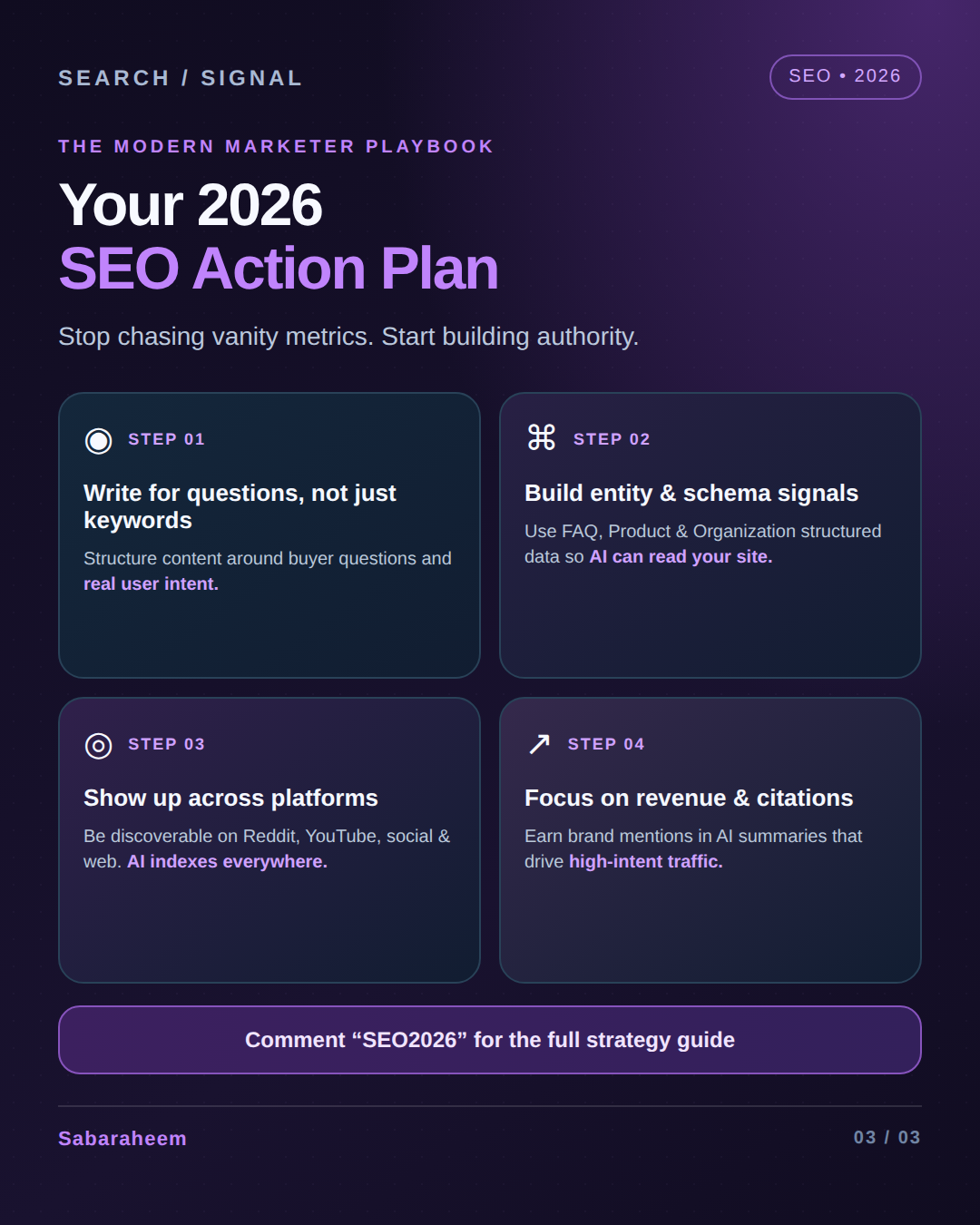
This guide breaks down exactly how to build a growth engine that works in today’s landscape. Not theory. Not fluff. Practical, founder-level steps across 5 critical trends — all informed by what’s actually moving the needle right now.
If your organic pipeline has plateaued, your paid CAC is climbing, or you’re just not showing up where your buyers look — this is the guide you needed six months ago. Let’s fix that.
CONTEXT — THE AI PIVOT: NAVIGATING THE 2026 SEARCH ECOSYSTEM
Before You Start: Understand the New Search Landscape
Here’s the thing about pivots — nobody enjoys them. But the SaaS founders who treated the AI shift as a disruption rather than an opportunity are now watching their organic traffic flatline while their competitors compound.
The 2026 search ecosystem is fundamentally different. Google’s AI Overviews now appear on 46% of all search queries (up from 11% in 2023). ChatGPT processes over 10 million search-like queries per day. Perplexity crossed 100 million monthly active users. Buyers aren’t just Googling anymore — they’re asking AI.
IMPORTANT: If your SaaS content strategy doesn’t account for AI-generated answers, you are invisible to a growing segment of your ICP. This isn’t a future problem. It’s a now problem.
The AI Pivot isn’t about abandoning SEO. It’s about expanding your definition of where discovery happens and who’s doing the discovering. Your buyers now form opinions about your product before they ever visit your website — in AI chat threads, in zero-click search results, in creator-led content they trust.
What the AI Pivot Actually Means for Your Growth Stack
- Traditional SEO: Rank on Page 1 of Google for target keywords
- AI-Pivoted SEO: Get cited, referenced, and recommended by AI engines
- Traditional content: Blog posts optimized for crawlers
- AI-Pivoted content: Structured, authoritative content optimized for AI comprehension
- Traditional distribution: Drive traffic to your website
- AI-Pivoted distribution: Build presence wherever buyers form intent
Got it? Good. Now let’s get into the actual how-to. Five trends, five step-by-step actions you can start this week.
Trend 1 : GEO & AEO: Winning the ‘Share of Model’ in AI Engines
How to make AI engines recommend YOUR SaaS — not your competitor’s
Here’s a metric your board hasn’t asked about yet but will: Share of Model. It measures how often your brand appears in AI-generated answers for your target category queries. Right now, some SaaS brand is dominating that share. Make sure it’s yours.
Generative Engine Optimization (GEO) and Answer Engine Optimization (AEO) are the tactical disciplines that get you there. And no — they’re not the same as traditional SEO, though they build on it.
STEP 1 Run the AI Audit
Before you optimize for anything, you need to know your current AI visibility. Open ChatGPT, Perplexity, and Google with AI Overviews enabled. Search for your top 10 buyer queries. Write down who appears in the AI-generated answers. Is it you? Your competitors? Nobody in your category?
Pro Tip: Save screenshots of competitor citations. These tell you exactly what content format and authority signals AI engines currently trust in your niche.
STEP 2 Build Content AI Engines Can Actually Cite
AI engines prefer content that is structured, authoritative, and directly answers specific questions. That means rewriting your cornerstone content with the following in mind:
- Open every article with a direct, concise answer to the primary query (2–3 sentences max)
- Use FAQ sections with schema markup on every high-intent page
- Include data, statistics, and named expert perspectives — AI engines love citable specifics
- Write in clear, declarative sentences — no passive voice, no hedge-everything legal-speak
STEP 3 Track Your Share of Model Monthly
Set up a simple tracker. Each month, run your 20 most important buyer queries through ChatGPT, Perplexity, and Google AI Overviews. Record which brands appear. Track your trend over time. This is your new organic KPI.
“GEO isn’t replacing SEO — it’s a new layer on top of it. Companies building both simultaneously are seeing 2.3x the branded search volume of those doing SEO alone.” — BrightEdge Research 2025
Trend 2: Zero-Click Dominance: Building Brand Authority Without the Click
How to win buyers who never visit your website — and turn impressions into pipeline
Here’s a statistic that might ruin your Monday: over 58% of Google searches in 2025 ended without a single click (SparkToro). Yes, more than half of your potential buyers got an answer — and moved on — without ever seeing your website.
The wrong response is panic. The right response is strategy.
Zero-Click Dominance is about making every impression — clicked or not — do brand-building work for you. When a buyer sees your brand cited in an AI overview, a featured snippet, or a People Also Ask result, that’s a trust deposit. Stack enough of them and you become the obvious choice when the purchase intent finally crystallizes.
How to Execute a Zero-Click Strategy
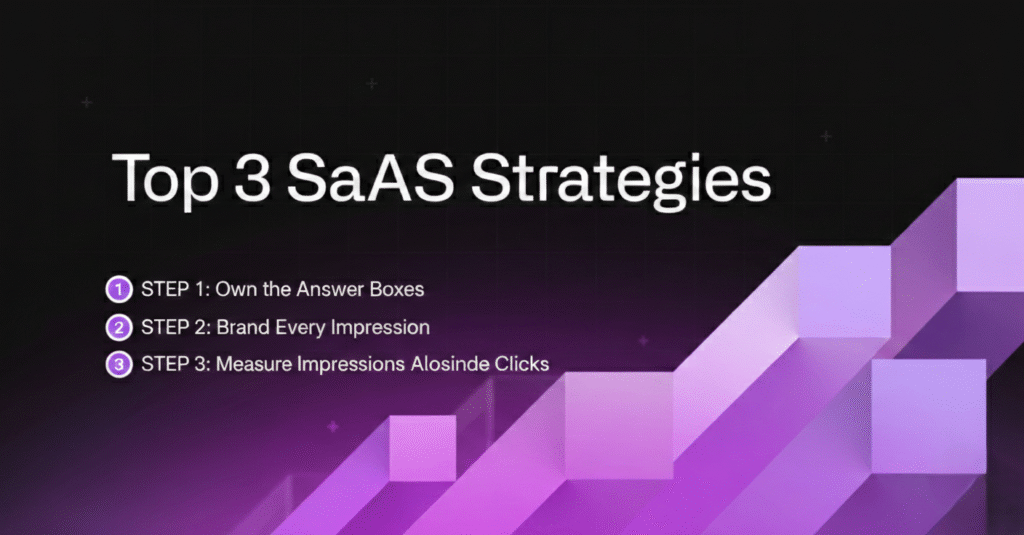
STEP 1 Own the Answer Boxes
Featured snippets and AI Overviews pull from content that answers questions clearly and concisely. Identify the top 15 questions your ICP asks at awareness and consideration stages. Rewrite or create pages that answer each one in under 50 words, followed by depth. This structure makes you the snippet candidate.
STEP 2 Brand Every Impression
Even when a buyer doesn’t click, your brand name, tagline, and positioning appear in the result. Make sure your meta titles and descriptions do active positioning work — not just keyword stuffing. Ask yourself: if a buyer only reads my meta description, do they understand what makes us different?
STEP 3 Measure Impressions Alongside Clicks
Stop judging SEO purely on clicks. In Google Search Console, track impression volume for your target queries. A page with 50,000 impressions and 1,200 clicks is doing massive brand work, even if the CTR looks ‘low.’ Impressions build awareness. Awareness builds pipeline. Eventually.
Pro Tip: Add brand recall questions to your sales discovery calls. Ask ‘Where had you heard of us before today?’ You’ll start seeing zero-click channels show up. That’s your proof-of-concept.
Trend 3: PageRank 2.0: Why Trust is the New Ranking Factor
How to build the trust architecture that both Google and AI engines reward in 2026
Google’s original insight — that links are votes of trust — still holds. But in 2026, ‘trust’ is measured across far more dimensions than backlinks. E-E-A-T (Experience, Expertise, Authoritativeness, Trustworthiness) has expanded into a multi-signal trust framework that affects both traditional rankings and AI citations.
The short version: if Google (or ChatGPT) isn’t sure whether to trust your brand, it won’t recommend you. And in a world where buyers use AI to shortlist vendors, not being trusted by AI is not being found at all.
The Trust Architecture Checklist for SaaS Founders
STEP 1 Make Your Experts Visible
Every piece of content should have a named, credentialed author. Build author bio pages with real credentials, LinkedIn profiles, speaking history, or publication credits. AI engines and Google’s quality evaluators both look for human expertise signals. Anonymous corporate blog posts score lower on E-E-A-T — full stop.
STEP 2 Earn Third-Party Validation
What others say about you matters more than what you say about yourself. Actively pursue:
- Editorial coverage in SaaS-relevant publications (G2, Product Hunt, industry newsletters)
- Analyst mentions (Gartner, Forrester, G2 Crowd reports)
- Guest bylines in publications your ICP actually reads
- Podcast appearances where you’re cited as an expert
STEP 3 Audit and Clean Your Trust Signals
Run a trust audit quarterly. Check for outdated statistics on your pages, broken external links to reputable sources, missing author information, and inconsistent brand claims across your site. These small trust gaps compound into lower E-E-A-T scores over time.
Trust is not a one-time campaign. It’s an ongoing system. The SaaS brands with the highest AI citation rates in 2026 are the ones who treated trust-building like product development — with ownership, iteration, and metrics.
Trust Signal Priority Matrix for SaaS (2026)
| Trust Signal | Impact Level | Time to Implement | AI Citation Boost |
|---|---|---|---|
| Author bio pages + credentials | High | 1–2 days | +31% |
| Editorial press coverage | Very High | 4–8 weeks | +47% |
| G2 / review platform presence | High | 2–4 weeks | +28% |
| Data-backed original research | Very High | 6–12 weeks | +62% |
| Consistent structured content (FAQ schema) | Medium | Ongoing | +19% |
| Analyst/influencer third-party citations | Very High | 8–16 weeks | +55% |
AI citation boost estimates based on BrightEdge and Semrush research, 2025.
TREND 4: The Media-First SaaS: Leveraging Creator-Led B2B Content
How to stop being a software company that ‘does content’ and start being a media brand that happens to sell software
Every SaaS company publishes content. That’s exactly why most SaaS content doesn’t work. When everyone’s doing the same thing — blog posts, ebooks, generic thought leadership — the signal-to-noise ratio drops to zero. Your buyers tune out.
The companies breaking through in 2026 made a fundamental mindset shift: they stopped treating content as a marketing tactic and started treating it as a product. They became media-first. And the results are not subtle — media-first SaaS companies generate 3.8x more inbound pipeline than content-as-an-afterthought companies (Demand Gen Report, 2025).
How to Become a Media-First SaaS
STEP 1 Find Your Distinctive Voice(s)
Media companies have personalities. Does your SaaS? Identify 2–3 people inside your company — founders, domain experts, practitioners — who have genuine opinions, real experience, and the ability to communicate both. These are your content anchors. Build your content ecosystem around them, not around your product features.
Pro Tip: A founder with 4,000 engaged LinkedIn followers who posts weekly drives more pipeline than a polished corporate blog with 40,000 monthly visitors. Attention is earned by humans, not brands.
STEP 2 Build Formats That Scale Trust
Creator-led content doesn’t have to mean a daily TikTok. For B2B SaaS, the highest-trust formats in 2026 are:
- Newsletter with a specific editorial POV (weekly, 1,000–1,500 words, no fluff)
- Video interview series featuring customers and category experts
- Podcast positioning your company at the intersection of your buyers’ interests
- LinkedIn thought leadership series from named executives (not the company page)
STEP 3 Distribute Before You Optimize
Most SaaS teams write content and then wonder why nobody reads it. Flip the process. Build your audience first — on LinkedIn, in newsletters, on podcasts — and then use your owned channels to amplify SEO-optimized long-form content. Distribution is the multiplier. Content without distribution is a tree falling in an empty forest.
TREND 5: Product-Led SEO: Turning Your Product into a Search Engine Magnet
How to build SEO assets that scale because your users build them for you
Here’s an uncomfortable question: does your product generate SEO value, or does it only consume marketing budget? Most SaaS products do the latter. But the smartest growth teams in 2026 have figured out how to make the product itself a compounding organic growth asset.
Product-Led SEO (PL-SEO) is the discipline of designing product features, user outputs, and data experiences that create indexable, high-intent web pages at scale — without hiring a content team to write each one.
Three PL-SEO Models That Work for SaaS
STEP 1 The Free Tool Model
Create a standalone free tool that solves a specific, high-search-volume problem your ICP has. The tool itself ranks for high-intent queries. Users who get value from the free tool discover your paid product. Classic examples: HubSpot’s Website Grader, Ahrefs’ free keyword tools, Canva’s free design templates.
The math is compelling: a single well-designed free tool can generate 15,000–50,000 monthly organic visits and introduce your brand to buyers who would never have found you through a traditional blog post.
STEP 2 The User-Generated Content Model
Design product features that let users create public-facing outputs — portfolios, reports, profiles, project showcases. Each user output becomes a unique, indexed page targeting a specific query. Notion’s public page templates, Figma’s community files, and Webflow’s showcase gallery are perfect executions of this model.
Pro Tip: Add a subtle ‘Made with [Your Product]’ link on every user-generated public page. It’s a backlink, a brand impression, and a discovery mechanism all in one.
STEP 3 The Programmatic SEO Model
Use your product’s data or integrations to generate thousands of structured pages at scale. Zapier’s integration pages (‘Connect HubSpot + Salesforce’), G2’s comparison pages (‘HubSpot vs Salesforce’), and Booking.com’s city pages are the gold standard. Each page targets a specific query. All pages together create dominant topical authority.
CAUTION: Programmatic SEO done badly is spam. Every generated page must provide genuine user value. Google’s Helpful Content system will demote thin, templated pages that exist purely for SEO without meaningful content differentiation.
Your 2026 SaaS Growth Action Plan: Start Here
Five trends. Five frameworks. The question is always: where do you start?
Here’s the honest answer: it depends on your current state. But if you’re starting from scratch or rebuilding, here’s the priority order that produces the fastest compounding returns:
- Run your AI audit (Trend 1, Step 1) — takes 2 hours, tells you everything about your current visibility gap
- Rewrite your 5 highest-traffic pages for GEO/AEO structure — direct answers, FAQs, schema markup
- Build or update author bio pages for every content contributor — highest trust ROI per hour spent
- Identify one media-first format your team can sustain — newsletter, LinkedIn series, or podcast
- Audit your product for PL-SEO opportunities — one good free tool can change your entire acquisition curve
None of this requires a 12-person team or a $500K budget. It requires clarity, consistency, and the willingness to play a slightly longer game than your competition. The SaaS founders winning in 2026 started their AI pivot in 2024. The second best time to start is this week.
FAQ: SaaS Founders Ask, We Answer
How long does it take to see results from GEO/AEO optimization?
AI citation visibility typically appears within 8–12 weeks of structural content changes. Meaningful Share of Model growth — where you consistently appear in AI-generated answers for target queries — takes 4–6 months of sustained execution. This is faster than traditional SEO rank building for most competitive terms.
Do I need to choose between traditional SEO and GEO?
No. Traditional SEO builds the authority foundation that GEO and AEO require. Strong domain authority, high-quality backlinks, and technical SEO health are prerequisites for AI engine visibility. Think of GEO and AEO as the next layer on top of an existing SEO foundation — not a replacement for it.
What’s the minimum viable Media-First SaaS strategy for a small team?
One channel, one format, one owner, one year. Pick the format your audience trusts most — usually LinkedIn or a niche newsletter for B2B SaaS. Assign one person as content owner. Commit to weekly publishing for 12 months. Consistency compounding over 12 months outperforms a sporadic multi-channel approach every time.
Is Product-Led SEO only for large SaaS companies with engineering resources?
The free tool model is accessible to almost any SaaS company. Simple calculators, ROI estimators, or grader tools can be built with minimal engineering effort — sometimes using no-code tools. Start small. A single, genuinely useful free tool that ranks for 3–5 high-intent keywords can generate meaningful pipeline within 6 months.
How do I measure Zero-Click impact if there are no clicks to track?
Track branded search volume month-over-month in Google Search Console. An increase in branded queries — people directly searching your company name — is the clearest signal that zero-click impressions are building awareness and recall. Also add ‘Where did you first hear about us?’ to your sales discovery process and your signup forms.
Published by seoportfolio.in | February 2026 | For SaaS Founders & Growth Leaders

Sharing my journey and learnings in Tech and AI. As a Digital Marketing Expert, I help brands boost their visibility and sales with smart personal branding and the latest AI tricks.
Leave a Reply