For a small website, keyword grouping is worth the effort, and it does not need a paid tool. A small site can only publish a limited number of pages, so each page has to target one clear topic. Grouping tells you which searches belong on the same page and which need their own. One source aimed at small sites says a spreadsheet is usually enough at the start, and that a list of a couple of hundred phrases takes a few hours to sort by hand. The habit that matters most is checking what Google actually shows for each group before you decide on pages.
Group your keywords by search intent, give each group one page, and use a spreadsheet until your list grows past a few hundred phrases. Check the search results before you finalise a group, and publish the pages that matter most to your business first.
Grouping
Clustering
Spreadsheet is enough for
Page plan to aim for
Sort keywords by theme, by hand
Group keywords by shared Google results
A few hundred keywords
About 10 to 20 pages in the first few months
Keyword Grouping vs Keyword Clustering: What Is the Difference?
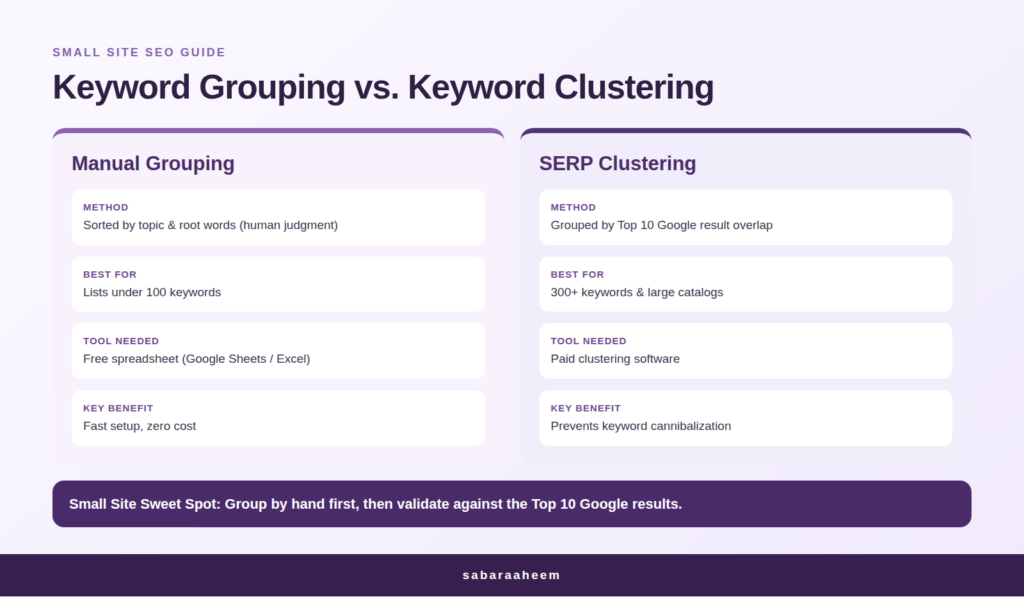
The difference is how the groups are decided. Grouping is the older, manual approach: you sort keywords into themed buckets by topic, root word or funnel stage. Clustering is data driven: it groups keywords by how much their Google results overlap. KeyClusters puts it this way: grouping looks at words, while clustering looks at search intent through ranking behaviour.
Grouping (manual)
Clustering (SERP based)
How groups are made
By human judgement: topic, root word, funnel stage
By overlap in the top 10 Google results
Speed
Slow as the list grows
Fast, even for very large lists
Main risk
Two people can group the same list differently, and similar queries may be split across pages
Needs a paid tool or manual search result checks
Best for
Very small lists, early topic discovery, sites that are not about Google traffic
For a small site the practical answer is to combine them. Group by hand to understand your topics, then check the search results for each group. SEOcrawl describes the same workflow: draft the groups by meaning, validate against the top 10 results, and split any group where the results disagree.
Is Keyword Grouping Worth It? A Pick by Site Situation
Your list size, niche and goals change the answer. Use this as a starting point:
Your situation
Best approach
Why
New site, under 100 keywords
Manual grouping in a spreadsheet
The list is small enough to sort by hand. KeyClusters says grouping suits lists under about 50 to 100 keywords.
Small site, 100 to a few hundred keywords
Manual grouping plus search result checks
Artiql says manual work holds up to a few hundred keywords and takes a few hours for a couple hundred.
Site with overlapping older posts
Group, then merge or redirect
Two posts on the same search compete with each other. Grouping shows which to combine.
Local business with a few services
One page per service group
A short, clear page plan matters more than a big keyword list.
Blog covering many related topics
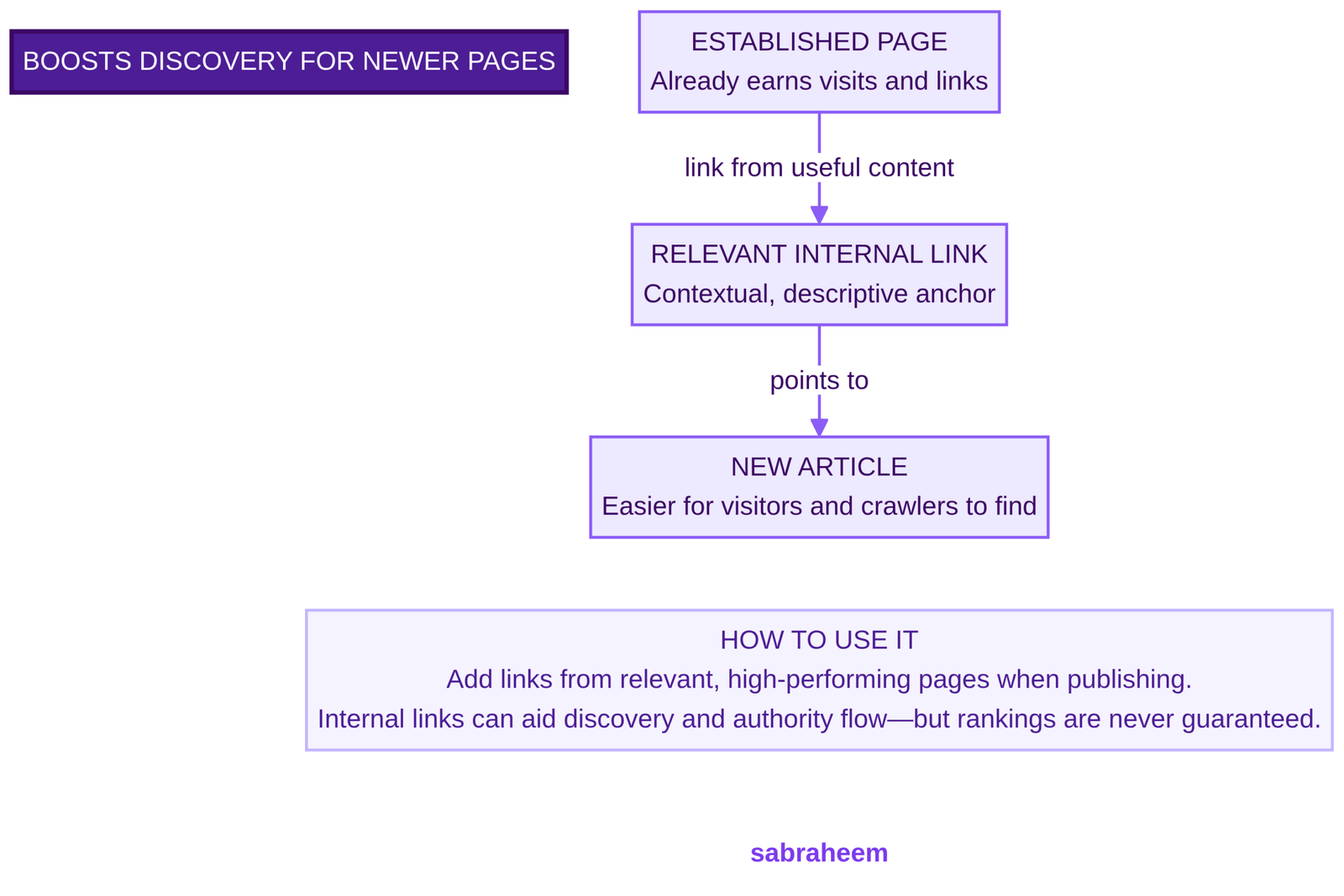
Group by topic, then link the pages
Grouped pages can support each other through internal links.
Thousands of keywords, many markets or a large catalogue
A clustering tool
Artiql names multilingual sites and large catalogues as the cases where paying makes sense.
Where the evidence is thin: The strongest claims for keyword grouping come from SEO tool vendors, including Artiql, KeyClusters, SEOcrawl and KeySearch, which sell related products. The logic is sound and the sources agree with each other, but treat the figures as rules of thumb and test them on your own site.
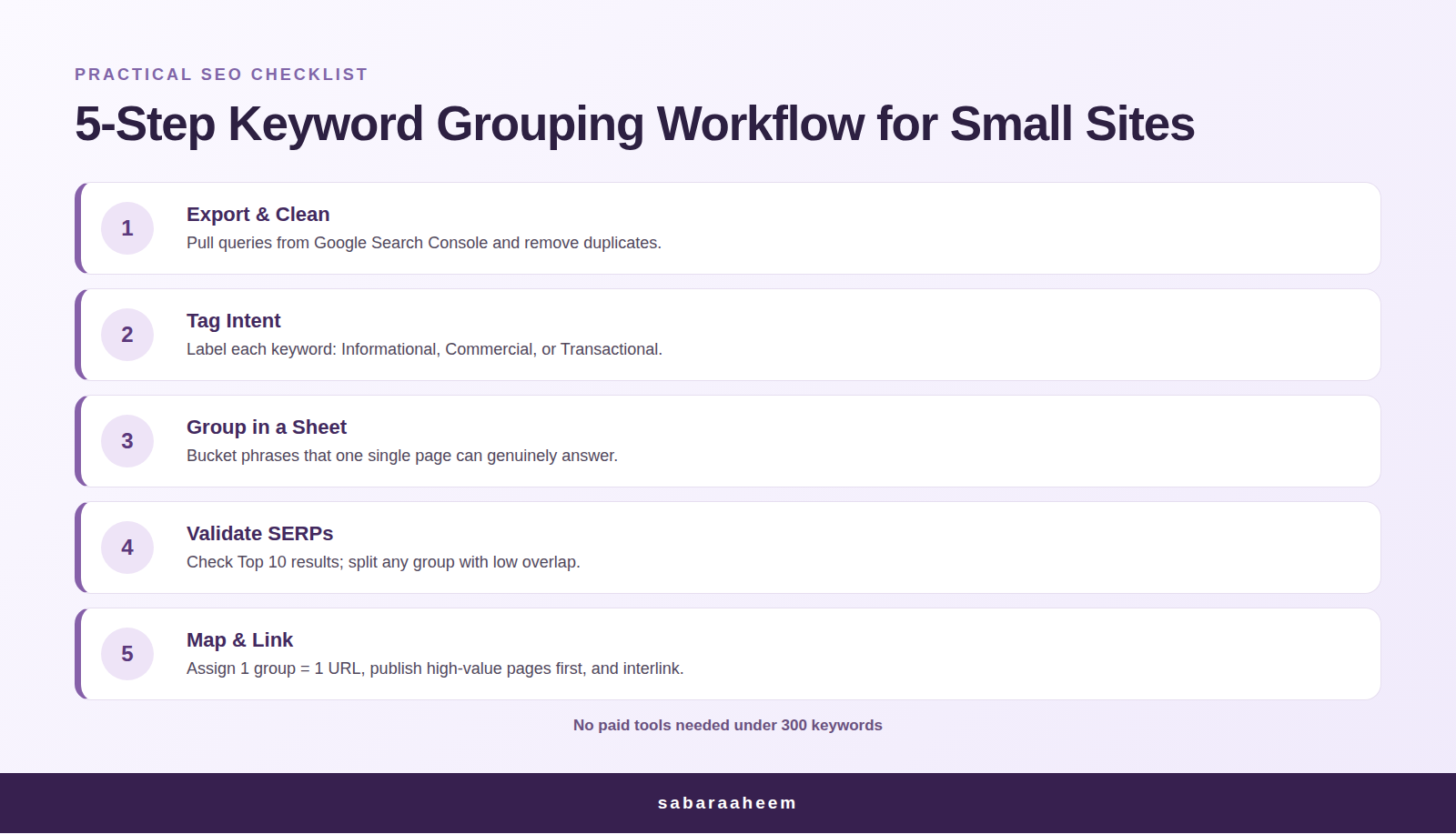
You need a spreadsheet, your Google Search Console data and an hour or two per batch of keywords.
Step
What to do
Why it works
1
Collect your keywords. Use Google Search Console queries, customer questions, sales or support notes and related searches.
Artiql suggests building the list from customer language and Search Console, and keeping it modest at first.
2
Remove duplicates and near-identical phrases. Merge spelling and word-order variants into one row.
Fewer rows make the sorting faster and the groups clearer.
3
Label the intent. Mark each keyword as informational, commercial or transactional.
SEOcrawl lists mixing intents on one page as a common mistake.
4
Group by meaning. Put keywords that one page could answer together.
This gives you rough buckets to test.
5
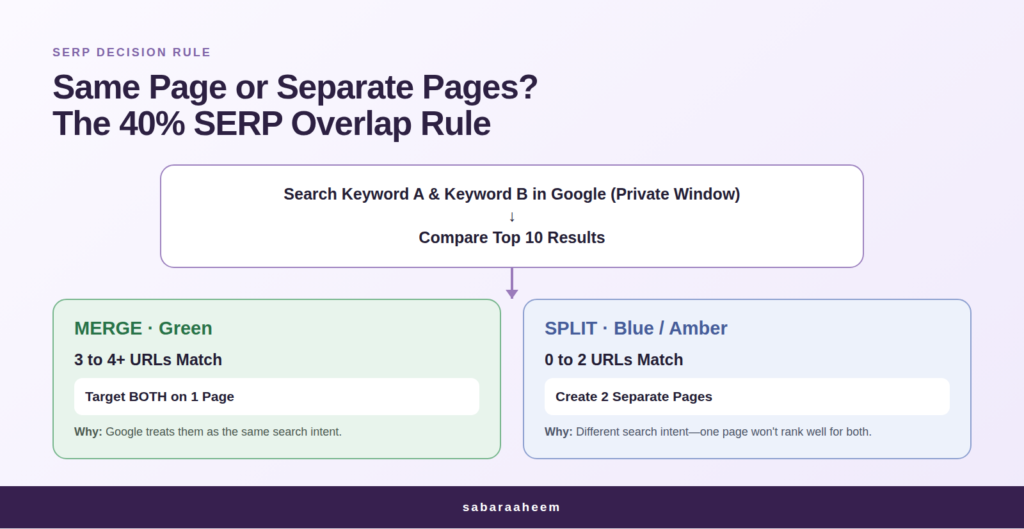
Check the top 10 results. Search each group in a private window and compare the results.
If three or four results match, keep the keywords together. If they differ, split the group.
6
Pick a main keyword for each group. Use the clearest phrase, often the one with the most impressions.
Other phrases in the group become headings, FAQs and supporting terms.
7
Map each group to one URL. Record the group, main keyword, supporting keywords and page in your sheet.
This is your content plan and shows gaps and overlaps.
8
Link related pages. Connect pages from nearby groups with clear anchor text.
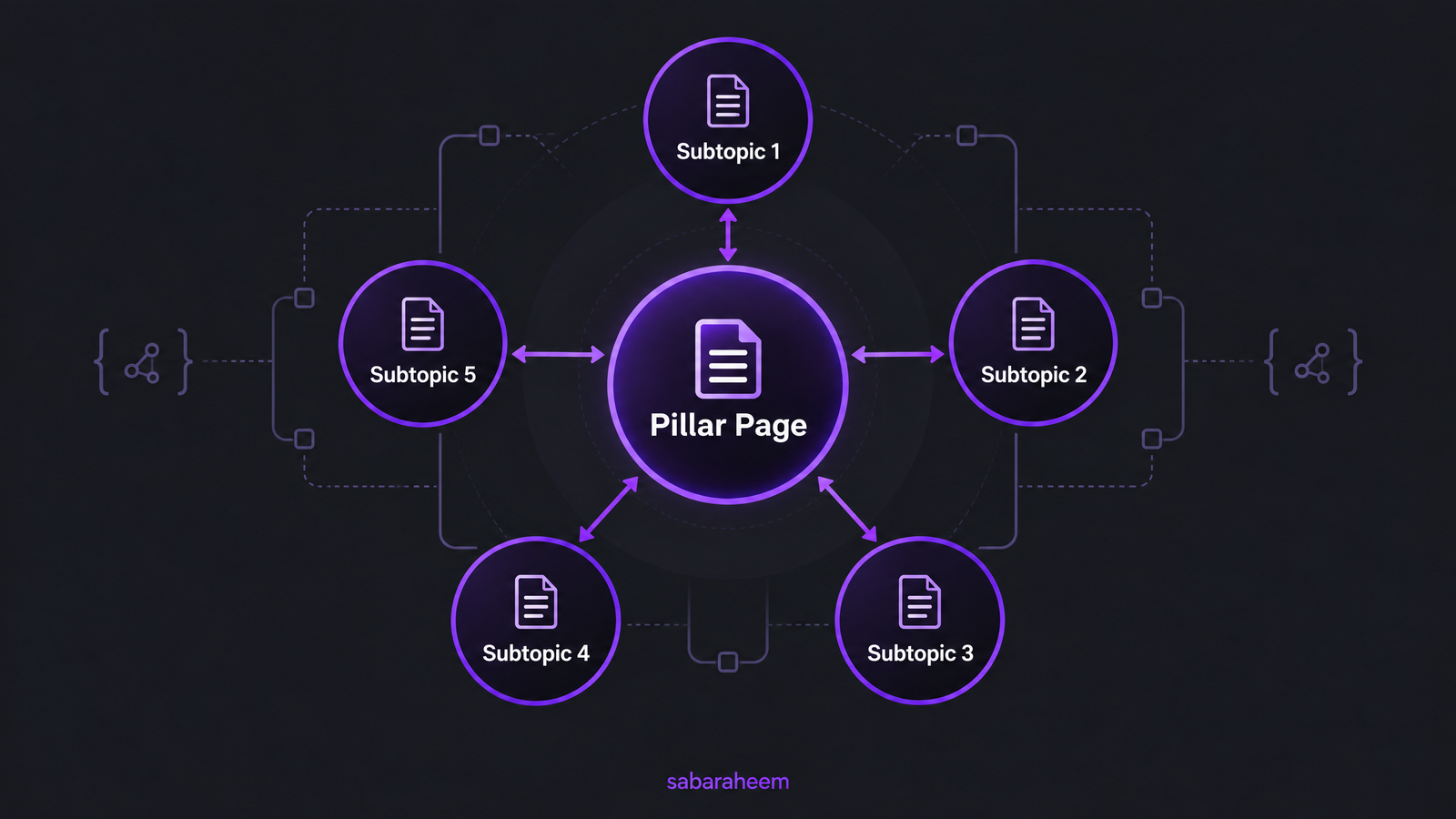
Artiql recommends a pillar page with linked supporting pages.
9
Publish the most valuable pages first, and review. Revisit the groups when results change.
Artiql says publishing, not clustering, is usually the bottleneck. SEOcrawl lists clustering once and never rechecking as a mistake.
A group can hold anywhere from two keywords to twenty, as long as they share one intent, according to SEOcrawl. Do not worry about the group size. Worry about whether one page could genuinely answer all of them.
Spreadsheet or Tool: What Should a Small Site Use?
A spreadsheet is enough for most small sites. Artiql says paid tools are hard to justify for a job small sites do only a few times a year, and that free tools usually cap each run at a few hundred to a few thousand keywords, with plans that change often.
KeySearch says it accepts up to 1,000 keywords at once and offers a 7 day trial. Check current terms.
Artiql names three cases where a paid tool is worth it: multilingual sites that need research per market, large catalogues with many near-identical variations, and clean-ups of older sites with overlapping posts.
Does SEO Still Matter in 2026 With AI Search?
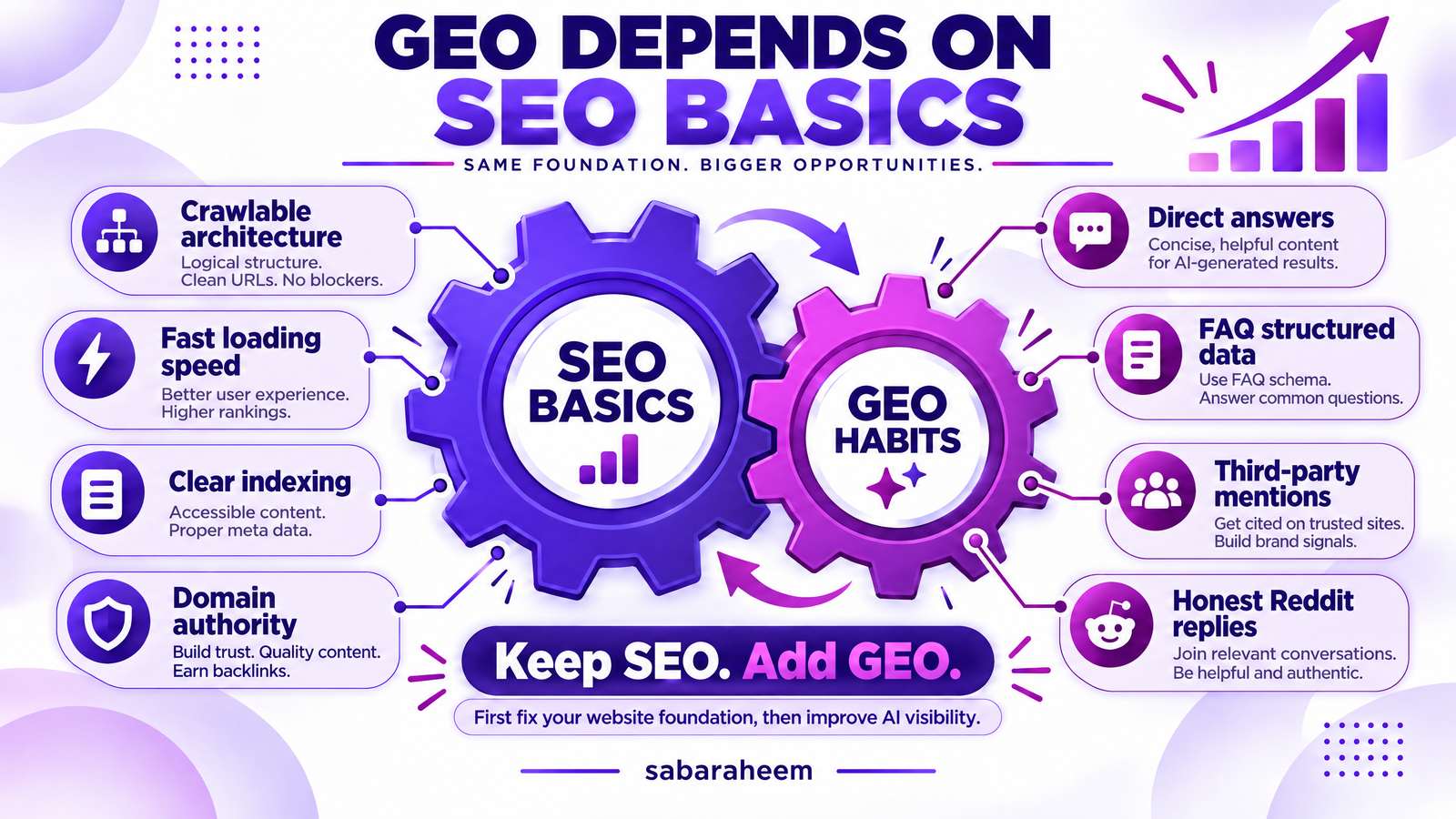
Yes, and keyword grouping still applies. Google’s own guidance says there are no additional requirements to appear in AI Overviews or AI Mode, and no special optimisation or markup is needed. A page has to be indexed and eligible to show in Search with a snippet. Google lists the usual fundamentals: let it crawl the page, use internal links, give a good page experience and keep important content in text.
That is good news for a small site. Grouping keywords into clear, single-purpose pages and linking them together is standard SEO work, and it is the same work that makes a page easy to understand for search and for AI answers.
Question
Short answer
Do keywords still matter?
Yes, as a way to understand what people search for. Stuffing one phrase repeatedly does not help.
What keyword density is good?
There is no official target. Write naturally and use your main phrase in the title, a heading and the opening paragraph.
These come from People Also Ask and related searches:
Question
Short answer
Is keyword grouping worth it for a small website?
Yes. It stops pages competing with each other and gives you a clear page plan.
Why does SEO still matter in 2026?
People still search, and Google says AI features use the same fundamentals as normal search.
How many SEO keywords should I use?
Aim for one main keyword and a few close variations per page. A group can hold two to twenty keywords if they share one intent, per SEOcrawl.
Which keyword is best for SEO?
The one that matches what your page truly answers and that you can realistically compete for.
How much keyword density is good?
There is no official figure. Write naturally.
Do keywords still matter for SEO?
Yes, as a guide to intent. Repeating a phrase does not help.
Can I do my own SEO?
Yes, especially keyword grouping, content planning and internal links.
Is it worth paying for SEO services?
It can be when you lack time or technical skills. Ask for clear deliverables and be careful of guaranteed rankings.
How much should SEO cost a month?
It varies by country, provider and scope, so compare written quotes.
Can ChatGPT do SEO?
It can help with research, grouping and drafts, but you review the result.
Is AI going to take over SEO?
I cannot say for certain. AI tools speed up the work, and judgment about intent and quality still sits with you.
Will SEO exist in 5 years?
Nobody can promise it, and you should be cautious of anyone who does. Search is changing, and the need for clear, useful pages remains.
What is replacing SEO?
Nothing has replaced it. Email, social, video and paid ads work alongside it.
What is an SEO expert salary?
It varies a lot by country and experience, so check a current salary site for your market.
How much does GoDaddy charge for SEO?
I have not verified current pricing. Check GoDaddy’s website.
Frequently Asked Questions
Is keyword grouping worth it for a small website?
Yes. A small site has few pages, so each one needs a clear purpose. Grouping shows which keywords share a page and prevents two pages competing for the same search.
Do I need a paid tool to group keywords?
Not at the start. A spreadsheet and Google Search Console are enough for a list of up to a few hundred keywords, according to Artiql. Consider a tool when checking results by hand becomes impractical.
What is the difference between keyword grouping and keyword clustering?
Grouping is manual and based on topic or words. Clustering uses overlap in Google’s top 10 results to decide which keywords belong together.
How do I know two keywords belong on the same page?
Search both and compare the top 10 results. If three or four match, one page can usually serve both. If the results differ, give each its own page.
What is keyword cannibalization?
It happens when two or more of your pages compete for the same search, so neither ranks as well as one stronger page would.
How often should I redo my groups?
Review them when you add new pages or when rankings change. SEOcrawl lists clustering once and never rechecking as a mistake.
Export your queries from Google Search Console, sort them into groups by intent, check the top 10 results for each group, and give each group one page. Browse more guides on the information about SEO blog.
Artiql, KeyClusters, SEOcrawl and KeySearch sell SEO tools or services, so their figures are rules of thumb, not independent research. A Moz guide on grouping keywords also appeared in search results but could not be opened, so it is not cited. Pricing and tool limits change often, so check each provider’s site. This post is general information, not professional advice.
Sharing my journey and learnings in Tech and AI. As a Digital Marketing Expert, I help brands boost their visibility and sales with smart personal branding and the latest AI tricks.
Summary
Article Name
Keyword Grouping for Small Websites: Is It Worth the Effort?
Description
Is keyword grouping worth it for a small site? Yes, for most. See grouping vs clustering, a step-by-step method, free tools and when a paid tool makes sense.


Leave a Reply