|
Getting your Trinity Audio player ready… |
Table of Contents
| Semantic search is the practice of search engines understanding the meaning and context behind a query rather than just matching keywords. Schema markup is the structured data code (JSON-LD format) that makes your content machine-readable by explicitly labeling entities, relationships, and information types for search engines and AI systems. Together, they enable Google and AI platforms to comprehend what your content actually means, not just what words it contains, directly improving your visibility in rich results, AI Overviews, and voice search answers. |
Introduction: The Gap Between What You Wrote and What Google Understands
Here is a problem most website owners never think about: you can write brilliant, accurate, genuinely helpful content, and search engines can still misunderstand what it means.
Not because your writing is unclear to humans. Because search engines and AI systems do not read the way humans do. They process patterns, structure, and explicit signals. Without those signals, even excellent content gets interpreted with uncertainty, and uncertain content does not get confidently ranked, cited, or recommended.
This is the gap that semantic search and schema markup exist to close. Semantic search is the shift in how search engines interpret meaning. Schema markup is the practical tool that helps you bridge that gap by making your content explicitly, unambiguously machine-readable.
This guide explains both concepts clearly, shows you exactly how they connect, and gives you the implementation steps to apply them to your own content today. This builds directly on two related guides worth reading alongside this one: what is schema markup and how does it help businesses rank and what is entity SEO and why it matters more than keywords in 2026.
1. What Is Semantic Search?
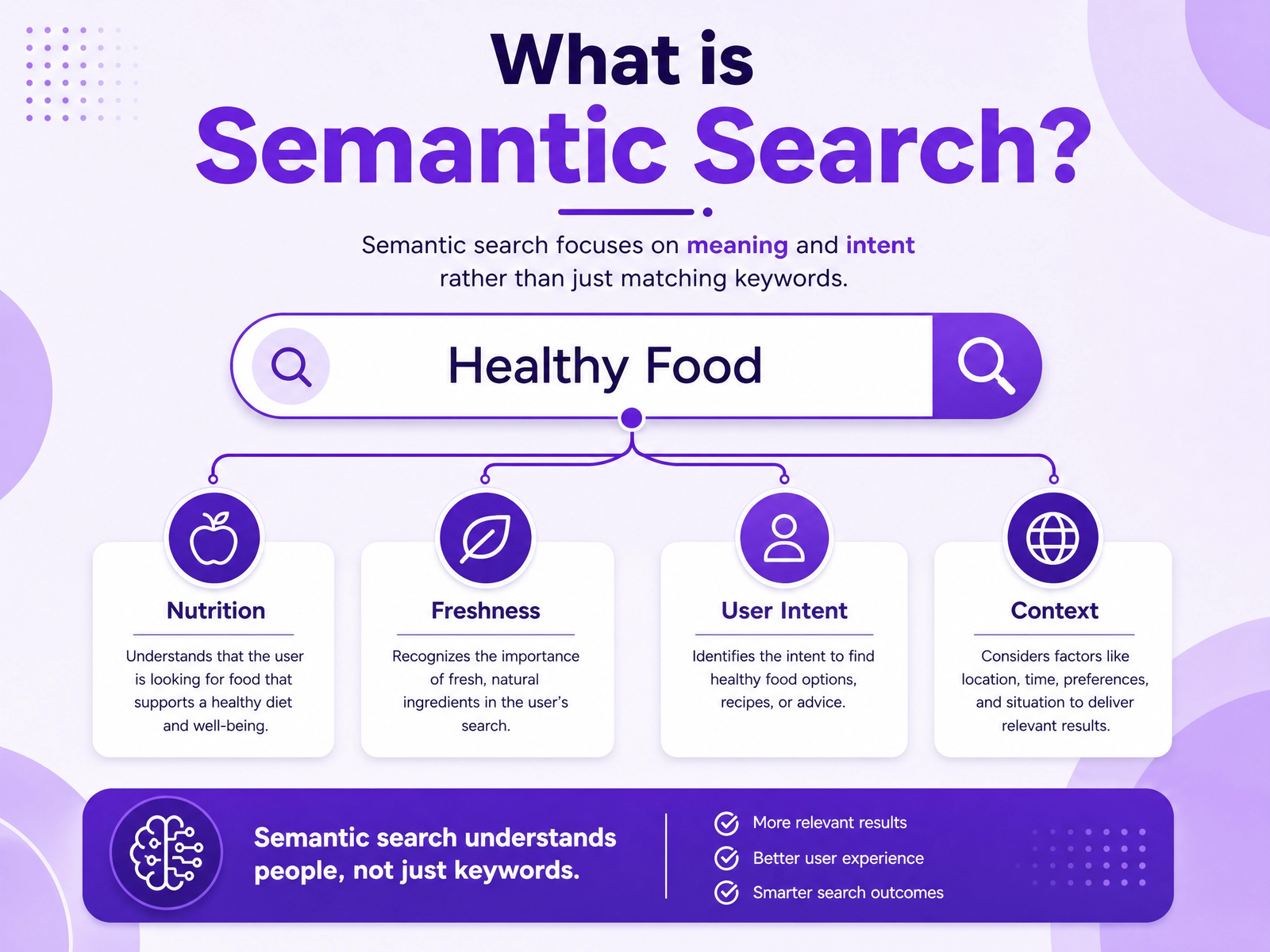
Semantic search is a search methodology where the engine tries to understand the intent and contextual meaning behind a query, rather than simply matching the literal words typed into the search box.
Before semantic search, Google worked largely on keyword matching. If you searched ‘apple nutrition,’ Google looked for pages containing those exact words or close variations. It had limited ability to understand whether you meant the fruit or the technology company, or to understand related concepts like vitamins, calories, or health benefits that were not literally present in your query.
Semantic search changed this. Powered by advances like Google’s Hummingbird update, RankBrain, BERT, and now large language models, Google increasingly understands concepts, relationships between ideas, user intent, and context. Search ‘apple nutrition’ today and Google understands you mean the fruit, and can surface pages about vitamins and calories even if those exact words were not in your query.
| The Simple Way to Understand Semantic Search:Keyword search asks: does this page contain these words? Semantic search asks: does this page answer what the person actually wants to know? The second question requires genuine comprehension, not just text matching, and that comprehension is exactly what schema markup helps enable. |
Why Semantic Search Matters More Than Ever in 2026
- AI systems like Google AI Mode, ChatGPT, and Perplexity are built entirely on semantic understanding, they generate answers by comprehending meaning, not matching keyword strings
- Voice search queries are naturally conversational and semantic, understanding intent is essential to answering them correctly
- Users increasingly search in natural, question-based language rather than fragmented keyword phrases
- Semantic understanding is the foundation of entity SEO, where search engines recognize your brand as a defined, connected entity rather than just a source of matching text
2. What Is Schema Markup and How Does It Enable Semantic Understanding?
Schema markup is a standardized vocabulary of code, created through a collaboration between Google, Bing, Yahoo, and Yandex under Schema.org, that website owners add to their HTML to explicitly label what their content means.
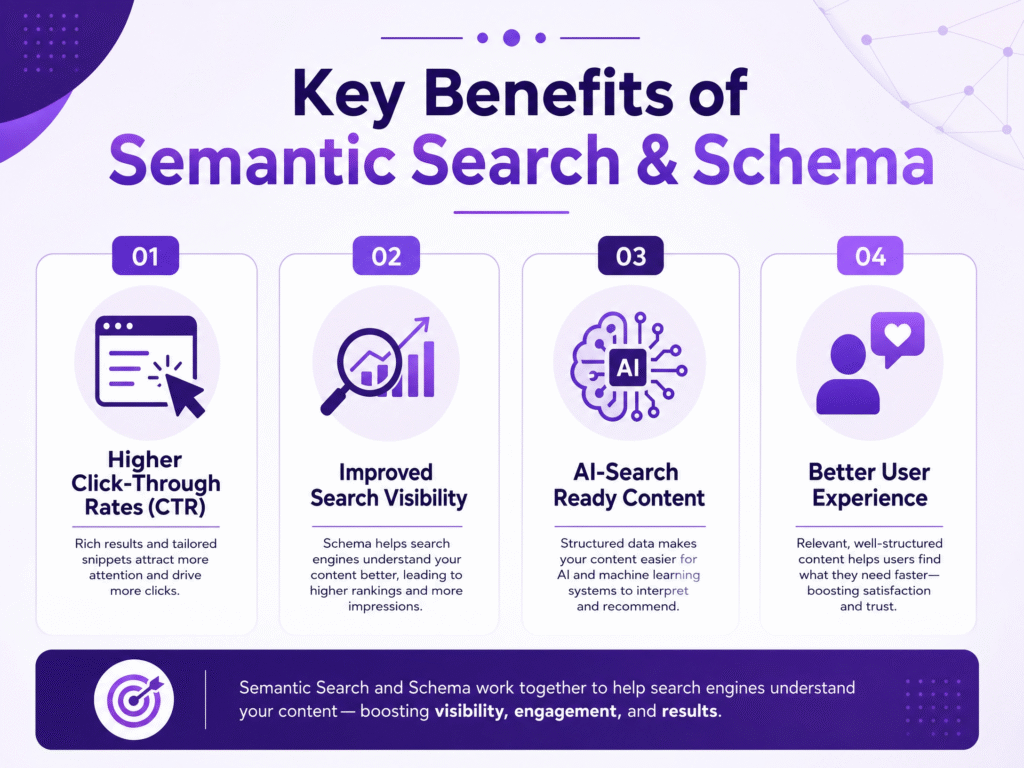
This is the critical connection between semantic search and schema markup: semantic search is Google’s goal of understanding meaning. Schema markup is the tool that removes the guesswork from that process by telling Google directly, in a structured, unambiguous format, exactly what your content represents.
| Without Schema Markup | With Schema Markup |
|---|---|
| Google infers your content is probably about a recipe based on word patterns | Schema explicitly states: this is a Recipe, these are the ingredients, this is the cook time |
| Google guesses whether a number is a price, a rating, or a phone number | Schema explicitly labels: this is a price, this is a rating value, this is a telephone number |
| Google has to determine relationships between entities through contextual inference | Schema explicitly states relationships: this Person is the author of this Article, this Organization employs this Person |
| AI systems extract information with some uncertainty about accuracy | AI systems extract information with high confidence because it is explicitly structured |
Schema markup does not change what your content says. It changes how confidently and accurately machines understand what it means. This is precisely why schema is foundational to getting cited in ChatGPT, Perplexity, and Google AI Overviews and to broader LLM SEO strategy.
3. How Semantic Search and Schema Markup Work Together
Think of semantic search as Google’s ambition: to understand meaning, context, and intent the way a knowledgeable human would. Schema markup is one of the most direct tools you have to assist that ambition, by removing ambiguity from your content at the structural level.
The Entity Relationship Model
Semantic search fundamentally works by understanding entities (people, places, things, concepts) and the relationships between them, rather than isolated keywords. Schema markup is specifically designed to declare these entities and relationships explicitly.
| A Concrete Example:Without schema, if your page says ‘Saba Raheem wrote this guide about SEO for AI search,’ Google has to infer: is Saba Raheem a person? Is she the author? What is her relationship to the topic ‘SEO for AI search’?With Author Schema, you explicitly declare: entity type is Person, name is Saba Raheem, this Person is the author of this Article, this Article’s topic is SEO and AI search. There is no inference required. The relationship is stated directly. |
4. The Essential Schema Types for Machine-Readable Content
Not every schema type applies to every page. These are the types with the highest impact for making general content semantically clear to search engines.
| 📰 Schema 1: Article / BlogPosting SchemaUsed For: Blog posts, news articles, and long-form written contentWhat It Does: Declares your content as an article entity, states the headline, author, publish date, and main topic explicitly, helping search engines understand content type, freshness, and authorship simultaneouslySample Code:“@type”: “BlogPosting”, “headline”: “…”, “author”: {“@type”: “Person”, “name”: “…”}, “datePublished”: “2026-06-01”, “about”: {“@type”: “Thing”, “name”: “topic entity”} |
| ❓ Schema 2: FAQPage SchemaUsed For: Pages containing question and answer sectionsWhat It Does: Explicitly marks each question and its answer as a distinct semantic unit, enabling search engines to extract and display them directly, and giving AI systems clearly bounded units of information to citeSample Code:“@type”: “FAQPage”, “mainEntity”: [{“@type”: “Question”, “name”: “…”, “acceptedAnswer”: {“@type”: “Answer”, “text”: “…”}}] |
| 👤 Schema 3: Person SchemaUsed For: Author bios, about pages, team member profilesWhat It Does: Declares an individual as a distinct entity with attributes (name, job title, credentials) and relationships (employer, sameAs links to social profiles), forming the foundation of personal entity recognitionSample Code:“@type”: “Person”, “name”: “…”, “jobTitle”: “…”, “sameAs”: [“https://linkedin.com/…”, “https://twitter.com/…”] |
| 🏢 Schema 4: Organization SchemaUsed For: Homepage, about page, brand identityWhat It Does: Declares your business as a distinct entity with a name, logo, description, and relationships to other verified profiles, forming the foundation of brand entity recognition in the Knowledge GraphSample Code:“@type”: “Organization”, “name”: “…”, “logo”: “…”, “sameAs”: [“https://linkedin.com/company/…”, “…”] |
| 🔗 Schema 5: BreadcrumbList SchemaUsed For: Site navigation and page hierarchyWhat It Does: Explicitly declares the relationship between a page and its position within your site’s content structure, helping search engines understand how topics and entities relate to each other across your domainSample Code:“@type”: “BreadcrumbList”, “itemListElement”: [{“@type”: “ListItem”, “position”: 1, “name”: “Home”, “item”: “…”}] |
| 📍 Schema 6: LocalBusiness SchemaUsed For: Local business homepages and contact pagesWhat It Does: Declares a business as a distinct local entity with explicit attributes: address, hours, service area, and category, directly supporting local semantic search and Google Maps relevanceSample Code:“@type”: “LocalBusiness”, “name”: “…”, “address”: {…}, “openingHours”: […] |
5. Writing Content That Supports Semantic Understanding (Beyond Schema)
Schema markup is the technical layer, but the way you write your content also directly affects how well search engines and AI systems understand its meaning. These writing practices support semantic clarity even before any code is added.
Use Clear, Specific Entity Names
Vague references like ‘the company’ or ‘this person’ repeatedly throughout content make entity recognition harder. Use specific, consistent names: your brand name, the person’s full name, the specific product name. Consistency in naming is what allows search engines to confidently connect your content across multiple pages to the same entity.
Structure Content Around Questions and Direct Answers
Content structured with clear question-format headings followed by direct answers gives semantic search systems an unambiguous unit of meaning to extract. This is the same direct-answer principle covered in how to optimize content for Google AI Overviews, and it works because it removes interpretive ambiguity about what question a section is answering.
Establish Explicit Relationships in Your Writing
Instead of writing ‘This approach works well,’ write ‘Schema markup improves AI Overview citation rates.’ The second sentence explicitly names both entities (schema markup, AI Overview citation rates) and states the relationship between them (improves). This kind of explicit, declarative writing is inherently more semantically clear than vague or implied statements.
Cover Topics Comprehensively, Not Just the Primary Keyword
Semantic search evaluates whether your content covers the full conceptual territory associated with a topic, not just whether it contains one target keyword. This is why topical authority content clusters outperform isolated posts for semantic relevance, comprehensive coverage signals genuine understanding of a topic rather than superficial keyword targeting.
6. Implementation Checklist: Making Your Content Machine-Readable
| Action | Priority | Where to Apply It |
|---|---|---|
| Implement Article/BlogPosting Schema with author and date | Critical | Every blog post |
| Implement FAQPage Schema for question-answer sections | Critical | Posts with FAQ or PAA sections |
| Implement Person Schema for author bios with sameAs links | Critical | Author bio pages, About page |
| Implement Organization Schema with sameAs links | Critical | Homepage |
| Use consistent, specific entity naming throughout content | High | All content, ongoing practice |
| Structure sections with question-format headings and direct answers | High | All blog posts |
| Implement BreadcrumbList Schema for site navigation | Medium | All non-homepage pages |
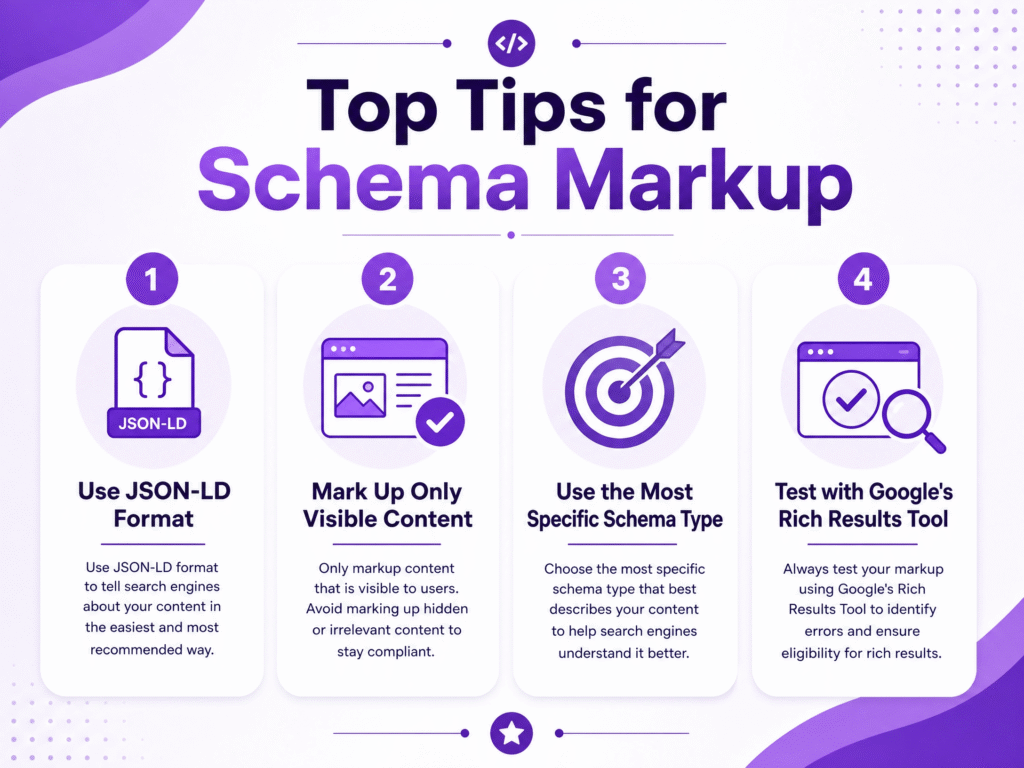
| Validate all schema using Google’s Rich Results Test | Critical | After every schema implementation |
| Build topical clusters for comprehensive semantic coverage | High | Content strategy, ongoing |
| Ensure AI crawlers (GPTBot, PerplexityBot) are not blocked | Critical | robots.txt |
For a complete audit that checks your current schema implementation, semantic content structure, and technical crawlability all at once, the free SEO audit formula covers exactly this.
7. How to Validate Your Schema Markup
- Open Google’s Rich Results Test at search.google.com/test/rich-results
- Enter your page URL or paste your code directly
- Review which schema types are detected and whether they pass validation without errors
- Fix any flagged missing required fields or syntax errors
- Check Google Search Console under the Enhancements section periodically to monitor schema health across your whole site
- Re-validate after any content update, since schema data must always match the visible content on the page exactly
8. Your 30-Day Plan to Make Your Content Machine-Readable
Week 1: Foundation Schema
- Implement Organization Schema on your homepage with complete sameAs links
- Implement Person Schema for your author bio with sameAs links to LinkedIn and other profiles
- Add Article/BlogPosting Schema to your 10 most-visited posts
Week 2: Content Structure Audit
- Review your top 10 posts and convert vague headings into clear question-format headings
- Rewrite opening paragraphs under each heading to state direct answers explicitly
- Add FAQPage Schema to any post containing question-answer sections
Week 3: Entity Consistency
- Audit your content for consistent, specific entity naming rather than vague references
- Add BreadcrumbList Schema across your site’s key pages
- Verify AI crawlers are not blocked in robots.txt
Week 4: Validate and Expand
- Validate all implemented schema using Google’s Rich Results Test
- Check Google Search Console Enhancements for any flagged errors
- Begin planning a topical content cluster for comprehensive semantic coverage of your core expertise area. See the topical authority cluster methodology
- For hands-on implementation support, work with me
People Also Ask
What is the difference between semantic search and keyword search?
Keyword search matches the literal words in a query against words on a webpage. Semantic search interprets the meaning, context, and intent behind a query, understanding related concepts, synonyms, and user intent even when exact keywords do not appear. Semantic search allows search engines to answer conversational and natural language queries far more accurately than keyword matching alone.
Does schema markup directly improve rankings?
Schema markup does not directly boost keyword rankings the way backlinks or content quality do. What it does is make your content semantically clear to search engines, which improves rich result eligibility, AI Overview citation probability, and voice search performance. These improvements indirectly support rankings through better click-through rates and stronger E-E-A-T signals. Full context in what is schema markup and how does it help businesses rank
What is machine-readable content?
Machine-readable content is content structured and labeled in a way that computers, search engines, and AI systems can process and understand automatically, without requiring human interpretation. Schema markup is the primary tool for making web content machine-readable, since it uses a standardized vocabulary that explicitly labels entities, relationships, and data types in a format algorithms can reliably parse.
How does semantic search relate to AI search engines like ChatGPT and Perplexity?
AI search engines are built entirely on semantic understanding, they process language by comprehending meaning and relationships between concepts, not by matching keyword strings. This means the same principles that improve your semantic search visibility, clear entity naming, structured data, and comprehensive topical coverage, also directly improve your probability of being cited by ChatGPT, Perplexity, and similar systems. Full strategy in LLM SEO best practices 2026
What schema type should I implement first?
Start with Organization Schema on your homepage and Person Schema for your author bio, since these establish your foundational entity identity. Follow immediately with Article Schema on your most important blog posts and FAQPage Schema on any post with question-answer sections. These four types cover the highest-impact semantic clarity improvements for most websites.
Frequently Asked Questions
Can I improve semantic search visibility without using schema markup?
Partially. Writing clear, specific, well-structured content with consistent entity naming and comprehensive topical coverage improves semantic clarity even without schema. However, schema markup removes ambiguity in a way that natural language alone cannot fully achieve, since it explicitly labels data in a machine-parseable format. For maximum semantic search performance, both content quality and schema implementation are needed together. For a broader view of how these signals compound, see the future of search: mastering 2026 SEO changes
Is JSON-LD the only way to implement schema markup?
No, but it is the strongly recommended format. Schema can technically be implemented via Microdata or RDFa embedded directly in HTML tags, but Google explicitly recommends JSON-LD because it is cleaner to implement, easier to validate, and does not require modifying the visible HTML structure of your page. Nearly all modern schema implementation guidance, including WordPress plugins like Rank Math and Yoast, defaults to JSON-LD.
How often should I update my schema markup?
Update schema whenever the underlying content it describes changes, a new author, an updated publish date, a changed business description, or new FAQ content. Schema data that contradicts the visible page content is a validation error and can trigger Google warnings. As a general practice, review your schema implementation quarterly alongside any broader content refresh.
Does semantic search mean keywords no longer matter?
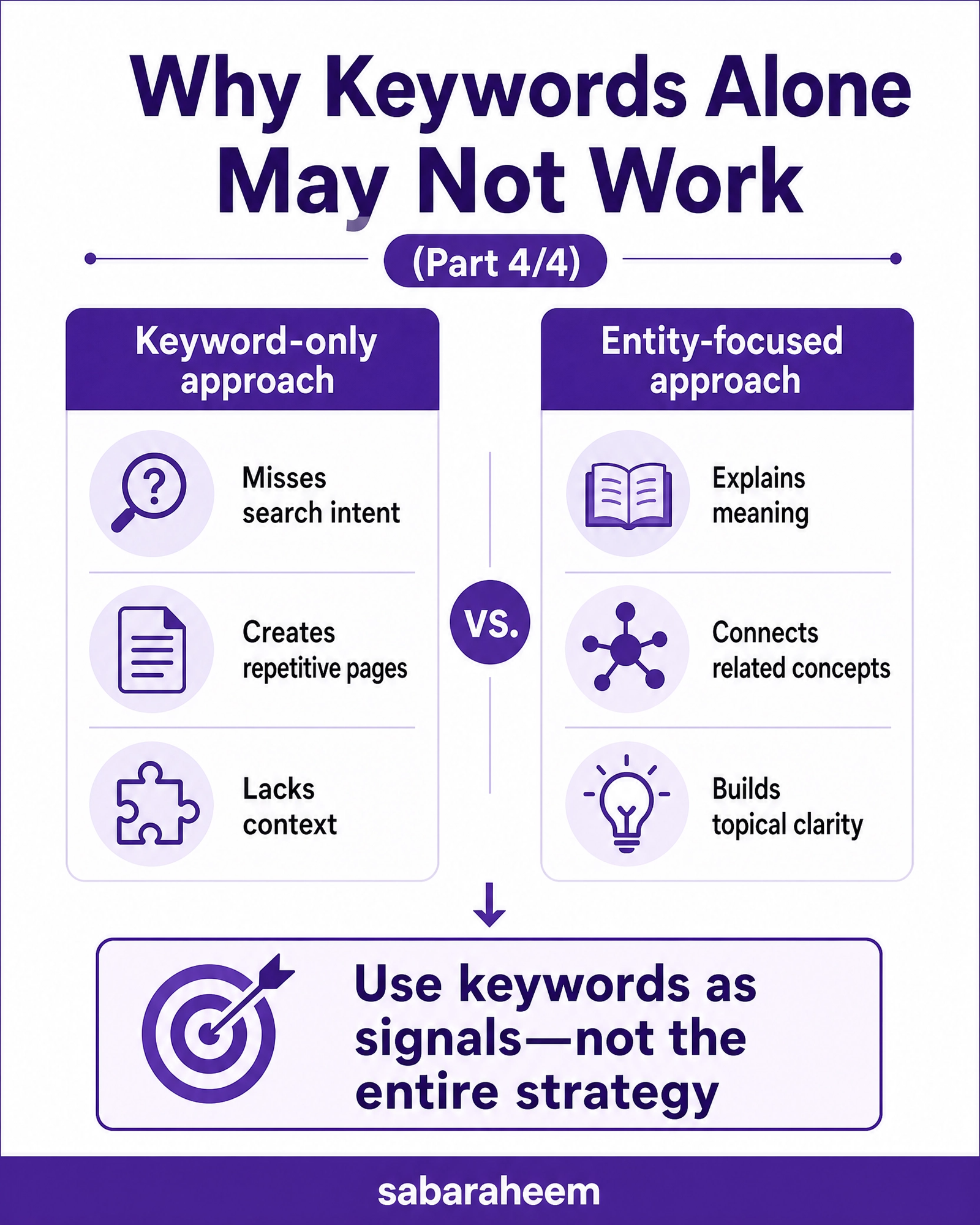
No. Keywords still matter as signals of relevance and search volume, but they are no longer sufficient alone. Semantic search means search engines evaluate whether your content genuinely addresses the meaning and intent behind a query, which requires comprehensive, well-structured, entity-clear content, not just keyword presence. Keywords indicate what to write about, semantic clarity determines whether search engines understand what you actually wrote. See types of SEO in digital marketing for how keyword-based and semantic approaches fit together.
What tools help validate machine-readable content beyond Google’s Rich Results Test?
Google’s Rich Results Test and Schema Markup Validator (validator.schema.org) are the primary free validation tools. Google Search Console’s Enhancements report monitors ongoing schema health across your full site. For broader semantic content analysis, tools like Clearscope and MarketMuse assess whether your content comprehensively covers the semantic territory associated with a topic, complementing the technical validation that schema tools provide.
| Ready to Make Your Content Machine-Readable?Get a free SEO audit covering your schema implementation, semantic content structure, and AI readiness.>>> Get Your Free SEO Audit <<<Or book a strategy session to implement schema and semantic content structure |

Sharing my journey and learnings in Tech and AI. As a Digital Marketing Expert, I help brands boost their visibility and sales with smart personal branding and the latest AI tricks.

Leave a Reply