|
Getting your Trinity Audio player ready… |
Table of Contents
Most SEO strategies treat keywords as isolated targets — one page, one keyword, fingers crossed. Keyword clustering is the strategy that ends that approach and builds something that actually compounds.
| 100+Keywords one clustered page can rank for simultaneously | 3×More organic traffic vs single-keyword page strategy | 4Search intent types every cluster must map to | 60%Less content needed with smart keyword clustering |
Here’s what’s actually happening in Google right now: two businesses publish content on the same topic. One targets individual keywords across twenty thin pages. The other groups those same keywords into five comprehensive cluster pages backed by a logical internal linking structure. Six months later, the second business owns the topic. Not because they published more — because they understood that Google ranks topical authority, not keyword frequency. This guide shows you the exact process to build that authority through keyword clustering, step by step.
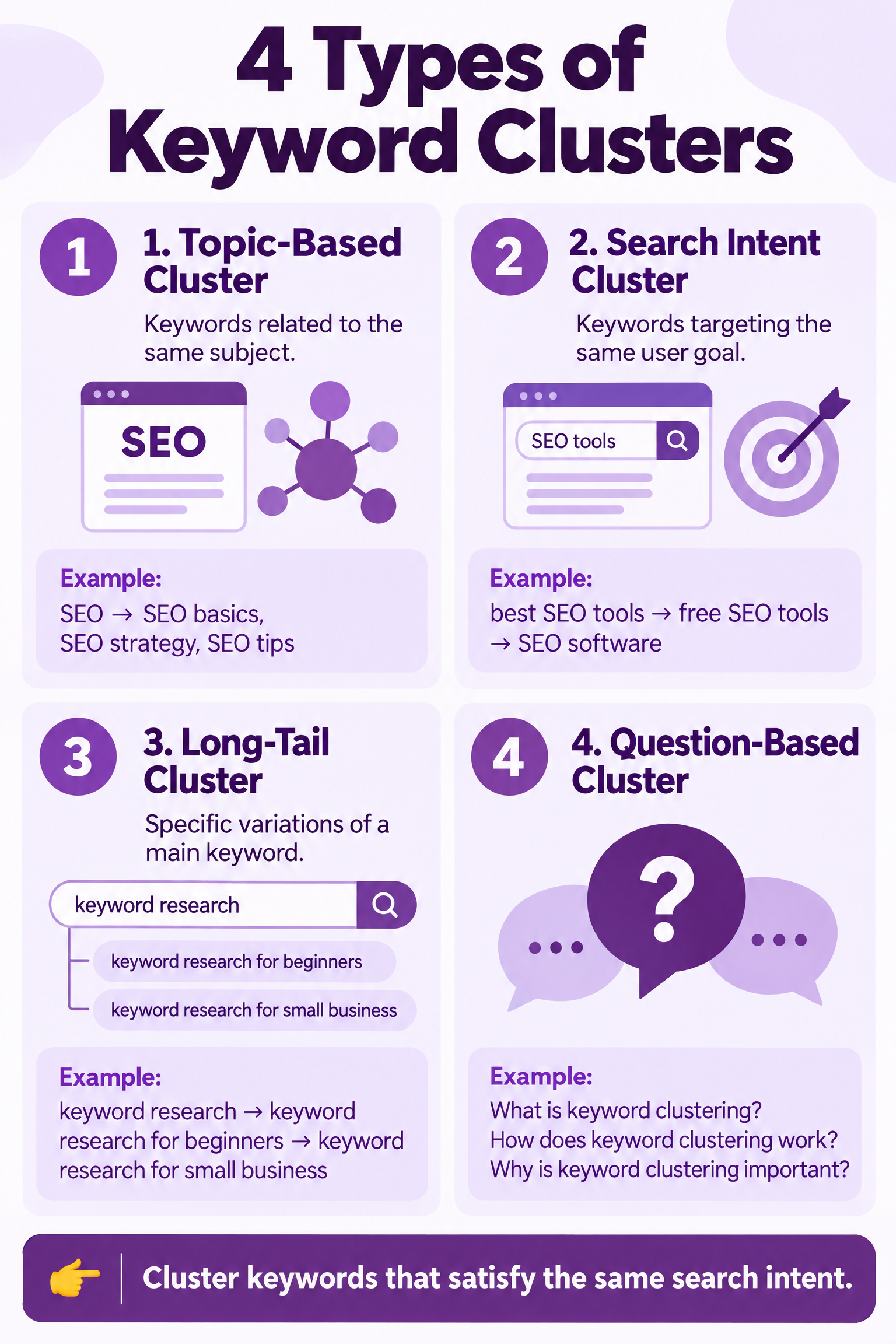
1. What Is Keyword Clustering — And Why It Changes Everything
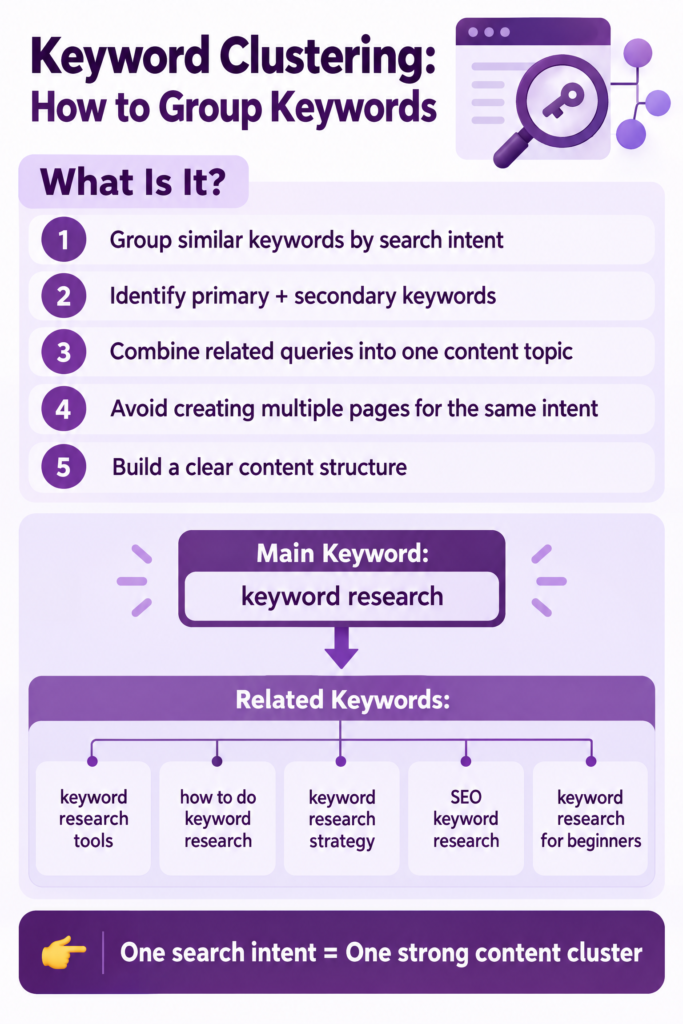
Keyword clustering is the process of grouping related search terms together so that one well-structured piece of content targets all of them simultaneously, rather than creating separate pages for each variation.
The mechanic is straightforward: instead of writing one article for “keyword research tools,” another for “best keyword research software,” and a third for “free keyword research tools,” you recognise that these queries share the same search intent and can be served by one comprehensive, authoritative page that targets all three.
“Keyword clustering groups related search terms with the same intent so you can target multiple keywords with one comprehensive page — it’s the foundation of how topical authority is actually built.”
— AirOps SEO Content Strategy Report, February 2026
- Topical Authority — when you create a network of content covering a topic from all angles, you signal to Google that you’re an expert in that domain, not just a page about a keyword.
- Avoids Cannibalization — without clustering, multiple pages compete for the same query, confusing Google about which page to rank. Clustering eliminates this by design.
- Content Efficiency — instead of publishing fifty thin articles, you publish fifteen comprehensive cluster pages. Less work, more rankings, better user experience.
- AI Search Visibility — in 2026, clustered content that covers a topic comprehensively is significantly more likely to be cited by LLMs like ChatGPT, Perplexity, and Google AI Overviews.
2. Understanding Search Intent: The Foundation of Every Cluster

Before you can cluster any keywords, you must understand why someone is searching. For a deeper primer, see this information about SEO. Two keywords can look similar on paper but serve completely different intents — and grouping them into the same cluster will fail both.
Every keyword in your list belongs to one of four intent categories. Getting this right is the single most important step in keyword clustering:
- Informational Intent — the searcher wants to learn something and is in research mode, not buying mode. Format: guides, explanations, how-tos, definitions. Examples: “what is keyword clustering,” “how does SEO work.”
- Navigational Intent — the searcher is looking for a specific brand, website, or resource they already know. Rarely worth targeting unless it’s your own brand. Examples: “Ahrefs login,” “Google Search Console.”
- Commercial Intent — the searcher is researching before buying, comparing options. Format: comparison pages, reviews, best-of lists. Examples: “best keyword clustering tools,” “Ahrefs vs Semrush.”
- Transactional Intent — the searcher is ready to act: buy, sign up, download, or contact. Format: product pages, pricing pages, CTAs. Examples: “buy Ahrefs subscription,” “Semrush pricing.”
The Clustering Rule: only group keywords that share the same intent. “What is keyword clustering” (informational) and “best keyword clustering tools” (commercial) should never be on the same page — they serve different user goals and will produce a confused, underperforming piece of content that ranks poorly for both.
3. Three Methods to Cluster Keywords
A. SERP-Based Clustering (Most Accurate)
Search each keyword and compare the top 10 results. If two keywords share 3 or more of the same ranking URLs, they belong in the same cluster. This is how Google itself defines keyword groupings. The downside: it’s manual and time-consuming at scale. Best for high-stakes clusters where precision matters.
B. Semantic / NLP Clustering (Fastest at Scale)
Group keywords by meaning and topic relationship rather than SERP overlap. Tools like Keyword Insights, Frase, and SE Ranking use NLP to identify keywords that cover the same concept even when the wording differs. Best for large keyword lists (500+). Always validate the clusters with a spot-check SERP analysis before finalising.
C. Manual / Intent-Based Clustering (Full Control)
Review keywords in a spreadsheet, classify each by intent type, then group keywords sharing the same intent and topic into clusters. Best for keyword lists under 200 terms or for highly specialised industries where tool accuracy is lower.
4. The Step-by-Step Keyword Clustering Process
- 1. Collect your keyword universe — start with 5–10 seed keywords, expand with Google Keyword Planner, Ahrefs, Semrush, or Search Console, and include competitor keyword research. Target 200–1,000 keywords.
- 2. Classify every keyword by search intent — informational (I), commercial (C), transactional (T), or navigational (N). This is mandatory before grouping.
- 3. Group keywords into clusters by intent + topic — identify one primary keyword per cluster and validate with a SERP check on the primary and 2–3 secondary keywords.
- 4. Assign each cluster to a single URL — check which pages already rank before creating new ones, and use a logical URL hierarchy containing the primary keyword.
- 5. Prioritise clusters for content production — score each cluster on Business Impact, Keyword Difficulty, and Search Volume; prioritise high impact + low difficulty first.
- 6. Write content that covers the entire cluster — primary keyword in title/H1/first 200 words, secondary keywords as H2/H3s, long-tail variations in body and FAQs.
- 7. Build internal links between clusters — cluster pages link to 2–3 related cluster pages and back to the pillar; the pillar links to all cluster pages.
5. Real-World Cluster Example: “Project Management Software”
Here’s what a properly built keyword cluster looks like in practice:
| Page | Primary + Secondary Keywords | Intent | Target URL | Est. Monthly Volume |
|---|---|---|---|---|
| Pillar — Project Management Software | project management software; project management tools; best project management apps; project management software comparison; what is project management software | Commercial | /project-management-software/ | 45,000+ |
| Cluster 1 — Free Project Management Tools | free project management tools; free project management software; project management free plan; best free project management tools for small teams; asana free plan features | Commercial | /project-management-software/free/ | 18,000+ |
| Cluster 2 — Asana vs Monday vs Trello | asana vs monday; trello vs asana; monday vs trello; asana vs monday vs trello comparison; which project management tool is better | Commercial | /project-management-software/comparison/ | 12,000+ |
| Cluster 3 — How to Use Project Management Software | how to use project management software; project management software tutorial; getting started with project management tools; how to set up projects in asana for beginners | Informational | /project-management-software/how-to-use/ | 6,000+ |
What this architecture achieves: four pages together cover 80,000+ monthly searches. Each page is authoritative on its specific intent, and they link to each other to pass authority across the cluster. The pillar page ranks for broad commercial terms while cluster pages capture specific comparison and informational queries.
6. Best Tools for Keyword Clustering in 2026
| Tool | Method | Best For | Price | Verdict |
|---|---|---|---|---|
| Keyword Insights | SERP + AI intent | Intent-based clustering + brief generation | From $58/mo | Best Overall |
| Frase | NLP + SERP | Cluster map → brief → draft in one platform | From $39/mo | Best for Teams |
| Semrush Keyword Strategy Builder | SERP overlap | Large keyword lists inside Semrush ecosystem | Included in Semrush | Best for Semrush Users |
| SE Ranking Keyword Grouper | SERP overlap | Integrated grouping with rank tracking | From $65/mo | Best for Rank Tracking |
| Ahrefs Keywords Explorer | SERP + semantic | Keyword discovery + parent topic grouping | From $129/mo | Best for Research |
| Manual (Google Sheets) | Manual intent | Small lists, full control, no tool cost | Free | Best for Small Sites |
7. Turning Clusters Into a Content Calendar
Clustering produces a content plan — but a plan without execution is just a spreadsheet. Here’s how to turn your cluster map into a prioritised content calendar aligned to the buyer journey:
- Month 1–2 (Foundation) — publish pillar pages first, then your highest-priority commercial intent clusters (comparisons, buying guides, best-of content) to drive revenue and establish topical presence.
- Month 3–4 (Authority) — publish informational cluster pages that support your commercial content — how-to guides, definitions, explainers — and internal link back to the pillar and commercial clusters.
- Month 5–6 (Depth) — publish long-tail and specific-variant clusters: location pages, use-case pages, and niche variations, which benefit from authority already flowing from earlier pages.
- Month 7+ (Optimise) — review Search Console data, identify clusters ranking in positions 4–15 for optimisation, fix low-CTR clusters, and expand existing pages rather than creating new ones.
8. Common Keyword Clustering Mistakes to Avoid
- Grouping by word similarity instead of intent — “running shoes” and “running shoe size chart” look related but have different intents, and forcing them together serves neither query well.
- Creating clusters that are too broad — a cluster covering 200 loosely related keywords produces bloated, unfocused content. Keep clusters tight — 8–15 keywords outperforms a sprawling 50.
- Ignoring existing rankings before creating new pages — always check Search Console; optimise an existing ranking page rather than creating a competing new one.
- Not building internal links after publishing — a cluster page without internal links is just an isolated page, not part of a cluster.
- Prioritising volume over intent alignment — a high-volume keyword that doesn’t match your topical authority or business model is harder to rank for and less valuable than a smaller, highly relevant one.
- Never revisiting clusters after publishing — search intent evolves; revisit your cluster map every 6 months and update existing pages with new secondary keywords.
9. Semantic Entities & NLP Keywords for This Topic
Core entities, semantically related terms, and NLP-relevant phrases extracted by entity type for topical authority mapping and content optimisation:
1-Word Entities: clustering, keywords, intent, content, SERP, topical, pillar, authority, cannibalization, semantic, informational, commercial, transactional, navigational, cluster, indexing, ranking, grouping, volume, query
2-Word Entities: keyword clustering, search intent, content plan, topical authority, pillar page, cluster page, SERP overlap, keyword difficulty, content calendar, internal linking, long-tail keywords, search volume, content strategy, buyer journey, keyword research, topic cluster, keyword cannibalization, content gap, URL structure, semantic SEO
3-Word Entities: keyword clustering strategy, search intent classification, hub and spoke, content cluster model, SERP-based clustering, NLP keyword grouping, pillar page structure, internal link matrix, winning content plan, keyword priority scoring, informational search intent, commercial intent pages, topic cluster model, content calendar template, keyword universe collection, semantic keyword grouping, AI search visibility, cluster page URL, long-tail keyword cluster, buyer journey alignment
10. Frequently Asked Questions
How many keywords should be in a single cluster?
There’s no fixed rule, but most effective clusters contain between 5 and 20 keywords. Too few and you’re likely splitting keywords that belong together; too many and your cluster is probably mixing intents or covering too broad a topic. A well-focused cluster of 8–15 closely related keywords with the same intent is the practical sweet spot. For very broad pillar topics, a primary cluster of 15–25 keywords can work if the pillar page is comprehensive and long-form.
What is the difference between a pillar page and a cluster page?
A pillar page is a comprehensive, broad overview of a main topic — the hub of your topic cluster architecture — that links to multiple cluster pages going deeper on specific subtopics. A cluster page is a focused, in-depth piece covering one specific subtopic or intent, linking back to the pillar and to related cluster pages. For example, “Project Management Software” would be the pillar, while “Free Project Management Tools” or “Asana vs Monday Comparison” would be cluster pages within it.
How does keyword clustering prevent cannibalization?
Keyword cannibalization happens when two pages compete for the same query, splitting ranking signals. Clustering prevents this structurally: every keyword is assigned to exactly one cluster, and every cluster maps to exactly one URL, so two pages never target the same keyword. The URL mapping step is where cannibalization is prevented — it forces an audit of existing pages before new ones are created.
Can I use AI tools to do keyword clustering automatically?
Yes — in 2026, AI-powered tools like Keyword Insights, Frase, and Semrush’s Keyword Strategy Builder make automated clustering far more accurate than earlier NLP approaches. However, automated output should always be validated, since the most common failure is intent mixing. Always spot-check automated clusters with a manual SERP review of the primary keyword before building content around them.
How long does it take to see results from keyword clustering?
Keyword clustering is a structural strategy, not a quick-win tactic — expect meaningful results in 3 to 6 months for new content on established sites, and 6 to 12 months for newer sites building topical authority from scratch. The timeline depends on publishing consistency, thoroughness of internal linking, and keyword competitiveness. The compounding effect accelerates over time as earlier clusters pass authority to later ones.
Does keyword clustering work for AI search (ChatGPT, Perplexity, Google AI Overviews)?
Yes — arguably more effectively than for traditional organic search. In 2026, LLMs select sources based on topical authority and comprehensive coverage of a subject rather than keyword matching alone. A site with a well-built cluster architecture is significantly more likely to be cited by AI systems than one with fragmented, thin pages, since comprehensive cluster pages mirror how AI models evaluate source quality.
start with 50 seed keywords, classify by intent, group into clusters of 8–15, map to URLs, and build internal links. That’s the entire system — and it compounds every month you run it.

Sharing my journey and learnings in Tech and AI. As a Digital Marketing Expert, I help brands boost their visibility and sales with smart personal branding and the latest AI tricks.

Leave a Reply